This longer reference provides the background behind the topic. Read it alongside the recipe collection when you want to connect an ingredient or food idea with a dish to prepare.
Overview
The pomegranate (Punica granatum) is a fruit-bearing, deciduous shrub in the family Lythraceae, subfamily Punicoideae, that grows to between 1.5 – 5 m tall. Rich in symbolic and mythological associations in many cultures, it originated in the region spanning the Caucasus and the Iranian plateau — including modern-day Iran, Turkmenistan, Afghanistan and Pakistan. Pomegranate was first domesticated by ancient Iranians in the Iranian plateau and nearby regions about 5,000 years ago. It is extensively cultivated for its fruit.
Pomegranate was exported from the Iranian plateau to other parts of Asia including Iraq, Turkey, and India, as well as parts of Africa and Europe. It was also introduced into Spanish America in the late 16th century and into California by Spanish settlers in 1769.
Although the pomegranate is indigenous to Iran and its nearby regions, it is also nowadays cultivated across West Asia, South Asia, Central Asia, north and Sub-Saharan Africa, the drier parts of Southeast Asia, the Mediterranean basin, United States and Chile. The fruit is typically in season in the Northern Hemisphere from September to February, and in the Southern Hemisphere from March to May.
Pomegranate molasses is a key ingredient in traditional Persian cuisine, where it is used to add a rich sweet-sour flavour to dishes such as stews, sauces, and marinades, most notably in classic recipes like fesenjān, kabab torsh and zeytoon parvardeh. The pomegranate and its juice are variously used in baking, cooking, juice blends, garnishes, nonalcoholic drinks, and cocktails.
Description
The pomegranate is a shrub or small tree growing 1.5 to 5 m high, with multiple spiny branches. It is long-lived, with some specimens in France surviving for 200 years. The leaves are opposite or subopposite, glossy, narrow oblong, entire, 1.9 – 5 cm long, and 0.8 – 1.5 cm broad.
The flowers are bright red or white, and 3 cm or more in diameter, with three to seven petals. Some fruitless cultivars are grown for the flowers alone.
The flower's anthers close around the stigma until maturity, and the ovaries are divided internally into compartments or locules of many suspended ovules covered by a septum.
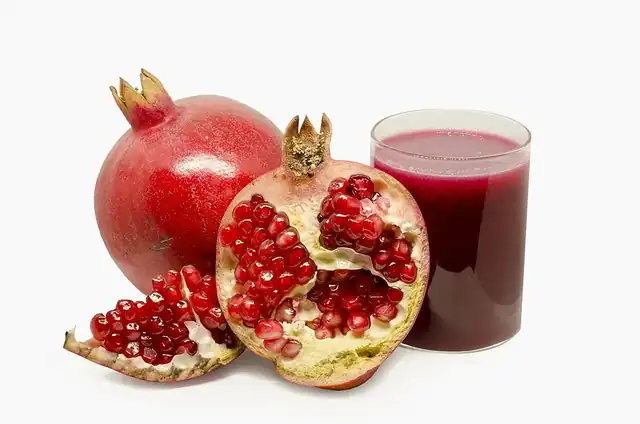
The pomegranate fruit husk is red-purple with an outer, hard pericarp, and an inner, spongy mesocarp (white "albedo"), which comprises the fruit's inner wall where seeds attach. Membranes of the mesocarp are organised as nonsymmetric chambers that contain seeds which are embedded without attachment to the mesocarp, also a result of fertilisation of the divided ovary. Pomegranate seeds are characterised by having sarcotesta, thick fleshy seed coats derived from the integuments or outer layers of the ovule's epidermal cells. The number of seeds in a pomegranate can vary from 200 to about 1,400. Botanically, the fruit is a berry with edible seeds and pulp produced from the ovary of a single flower.
Propagation
P. granatum reproduces sexually in nature, but can be propagated asexually. Propagation methods include layering, hardwood cuttings, softwood cuttings, and tissue culture. Required conditions for rooting cuttings include warm temperatures within the 18–29 °C (65–85 °F) range and a semihumid environment. Rooting hormone increases rooting success rate, but is not required.
Varieties
P. granatum var. nana is a dwarf variety of P. granatum popularly planted as an ornamental plant in gardens and larger containers, and used as a bonsai specimen tree. It could well be a wild form with a distinct origin. It has gained the Royal Horticultural Society's Award of Garden Merit.
The only other species in the genus Punica is the Socotran pomegranate (P. protopunica), which is endemic to the Socotran archipelago of four islands in the Arabian Sea. The territory is part of Yemen. It differs in having pink (not red) flowers and smaller, less sweet fruit.
Cultivars
P. granatum has more than 500 named cultivars, but has considerable synonymy in which the same genotype is named differently across regions of the world. Several characteristics between pomegranate genotypes vary for identification, consumer preference, preferred use, and marketing, the most important of which are fruit size, exocarp colour (ranging from yellow to purple, with pink and red most common), seed coat colour (ranging from white to red), the hardness of seed, maturity, juice content and its acidity, sweetness, and astringency.
Production and export
The leading producers globally are India and China, followed by Iran, Turkey, Afghanistan, the US, Iraq, Pakistan, Syria, and Spain. In 2019, Chile, Peru, Egypt, Israel, India, and Turkey supplied pomegranates to the European market. Chile was the main supplier to the United States market, which has a limited supply from Southern California. China was self-sufficient for its pomegranate supply in 2019, while other South Asia markets were supplied mainly by India. Pomegranate production and exports in South Africa competed with South American shipments in 2012–2018, with export destinations including Europe, West Asia, the United Kingdom, and Russia. South Africa imports pomegranates mainly from Israel.
Culinary
Pomegranate juice can be sweet or sour, but most fruit are moderate in taste, with sour notes from the acidic ellagitannins contained in the juice. Pomegranate juice has long been a common drink in West Asia and Europe, and is distributed worldwide. Grenadine syrup, commonly used in cocktails, originally consisted of thickened and sweetened pomegranate juice.
Before tomatoes (a New World fruit) arrived in West Asia, pomegranate juice, pomegranate molasses, and vinegar were widely used in Iranian cuisine; this mixture is found in traditional recipes such as fesenjān, a thick sauce made from pomegranate juice and ground walnuts, usually spooned over duck or other poultry and rice, and in ash-e anar (pomegranate soup).
In Turkey, pomegranate sauce (nar ekşisi) is used as a salad dressing, to marinate meat, or simply to drink. Pomegranate seeds are used in salads and sometimes as garnish for desserts such as güllaç. Pomegranate syrup, also called pomegranate molasses, is used in muhammara, a roasted red pepper, walnut, and garlic spread popular in Syria and Turkey.
In Mexico, pomegranate seeds are used to adorn the traditional dish chiles en nogada, representing the red of the Mexican flag in the dish which evokes the green (poblano pepper), white (nogada sauce) and red (pomegranate seeds).
More to savor

Chicken Vindaloo
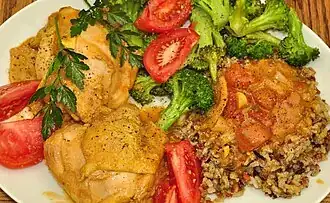
Coconut Chicken
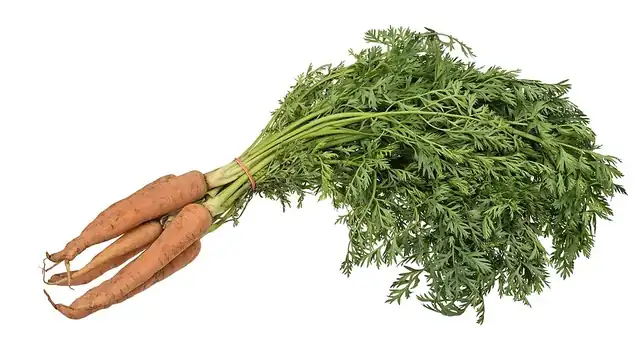
Carrot at the Table: The Food Behind the Name