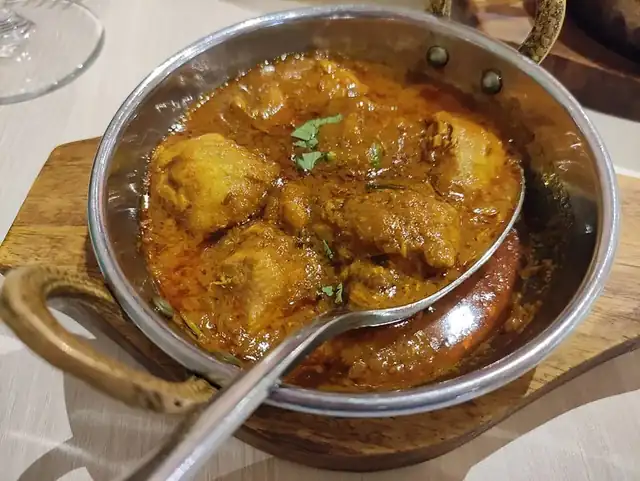
The dish is a starting point for exploring a wider food story. The guide below looks more closely at its background and different forms. When you want to cook, visit the recipe collection for ingredient quantities and step-by-step methods.
Overview
Curry is a dish with a spicy sauce, initially in Indian cuisine, then modified by interchange with the Portuguese, followed by the British, and eventually thoroughly internationalised. Many curries are found in the cuisines of countries in Southeast Asia and East Asia.
In medieval India, proto-curries were flavoured with mild spices such as asafoetida, cardamom, coriander, cumin, and ginger, with the limited heat of black pepper. A definite step in the development of modern curry was the arrival in India of spicy hot chili peppers, along with ingredients such as tomatoes and potatoes, part of the Columbian exchange of plants between the Old World and the New World. The Mughal Empire brought new subtly-spiced dishes, especially to the north of India. During the British Raj, Anglo-Indian cuisine developed, leading to Hannah Glasse's 18th century recipe for "currey the India way" in England. Curry was then spread in the 19th century by indentured Indian sugar workers to the Caribbean and by British traders to Japan. Further exchanges around the world made curry a fully international dish.
Early modern trade
The establishment of the Mughal Empire, in the early 16th century, brought some new and subtly spiced dishes, especially in the north. The Indo-Persian Mughal cuisine of the emperor Akbar, as described in the Ain-i-Akbari, could cook aubergines (eggplants) with asafoetida, cardamom, cloves, coriander, ginger, lime juice, onions, and pepper. The cuisine established dishes like biryani in India, derived from Persian pilau rice and the Persian habit of marinading meat in yoghurt (curd), combined with Indian-style use of spices.
Another influence was the establishment of the Portuguese trading centre in Goa in 1510, resulting in the introduction of chili peppers, tomatoes and potatoes to India from the Americas, as a byproduct of the Columbian Exchange. The food culture scholar Lizzie Collingham suggests that the Portuguese in Goa (in West India) heard and adopted words adopted into a local language from the Dravidian words from South India, becoming caril or carree as transcribed by British travellers of the time. This eventually led to the modern meaning of "curry" as a dish, often spiced, in a sauce or gravy. In 1598, an English translation of a Dutch book about travel in the East Indies mentioned a "somewhat sour" broth called Carriel, eaten with rice.
British influence
Curry was introduced to English cuisine from Anglo-Indian cooking in the 17th century, as spicy sauces were added to plain boiled and cooked meats. That cuisine was created in the British Raj when British wives or memsahibs instructed Indian cooks on the food they wanted, transforming many dishes in the process. Further, in the late 18th and early 19th centuries, when there were few British women in India, British men often lived with Indian mistresses, acquiring the local customs, language, and food. Curry was first served in coffee houses in Britain from 1809.
Indian cooks in the 19th century prepared curries for their British masters simplified and adjusted to Anglo-Indian taste. For instance, a quarama from Lucknow contained (among other ingredients) ghee, yoghurt, cream, crushed almonds, cloves, cardamom, and saffron; whereas an 1869 Anglo-Indian quorema or korma, "different in substance as well as name", had no cream, almonds, or saffron, but it added the then-standard British curry spices, namely coriander, ginger, and black peppercorns. Curry, initially understood as "an unfamiliar set of Indian stews and ragouts", had become "a dish in its own right, created for the British in India". Collingham describes the resulting Anglo-Indian cuisine as "eclectic", "pan-Indian", "lacking sophistication", embodying a "passion for garnishes", and forming a "coherent repertoire"; but it was eaten only by the British.
Globalisation
Since the mid-20th century, curries of many national styles have become popular far from their origins, and increasingly become part of international fusion cuisine. Alan Davidson writes that curry's worldwide extension is a result of the Indian diaspora and globalisation, starting within the British Empire, and followed by economic migrants who brought Indian cuisine to many countries. In 1886, 咖喱 (Gālí) (Chinese pronunciation of "curry") appeared among the Chinese in Singapore. Malay Chinese people then most likely brought curry to China.
Types
There are many varieties of curry. The choice of spices for each dish in traditional cuisine depends on regional cultural traditions and personal preferences. Such dishes have names such as dopiaza and rogan josh that refer to their ingredients, spicing, and cooking methods. Outside the Indian subcontinent, a curry is a dish from Southeast Asia which uses coconut milk and spice pastes, and is commonly eaten over rice. Curries may contain fish, meat, poultry, or shellfish, either alone or in combination with vegetables. Others are vegetarian. A masala mixture is a combination of dried or dry-roasted spices commonly homemade for some curries.
Curry powder, a commercially prepared mixture of spices marketed in the West, was first exported to Britain in the 18th century when Indian merchants sold a concoction of spices, similar to garam masala, to the British East India Company returning to Britain. Other commercial mixes include curry pastes and Japanese-style curry roux (in block or powder form).
East Asia
Japanese curry is usually eaten as karē raisu (カレーライス )– curry, rice, and often pickled vegetables, served on the same plate and eaten with a spoon, a common lunchtime canteen dish. It is less spicy and seasoned than Indian and Southeast Asian curries, being more of a thick stew than a curry. British people brought curry from the Indian colony back to Britain and introduced it to Japan during the Meiji period (1868 to 1912), after Japan ended its policy of national self-isolation (sakoku), and curry in Japan was categorised as a Western dish. Its spread across the country is attributed to its use in the Japanese Army and Navy which adopted it extensively as convenient field and naval canteen cooking, allowing even conscripts from the remotest countryside to experience the dish.
South Africa
Curry spread to South Africa with the migration of people from the Indian subcontinent to the region in the colonial era. African curries, Cape Malay curries and Natal curries include the traditional Natal curry, the Durban curry, bunny chow, and roti rolls. South African curries appear to have been created in both KwaZulu-Natal and the Western Cape, while others developed across the country over the late 20th and early 21st centuries to include ekasi, coloured, and Afrikaner varieties. Durban has the highest population density of Indians outside of India in the world.
More to savor

Austrian Napkin Dumpling (Serviettenknödel)
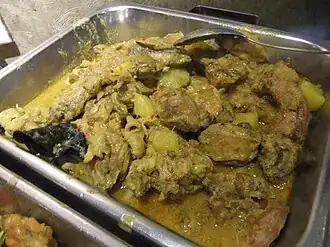
Kari Ayam (Indonesian Chicken Curry)
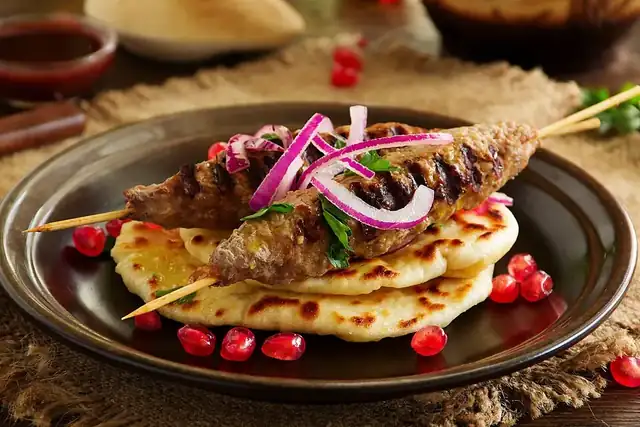
Kebabs: The Many Dishes Behind a Familiar Menu Word