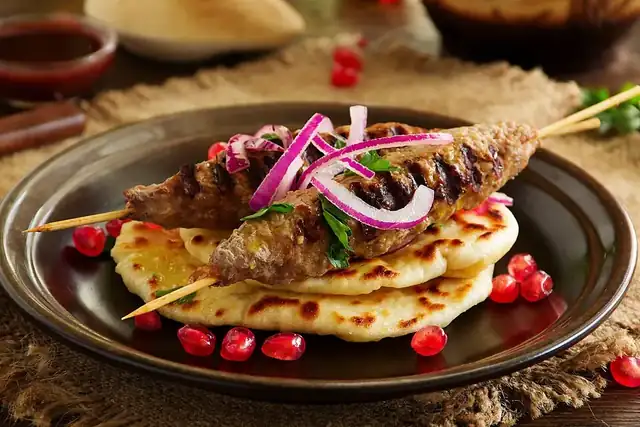
The dish is a starting point for exploring a wider food story. The guide below looks more closely at its background and different forms. When you want to cook, visit the recipe collection for ingredient quantities and step-by-step methods.
Overview
Kebab , kebap, kabob (alternative North American spelling), kebob, or kabab (Kashmiri) is a variety of roasted meat dishes that originated in the Middle East.
Kebabs consist of cut-up meat, sometimes with vegetables and various other accompaniments according to the specific recipe. Although kebabs are typically cooked on a skewer over a fire, some kebab dishes are oven-baked in a pan, or prepared as a stew such as tas kebab. The traditional meat for kebabs is most often lamb meat, but regional recipes may include beef, goat, chicken, fish, or even pork (depending on whether or not there are specific religious prohibitions).
Varieties by region
In most English-speaking countries, a kebab may be the classic shish kebab or souvlaki – small cubes of meat cooked on a skewer – or made with minced (ground) meat, as in doner kebab. By contrast, in Indian English, Bangladeshi English, Pakistani English and in the languages of the Middle East, other parts of Asia, and the Muslim world, a kebab is any of a wide variety of grilled meat dishes. Some dishes ultimately derived from Middle Eastern kebab may have different names in their local languages, such as the Chinese chuan.
China
Chuan , often referred to as "chuan" in Mandarin throughout the north, or kawap (كاۋاپ) in Uyghur, is a variation of kebab originating from the Uyghur people in the western province of Xinjiang and a popular dish in Chinese Islamic cuisine. The dish has since spread across the rest of the country and become a popular street food.
Although the most traditional form of chuan uses lamb or mutton, other types of meat, such as chicken, beef, pork, and seafood, may be used as well. Small pieces of meat are skewered and either roasted or deep-fried. Common spices and condiments include cumin, called "ziran", pepper, sesame, and sesame oil.
Greece
Kebabs existed as far back as the 17th century BC in the Minoan civilization. In Homer's Odyssey, there are descriptions of skewering strips of meat for broiling. Clifford A. Wright considers these an early version of shish kebab. In Classical Greece and Hellenistic Greece, kebabs were prepared in ancient Athenian taverna sites. They were grilled on an eschara.
Kebabs were also staples in the Byzantine Empire; there is iconographical evidence of Byzantine Greeks preparing them.
In the 1950s, the dish was typically served as a sandwich rolled in pita bread, or on a plate, with French fries and various salads and sauces such as tzatziki. Later in the 1960s, vendors also began selling dishes in the same style made with souvlaki, which resembles Turkish shish kebab, but is usually made with pork. Around the same time, the Greek word gyros replaced döner kebab, and the Greek style of the dish spread to become popular, particularly in North America, and various other parts of the world.
In fact, in West Germany, gyros made with pork had been established as a fast food before döner kebab became popular, dominating the German street food market alongside Italian pizza during the 1970s. A similar situation existed in Paris, France, where Greek restaurateurs were selling "sandwich grec" ("Greek sandwich"). This term was later replaced by "kebab" or "sandwich turc" ("Turkish sandwich").
In contrast to other areas of Greece, in Athens, both types of sandwich may be called souvlaki, with the skewered meat being called kalamaki.
South Caucasus
Both Armenian and Azerbaijani cuisine feature oblong kofta-style mincemeats kebabs known as lula or lyulya kebab, while Armenian cuisine refers to shish-style kebabs as khorovats, and doner kebab as Karsi khorovats after the city of Kars which became known for the dish during the time of the Ottoman Empire.
Iran
There are several distinct Persian varieties of kabab (کباب). Kabab may be served with either steamed, saffroned basmati or Persian rice and called chelow kabab (چلوکباب), which is considered the national dish of Iran. It may also be served with the various types of bread that are the most commonly eaten in Iran, such as lavash.
It is served with the basic Iranian meal accompaniments, in addition to grilled tomatoes on the side of the rice and butter on top of the rice. It is an old northern tradition (probably originating in Tehran) that a raw egg yolk should be placed on top of the rice as well, though this is strictly optional, and most restaurants will not serve the rice this way unless it is specifically requested. "Somagh", powdered sumac, is also made available and its use varies based on tastes to a small dash on the rice or a heavy sprinkling on both rice and meat, particularly when used with red (beef/veal/lamb) meat.
At Persian restaurants, the combination of one kabab barg and one kabab koobideh is typically called Soltani, meaning "sultan's feast". The combination of one kabab barg, one jujeh kabab and kabab koobideh is typically called Shah abbasi, meaning "Shah Abbas' meal". The traditional beverage of choice to accompany Persian kabab is doogh, a sour yogurt drink with mint and salt.
In the old bazaar tradition, the rice (which is covered with a tin lid) and accompaniments are served first, immediately followed by the kababs, which are brought to the table by the waiter, who holds several skewers in his left hand, and a piece of flat bread (typically nan-e lavash) in his right. A skewer is placed directly on the rice and while holding the kebab down on the rice with the bread, the skewer is quickly pulled out. With the two most common kababs, barg and koobideh, two skewers are always served. In general, bazaar kabab restaurants only serve these two varieties, though there are exceptions.
In Iranian Azerbaijan, "Binab (also Bonab) Kababi" is very famous in Iranian Azerbaijani local cuisine for its large size. It is named after the city of Binab in East Azerbaijan province. This kabab and other types (e.g., Shishlik, Kubide, Berge, Gelin, etc.) can be served alone or with rice and fresh salad on the side. In this region Kababs come usually with yogurt, hot bread, tomato, onion, parsley and paprika-salt, and tarragon.
Kabab koobideh (کباب کوبیده) it kūbide (کوبیده) is an Iranian minced meat kabab which is made from ground lamb, beef, or chicken, often mixed with parsley and chopped onions.
Similar dishes
Americas
City chicken (U.S.)
Spiedies (New York State)
Anticuchos (Andean)
Espetinho (Brazilian)
Africa
Sosatie (South African)
Suya (Nigerian)
More to savor

Austrian Napkin Dumpling (Serviettenknödel)
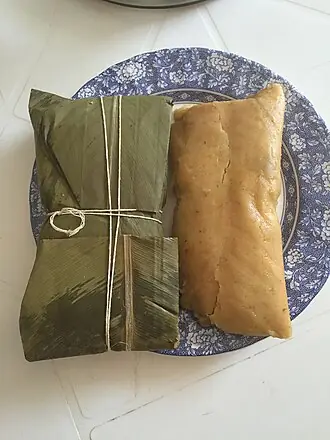
Hallaca (Venezuelan Stuffed Corn Dough)
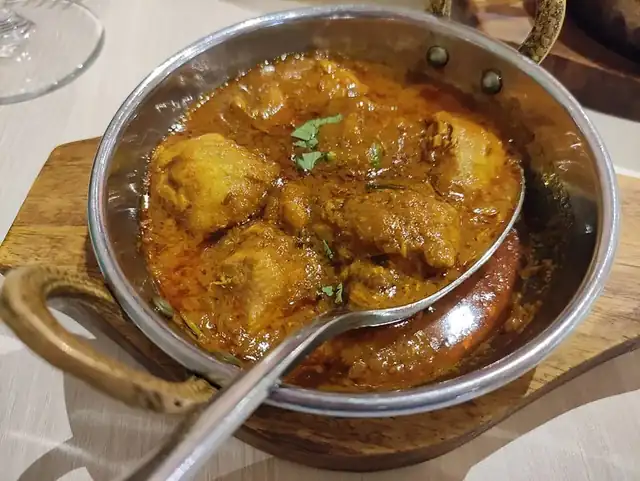
Curry: Why One Word Covers So Many Different Dishes