This longer reference provides the background behind the topic. Read it alongside the recipe collection when you want to connect an ingredient or food idea with a dish to prepare.
In this story
OverviewDescriptionDistribution and habitatAroma profileCentral and eastern EuropeAsia and Middle EastMiddle EastOverview
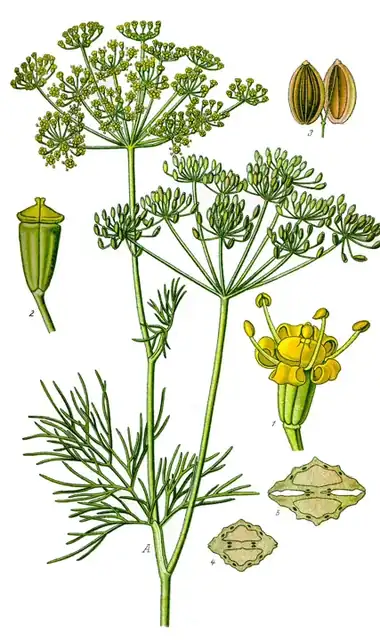
Dill (Anethum graveolens) is an annual herb in the celery family Apiaceae. Native to North Africa and West Asia, dill is grown widely in Eurasia, where its leaves and seeds are used as a herb or spice for flavouring food.
Description
Growing from a taproot like a carrot, dill grows up to 0.5-1.5 m tall. Its stems are slender and hollow with finely divided, softly delicate leaves; the leaves are alternately arranged, 10-20 cm long with ultimate leaf divisions measuring 1-2 mm broad, slightly wider than the similar leaves of fennel, which are less than 1 mm across but harder in texture.
In hot or dry weather, small white to yellow scented flowers form in small umbels 2.5–9 cm in diameter from one long stalk. The seeds come from dried up fruit 4-5 mm long and 1 mm thick, and straight to slightly curved with a longitudinally ridged surface.
Distribution and habitat
Dill is native to North Africa, Iran, and the Arabian Peninsula.
Aroma profile
Apiole and dillapiole
Carvone
Limonene
Myristicin
Umbelliferone
Fresh and dried dill leaves (sometimes called "dill weed" or "dillweed" to distinguish it from dill seed) are widely used as herbs in Europe and in central and south-eastern Asia.
Like caraway, the fern-like leaves of dill are aromatic and are used to flavour many foods such as gravlax (cured salmon) and other fish dishes, borscht, and other soups, as well as pickles (where the dill flower is sometimes used). Dill is best when used fresh, as it loses its flavor rapidly if dried. However, freeze-dried dill leaves retain their flavour relatively well for a few months.
Central and eastern Europe
In central and eastern Europe, the Nordic countries, the Baltic states, Ukraine, and Russia, dill is a staple culinary herb along with chives and parsley. Fresh, finely cut dill leaves are used as a topping in soups, especially the hot red borsht and the cold borsht mixed with curds, kefir, yogurt, or sour cream, which is served during hot summer weather and is called 'okroshka'. It also is popular in summer to drink fermented milk (curds, kefir, yogurt, or buttermilk) mixed with dill (and sometimes other herbs).
In the same way, dill is used as a topping for boiled potatoes covered with fresh butter – especially in summer when there are so-called new, or young, potatoes. The dill leaves may be mixed with butter, making a dill butter, to serve the same purpose. Dill leaves mixed with tvorog form one of the traditional cheese spreads used for sandwiches. Fresh dill leaves are used throughout the year as an ingredient in salads, e.g., one made of lettuce, fresh cucumbers, and tomatoes, as basil leaves are used in Italy and Greece.
Russian cuisine is noted for liberal use of dill, where it is known as укроп (ukrop). It is supposed to have antiflatulent properties; some Russian cosmonauts recommended its use in human spaceflight due to such properties being beneficial in confined quarters with a closed air supply.
In Polish cuisine, fresh dill leaves mixed with sour cream are the basis for dressings. It is especially popular to use this kind of sauce with freshly cut cucumbers, which are almost wholly immersed in the sauce, making a salad called 'mizeria'. Dill sauce is used hot for baked freshwater fish and for chicken or turkey breast, or used hot or cold for hard-boiled eggs. A dill-based soup, (zupa koperkowa), served with potatoes and hard-boiled eggs, is popular in Poland. Whole stems including roots and flower buds are used traditionally to prepare Polish-style pickled cucumbers (ogórki kiszone), especially the so-called low-salt cucumbers (ogórki małosolne). Whole stems of dill (often including the roots) also are cooked with potatoes, especially the potatoes of autumn and winter, so they resemble the flavour of the newer potatoes found in summer.
Some kinds of fish, especially trout and salmon, traditionally are baked with the stems and leaves of dill.
In the Czech Republic, white dill sauce made of cream (or milk), butter, flour, vinegar, and dill is called 'koprová omáčka' (also 'koprovka' or 'kopračka') and is served either with boiled eggs and potatoes, or with dumplings and boiled beef. Another Czech dish with dill is a soup called 'kulajda' that contains mushrooms (traditionally wild ones).
In Germany, dill is popular as a seasoning for fish and many other dishes, chopped as a garnish on potatoes, and as a flavouring in pickles.
Asia and Middle East
In Iran, dill is known as 'shevid' and sometimes, is used with rice and called 'shevid-polo'. It also is used in Iranian 'aash' recipes, and similarly, is called sheved in Persian.
In India, dill is known as 'Sholpa' in Bengali, shepu (शेपू) in Marathi, sheppi (शेप्पी) in Konkani, savaa in Hindi, or soa in Punjabi. In Telugu, it is called 'Soa-kura' (herb greens). It also is called sabbasige soppu (ಸಬ್ಬಸಿಗೆ ಸೊಪ್ಪು) in Kannada. In Tamil it is known as sada kuppi (சதகுப்பி). In Malayalam, it is ചതകുപ്പ (chathakuppa) or ശതകുപ്പ (sathakuppa). In Sanskrit, this herb is called shatapushpa. In Gujarati, it is known as suva (સૂવા). In India, dill is prepared in the manner of yellow 'moong dal', as a main-course dish. It is considered to have very good antiflatulent properties, so it is used as 'mukhwas', or an after-meal digestive. Traditionally, it is given to mothers immediately after childbirth.
In the state of Uttar Pradesh in India, a small amount of fresh dill is cooked along with cut potatoes and fresh fenugreek leaves (Hindi आलू-मेथी-सोया).
In Manipur, dill, locally known as pakhon, is an essential ingredient of chagem pomba – a traditional Manipuri dish made with fermented soybean and rice.
In Laos and parts of northern Thailand, dill is known in English as Lao coriander (ຜັກຊີ or ผักชีลาว), and served as a side with salad yum or papaya salad. In the Lao language, it is called 'phak see', and in Thai, it is known as 'phak chee Lao'. In Lao cuisine, Lao coriander is used extensively in traditional Lao dishes such as 'mok pa' (steamed fish in banana leaf) and several coconut milk curries that contain fish or prawns.
Middle East
In Arab countries, dill seed, called ain jaradeh (grasshopper's eye), is used as a spice in cold dishes such as fattoush, and pickles. In Arab countries of the Persian Gulf, dill is called 'shibint' and is used mostly in fish dishes. In Egypt, dillweed is commonly used to flavour cabbage dishes, including mahshi koronb (stuffed cabbage leaves).
More to savor

Chicken Vindaloo
Roasted Brined Turkey I
Onion at the Table: The Food Behind the Name