The dish is a starting point for exploring a wider food story. The guide below looks more closely at its background and different forms. When you want to cook, visit the recipe collection for ingredient quantities and step-by-step methods.
Overview
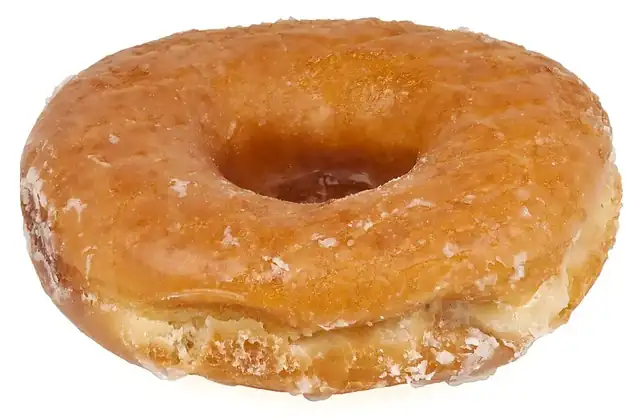
A doughnut or donut is a type of fried or baked good made from leavened dough. It is popular in many countries and is prepared in various forms as a sweet snack that can be homemade or purchased in bakeries, supermarkets, food stalls, and franchised specialty vendors.
Doughnuts are usually deep fried from a leavened dough. Baked or cake doughnuts are made with a thick leavened batter. Various toppings and flavors are used for different types, such as sugar, chocolate or maple glazing.
The two most common types are the ring doughnut and the filled doughnut, which is injected with fruit preserves (the jelly doughnut), cream, custard, or other sweet fillings. Small pieces of dough are sometimes cooked as doughnut holes. Once fried, doughnuts may be glazed with a sugar icing, spread with icing or chocolate, or topped with sugar, cinnamon, sprinkles or fruit. Other shapes include balls, flattened spheres, twists, and other forms. Doughnut varieties are also divided into cake doughnuts, including the old-fashioned (known outside of the US as baked doughnuts) and yeast-risen doughnuts. Doughnuts are often accompanied by coffee or milk in the US.
England and North America
Dutch settlers brought olykoek ("oil cake") to New York (or New Amsterdam) in the early 18th century. These doughnuts closely resembled later ones, but the ring donut had not yet appeared.
A recipe for fried dough "nuts" was published, in 1750 England, under the title "How to make Hertfordshire Cakes, Nuts and Pincushions", in The Country Housewife's Family Companion by William Ellis.
A recipe labelled "dow nuts", again from Hertfordshire, was found in a book of recipes and domestic tips written around 1800, by the wife of Baron Thomas Dimsdale, the recipe being given to the dowager Baroness by an acquaintance who transcribed for her the cooking instructions for a "dow nut".
"Dough nut"
One of the earliest known literary usages of the term dates to an 1808 short story describing a spread of "fire-cakes and dough-nuts". Washington Irving described "dough-nuts", in his 1809 History of New York, as "balls of sweetened dough, fried in hog's fat, and called dough-nuts, or olykoeks." These "nuts" of fried dough might now be called doughnut holes. The word nut is here used in the earlier sense of "small rounded cake or cookie", also seen in ginger nut. Doughnut is the traditional spelling and still dominates even in the United States, though donut is often used. At present, doughnut and the shortened form donut are both pervasive in American English.
"Donut"
The first known printed use of donut was in Peck's Bad Boy and his Pa by George W. Peck, published in 1900, in which a character is quoted as saying, "Pa said he guessed he hadn't got much appetite, and he would just drink a cup of coffee and eat a donut." According to author John T. Edge the alternative spelling "donut" was invented in the 1920s when the New York-based Display Doughnut Machine Corporation abbreviated the word to make it more pronounceable by the foreigners they hoped would buy their automated doughnut making equipment. The donut spelling also showed up in a Los Angeles Times article dated August 10, 1929, in which Bailey Millard jokingly complains about the decline of spelling, and that he "can't swallow the 'wel-dun donut' nor the ever so 'gud bred'".
The interchangeability of the two spellings can be found in a series of "National Donut Week" articles in The New York Times that covered the 1939 World's Fair. In four articles beginning 9 October, two mention the donut spelling. Dunkin' renamed in 2019, was named Dunkin' Donuts in 1950, following its 1948 founding under the name Open Kettle in Quincy, Massachusetts, is the oldest surviving company to use the donut variation; other chains, such as the defunct Mayflower Doughnut Corporation (1931), did not use that spelling. According to the Oxford Dictionaries, while "doughnut" is used internationally, the spelling "donut" is American, with Krispy Kreme being a notable exception. The spelling "donut" remained rare until the 1950s, and has since grown significantly in popularity.
Rings
Hanson Gregory, an American, claimed to have invented the ring-shaped doughnut in 1847 aboard a lime-trading ship when he was 16 years old. Gregory was dissatisfied with the greasiness of doughnuts twisted into various shapes and with the raw center of regular doughnuts. He claimed to have punched a hole in the center of dough with the ship's tin pepper box, and to have later taught the technique to his mother. Smithsonian Magazine states that his mother, Elizabeth Gregory, "made a deep-fried dough that cleverly used her son's spice cargo of nutmeg and cinnamon, along with lemon rind," and "put hazelnuts or walnuts in the center, where the dough might not cook through", and called the food 'doughnuts'.
Ring doughnuts may be formed by a number of methods, including joining the ends of a long, skinny piece of dough into a ring, or using a doughnut cutter, which simultaneously cuts the outside and inside shape, leaving a doughnut-shaped piece of dough and a doughnut hole (the dough removed from the center). This smaller piece of dough can be cooked and served as a "doughnut hole" or added back to the batch to make more doughnuts. A disk-shaped doughnut can also be stretched and pinched into a torus until the center breaks to form a hole. Alternatively, a doughnut depositor can be used to place a circle of liquid dough (batter) directly into the fryer.
Topping
After frying, ring doughnuts are often topped. Raised doughnuts are generally covered with a glaze (icing). Cake doughnuts can also be glazed, powdered with confectioner's sugar, or covered with cinnamon and granulated sugar. They are also often topped with cake frosting (top only) and sometimes sprinkled with coconut, chopped peanuts, or sprinkles.
Holes
Doughnut holes are small, bite-sized doughnuts that were traditionally made from the dough taken from the center of ring doughnuts. Before long, doughnut sellers saw the opportunity to market "holes" as a novelty and many chains offer their own variety, some with their own brand names such as "Munchkins" from Dunkin' Donuts and "Timbits" from Tim Hortons.
Filled
Filled doughnuts are flattened spheres injected with fruit preserves, cream, custard, or other sweet fillings, and often dipped into powdered sugar or topped off with frosting. Common varieties include the Boston cream, coconut, key lime, and jelly.
More to savor
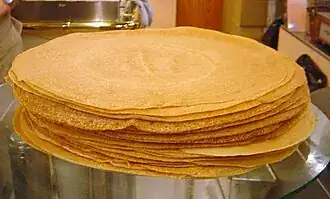
Crêpes I
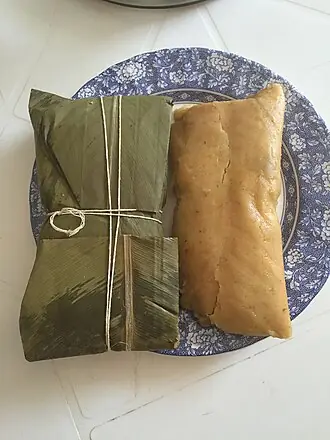
Hallaca (Venezuelan Stuffed Corn Dough)
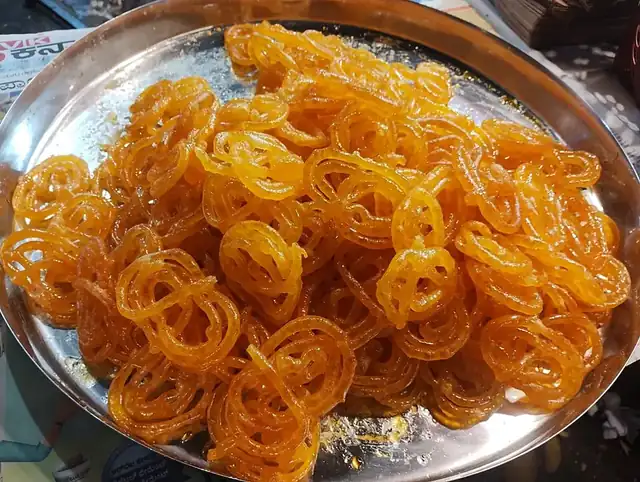
Jalebi: The Twisted Story of a Syrupy Sweet