The dish is a starting point for exploring a wider food story. The guide below looks more closely at its background and different forms. When you want to cook, visit the recipe collection for ingredient quantities and step-by-step methods.
Overview
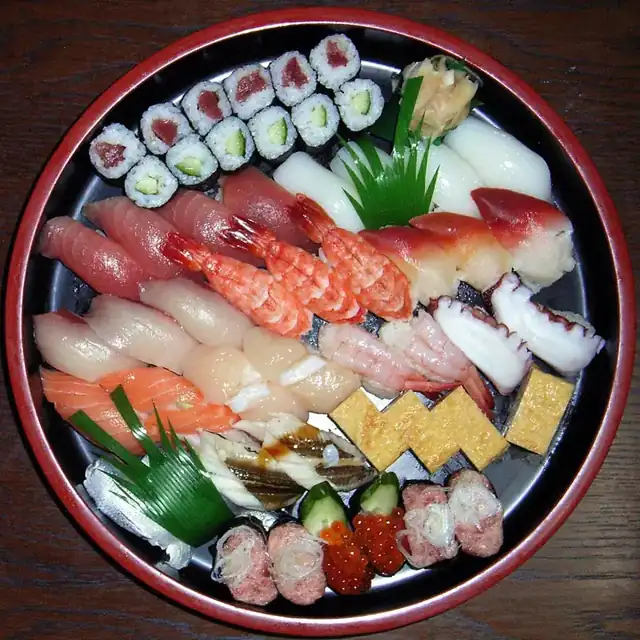
Sushi is a traditional Japanese dish made with vinegared rice, typically seasoned with sugar and salt, and combined with a variety of ingredients, such as seafood, vegetables, or meat; raw seafood is the most common, although some may be cooked. While sushi has numerous styles and presentations, the current defining component is the vinegared rice, also known as , or .
The modern form of sushi is believed to have been created by Hanaya Yohei, who invented nigiri-zushi, the most commonly recognized type today, in which seafood is placed on hand-pressed, vinegared rice. This innovation occurred around 1824 in the Edo period (1603–1867). It was the fast food of the chōnin class in the Edo period.
Sushi is traditionally made with medium-grain white rice, although it can also be prepared with brown rice or short-grain rice. It is commonly prepared with seafood, such as squid, eel, yellowtail, salmon, tuna, or imitation crab meat (surimi). Certain types of sushi are vegetarian. It is often served with pickled ginger, wasabi, and soy sauce. Daikon radish or pickled daikon are popular garnishes for the dish.
Types
The common ingredient in all types of sushi is vinegared sushi rice. Fillings, toppings, condiments, and preparation vary widely.
Due to rendaku consonant mutation, sushi is pronounced with zu instead of su when a prefix is attached, as in nigirizushi.
Makizushi
, or is a cylindrical piece formed with the help of a mat known as a . Makizushi is generally wrapped in nori (seaweed) but is occasionally wrapped in a thin omelette, soy paper, cucumber, or shiso (perilla) leaves. Makizushi is often cut into six or eight pieces, constituting a single roll order. Short-grain white rice is usually used, although short-grain brown rice, like olive oil on nori, is now becoming more widespread among the health-conscious. Rarely, sweet rice is mixed in makizushi rice.
Nowadays, the rice in makizushi can be many kinds of black rice, boiled rice, and cereals. Besides the common ingredients listed above, some varieties may include cheese, spicy cooked squid, yakiniku, kamaboko, lunch meat, sausage, bacon or spicy tuna. The nori may be brushed with sesame oil or sprinkled with sesame seeds. In a variation, sliced pieces of makizushi may be lightly fried with egg coating.
Below are some common types of makizushi, but many other kinds exist.
Nigirizushi
consists of an oblong mound of sushi rice that a chef typically presses between the palms of the hands to form an oval-shaped ball and a topping (the neta) draped over the ball. It is usually served with a bit of wasabi; toppings are typically fish such as salmon, tuna, or other seafood. Certain toppings are typically bound to the rice with a thin strip of nori, most commonly octopus (tako), freshwater eel (unagi), sea eel (anago), squid (ika), imitation crab (kanikama), and sweet egg (tamago).
(:ja:軍艦巻) is a special type of nigirizushi: an oval, hand-formed clump of sushi rice that has a strip of nori wrapped around its perimeter to form a vessel that is filled with some soft, loose or fine-chopped ingredient that requires the confinement of nori such as roe, nattō, oysters, uni (sea urchin roe), sweetcorn with mayonnaise, scallops, and quail eggs. Gunkan-maki was invented at the Ginza Kyubey restaurant in 1941; its invention significantly expanded the repertoire of soft toppings used in sushi.
Sushi-meshi
is a preparation of white, short-grained, Japanese rice mixed with a dressing consisting of rice vinegar, sugar, salt, and occasionally kombu and sake. It must be cooled to room temperature before being used for a sushi filling, or it will get too sticky while seasoned. Traditionally, it is mixed with a hangiri (a round, flat-bottom wooden tub or barrel) and a shamoji (a wooden paddle).
Sushi rice is prepared with short-grain Japanese rice, which has a consistency that differs from long-grain strains such as those from India, Sri Lanka, Bangladesh, Thailand, and Vietnam. The essential quality is its stickiness or glutinousness, although the type of rice used for sushi differs from glutinous rice. Freshly harvested rice (shinmai) typically contains too much water and requires extra time to drain the rice cooker after washing. In some fusion cuisine restaurants, short-grain brown rice and wild rice are also used.
There are regional variations in sushi rice, and individual chefs have their methods. Most of the variations are in the rice vinegar dressing: the Kantō region version of the dressing commonly uses more salt; in Kansai region, the dressing has more sugar.
Nori
The dark green seaweed wrappers used in makimono are called nori. Nori is a type of red algae, typically in the family Bangiaceae, traditionally cultivated in the harbors of Japan. Many different foliose red algae species are cultivated to be used as sushi wrappers, however Pyropia tenera is the most commonly farmed. This species ranks among the top three most commonly cultivated seaweed species in China, Korea, and Japan. Originally, algae was scraped from dock pilings, rolled out into thin, edible sheets, and dried in the sun, similar to making rice paper. Today, the commercial product is farmed, processed, toasted, packaged, and sold in sheets.
The size of a nori sheet influences the size of makimono. A full-size sheet produces futomaki, and a half produces hosomaki and temaki. To produce gunkan and some other makimono, an appropriately sized piece of nori is cut from a whole sheet.
Nori by itself is an edible snack and is available with salt or flavored with teriyaki sauce. The flavored variety, however, tends to be of lesser quality and is not suitable for sushi.
Etiquette
Unlike sashimi, which is almost always eaten with chopsticks, nigirizushi is traditionally eaten with the fingers, even in formal settings. Although sushi is commonly served on a small platter with a side dish for dipping, sushi can also be served in a bento, a box with small compartments that hold the various dishes of the meal.
Soy sauce is the usual condiment, and sushi is normally served with a small sauce dish or with soy sauce in a separate bento compartment. Traditional etiquette suggests that the sushi be turned over so that only the topping is dipped for flavor; the rice—which has already been seasoned with rice wine vinegar, sugar, salt, mirin, and kombu—would otherwise absorb too much soy sauce and would fall apart.
More to savor
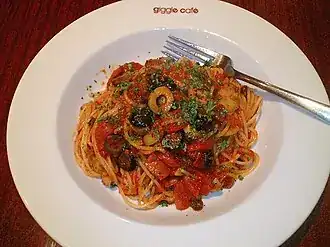
Spaghetti alla Puttanesca

Chicken Vindaloo

Doughnuts: More Than a Ring of Sweet Dough