This longer reference provides the background behind the topic. Read it alongside the recipe collection when you want to connect an ingredient or food idea with a dish to prepare.
In this story
OverviewDescriptionMalaysian varietiesIndonesian varietiesThai varietiesPhilippine varietiesCulinaryOverview
The durian is the edible fruit of trees in the genus Durio, most often applying to those of Durio zibethinus, the only species available on the international market. Other species are sold in their local regions.
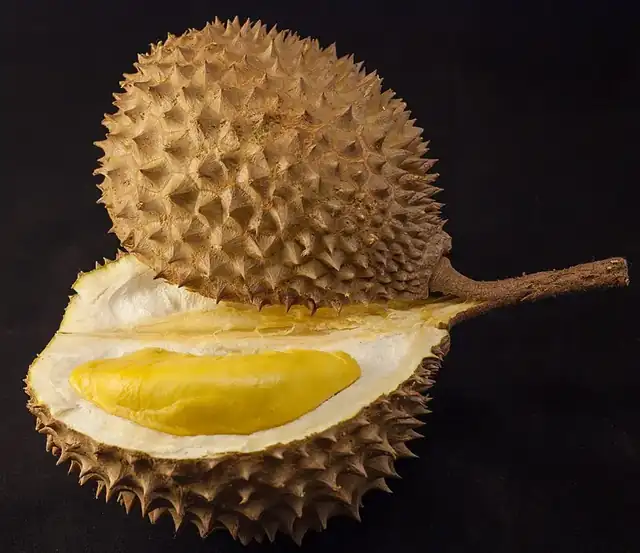
Known in some regions as the "king of fruits", the durian is distinctive for its large size, strong odour, and thorn-covered rind. The fruit can grow as large as 30 cm long and 15 cm in diameter, and it typically weighs 1 to 3 kg. Its shape ranges from oblong to round, the colour of its husk from green to brown, and its flesh from pale yellow to red, depending on the species. The flavour of the flesh is complex with savoury notes. The texture is creamy and pudding-like.
Some people regard the durian as having a pleasantly sweet fragrance, whereas many others find the aroma overpowering and unpleasant. The persistence of its strong odour, which may linger for several days, has led some hotels and public transportation services in Southeast Asia, such as in Singapore and Bangkok, to ban the fruit. The flesh can be consumed at various stages of ripeness, and it is used to flavour a wide variety of sweet desserts and savoury dishes in Southeast Asian cuisines. The seeds can be eaten when cooked.
Description
Durian trees are large, growing to 25 – 50 m in height depending on the species. The leaves are evergreen, elliptic to oblong and 10 – 18 cm long. The flowers are produced in three to thirty clusters together on large branches and directly on the trunk, with each flower having a calyx (sepals) and five (rarely four or six) petals. Durian trees have one or two flowering and fruiting periods per year, although the timing varies depending on the species, cultivars, and localities. Durian flowers are large and feathery, with copious nectar; they give off a heavy, sour, buttery odour. These features are typical of flowers pollinated by certain species of bats that eat nectar and pollen.
A typical durian tree can bear fruit after four or five years. The fruit can hang from any branch, and matures roughly three months after pollination. The fruit can grow up to 30 cm long and 15 cm in diameter, and typically weighs 1 to 3 kilograms (2–7 lb). Its shape ranges from oblong to round, the colour of its husk green to brown, and its flesh pale-yellow to red, depending on the species. Among the thirty known species of Durio, eight produce edible fruits: D. zibethinus, D. dulcis, D. graveolens, D. kutejensis, D. lowianus, D. macrantha, D. oxleyanus and D. testudinarius.
Malaysian varieties
The Malaysian Ministry of Agriculture and Agro-Based Industry has since 1934 maintained a list of registered varieties, where each cultivar is assigned a common name and a code number starting with "D". These codes are widely used through Southeast Asia; as of 2021, there were over 200 registered varieties. Many superior cultivars have been identified through competitions held at the annual Malaysian Agriculture, Horticulture, and Agrotourism Show. There are 13 common Malaysian varieties having favourable qualities of colour, texture, odour, taste, high yield, and resistance against various diseases.
'Musang King' ('D197') was discovered in the 1980s, when a man named Tan Lai Fook from Raub, Pahang, stumbled upon a durian tree in Gua Musang, Kelantan. He brought a branch back to Raub for grafting. The cultivar was named after its place of origin. The variety has bright yellow flesh and is like a more potent or enhanced version of the 'D24'. The D24 or Sultan durian has golden yellow flesh and a rich texture and aroma. It is a popular variety in Malaysia.
Indonesian varieties
Indonesia has more than 100 varieties of durian. The most cultivated species is D. zibethinus. Notable varieties are Bawor (Banyumas), Sukun (Central Java), Sitokong (Betawi), Sijapang (Betawi), Simas (Bogor), Sunan (Jepara), Si dodol and Si hijau (South Kalimantan), and Petruk (Central Java).
Thai varieties
In Thailand, 'Mon Thong' is the most commercially sought after cultivar, for its thick, full-bodied creamy and mild sweet-tasting flesh with moderate smell and smaller seeds, while 'Chanee' is most resistant to infection by Phytophthora palmivora. 'Kan Yao' is less common, but prized for its longer window of time when it is both sweet and odourless. Among the cultivars in Thailand, five are currently in large-scale commercial cultivation: 'Chanee', 'Mon Thong', 'Kan Yao', 'Ruang', and 'Kradum'.
By 2007, Thai government scientist Songpol Somsri had crossbred more than ninety varieties of durian to create 'Chantaburi No. 1', a cultivar without the characteristic odour. Another hybrid, Chantaburi No. 3, develops the odour about three days after the fruit is picked, which enables an odourless transport yet satisfies consumers who prefer the pungent odour. In 2012, two odourless cultivars, 'Long Laplae' and 'Lin Laplae', were presented to the public by Yothin Samutkhiri, governor of Thailand's Uttaradit province where they were developed.
Philippine varieties
Uncultivated durian trees found in Mindanao are known as "native" varieties. They have large seeds and thin flesh that is white or yellow. They are strong-tasting and generally more expensive than hybrids due to their rarity.
The two most popular cultivars in the Philippines are 'Arancillo' ('ACC.1497') and 'Puyat', both are hybrids descended from native durians and the 'Chanee' cultivar of Thailand. Other Philippine cultivars include 'Alcon Fancy', 'Duyaya', 'Umali', 'UPLB Gold', 'Atabrine' ('DES806'), 'DES1545', 'Kimbangan', 'Lacson 1' and 'Lacson 2', 'Malagkit', 'S7', 'S1', 'Mamer' ('DES916', a native variety from Calinan), and 'Galang Durian 69'.
Culinary
In Thailand, durians are eaten fresh with sweet sticky rice, and blocks of durian paste are sold in the markets, though much of the paste is adulterated with pumpkin. Unripe durians are cooked as a vegetable, except in the Philippines, where all uses are sweet rather than savoury. Malaysians make both sugared and salted preserves from durian. When durian is minced with salt, onions and vinegar, it is called boder. In Kelantan of Malaysia's Peninsular East Coast, fermented durian flesh or tempoyak is mixed with onion and chilli slices, lime juice and an anchovy-based sauce called budu, this mix is eaten as a condiment with rice-based meals.
The seeds, which are the size of chestnuts, can be eaten boiled, roasted or fried in coconut oil, with a texture that is similar to taro or yam, but stickier. In Java, the seeds are sliced thin and cooked with sugar as a confection. Uncooked seeds are potentially toxic due to cyclopropene fatty acids.
More to savor

Chicken Vindaloo

Sweet Beef

Pecan in the Kitchen: Exploring an Everyday Ingredient