This longer reference provides the background behind the topic. Read it alongside the recipe collection when you want to connect an ingredient or food idea with a dish to prepare.
In this story
OverviewDescriptionCultivars and pollinationHerbivore defenseProductionAroma and tasteCulinary usesOverview
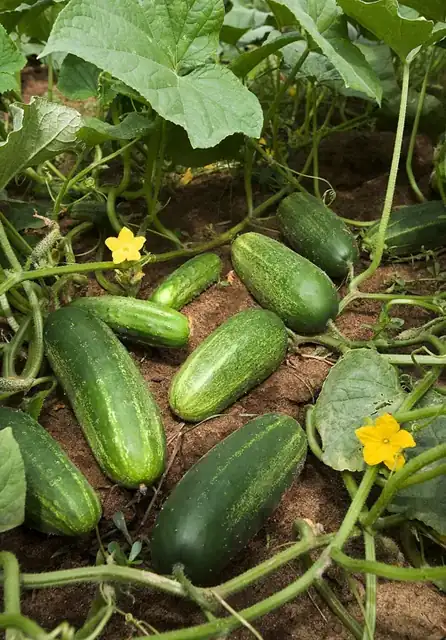
The cucumber (Cucumis sativus) is a widely-cultivated creeping vine plant in the family Cucurbitaceae that bears cylindrical to spherical fruits, used as culinary vegetables. Considered an annual plant, there are three main types: slicing, pickling, and seedless.
The cucumber originates in Asia, in a region extending from India, Nepal, Bangladesh, China (Yunnan, Guizhou, Guangxi), and Northern Thailand, but now grows on most continents, and many different types of cucumber are grown commercially and traded on the global market. In North America, a wild cucumber is a plant in the genera Echinocystis and Marah, though these are not closely related to the cucumber.
They have been cultivated for at least 3,000 years, and were eaten all year round by the Roman Emperor Tiberius. In the Middle Ages, Charlemagne had them grown for him, and the Spanish brought them to the Americas in the Columbian exchange in 1494. World production is led by China with over three quarters of the total.
Description
The cucumber is an annual creeping vine that roots in the ground and grows up trellises or other supporting frames, wrapping around supports with thin, spiraling tendrils. The plant can root in a soilless medium, then sprawl along the ground in the absence of a supporting structure. The vine has large leaves that form a canopy over the fruits.
The fruit of typical cultivars of cucumber is roughly cylindrical, but elongated with tapered ends, and may be as large as 62 cm long and 10 cm in diameter.
Cucumber fruits consist of 95% water (see nutrition table). In botanical terms, the cucumber is classified as a pepo, a type of botanical berry with seeds and an outer rind. In a culinary context, it is considered a vegetable.
Cultivars and pollination
Most cucumber cultivars are seeded and require pollination. For this purpose, thousands of honey beehives are carried to cucumber fields each year just before bloom. Cucumbers can be pollinated by bumblebees and several other wild bee species. Most cucumbers that require pollination are self-incompatible, thus requiring the pollen of another plant in order to form seeds and fruit. Some self-compatible cultivars exist that are related to the 'Lemon cucumber' cultivar.
Some cultivars are parthenocarpic, creating seedless fruit without pollination; these are often grown in greenhouses. However, fruit set is significantly higher when bees visit the flowers.
Traditional cultivars produce male blossoms first, then female, in about equivalent numbers. Newer gynoecious hybrid cultivars produce almost all female blossoms. They may have a pollenizer cultivar interplanted, and the number of beehives per unit area is increased, but temperature changes induce male flowers even on these plants, which may be sufficient for pollination to occur.
Herbivore defense
Phytochemicals in cucumbers may discourage natural foraging by herbivores, such as insects, nematodes or wildlife. As a possible defense mechanism, cucumbers produce cucurbitacin C, which causes a bitter taste in some cucumber varieties. This potential mechanism is under preliminary research to identify whether cucumbers are able to deter herbivores and environmental stresses by using an intrinsic chemical defense, particularly in the leaves, cotyledons, pedicel, carpopodium, and fruit.
Production
In 2024, world production of cucumbers and gherkins was 88 million tonnes, led by China with 78% of the total (table).
Aroma and taste
Depending on variety, cucumbers may have a mild melon aroma and flavor, in part resulting from unsaturated aldehydes, such as (E,Z)-nona-2,6-dienal, and the cis- and trans- isomers of 2-nonenal. The slightly bitter taste of cucumber rind results from cucurbitacins. The polyphenol content is higher in unpeeled cucumbers.
Culinary uses
In horticulture, cucumbers are classified into three main cultivar groups: slicing, pickling, and seedless/burpless. Cucumbers grown to eat fresh are called slicing cucumbers. The main varieties of slicers mature on vines with large leaves that provide shading. Slicers grown commercially for the North American market are generally longer, smoother, more uniform in color, and have much tougher skin. In contrast, those in other countries, often called European cucumbers, are smaller and have thinner, more delicate skin, often with fewer seeds, thus are often sold in plastic skin for protection. This variety is called a 'telegraph cucumber' in Australasia.
Pickling with brine, sugar, vinegar, and spices creates flavored products from cucumbers and other foods. Cucumbers grown for pickling are shorter, thicker, and thinner-skinned than other varieties.
Gherkins, cornichons, or baby pickles, are small cucumbers, typically those 1 to 5 in in length, often with bumpy skin, which are typically used for pickling. The word gherkin comes from the early modern Dutch gurken or augurken ('small pickled cucumber'). The term is used in the name for Cucumis anguria, the West Indian gherkin, a closely related species.
Burpless cucumbers are sweeter and have a thinner skin than other varieties of cucumber. They are reputed to be easy to digest and to have a pleasant taste. They can grow as long as 2 ft, are nearly seedless, and have a delicate skin. Most commonly grown in greenhouses, these parthenocarpic cucumbers are often found in grocery markets, shrink-wrapped in plastic. They are marketed as either burpless or seedless, as the seeds and skin of other varieties of cucumbers are said to give some people gas.
Cucumber shoots are regularly consumed as a vegetable, especially in rural areas. In Thailand they are often served with a crab meat sauce. They can be stir fried or used in soups.
More to savor

Chicken Vindaloo

Gajjar Halwa (Carrot Pudding)
Millet in the Kitchen: Exploring an Everyday Ingredient