Use the regional background below as a starting point for exploring the food, rather than expecting one dish to represent every household. Food traditions differ within a country and continue to change through travel, migration, and everyday cooking.
In this story
OverviewMiddle AgesIndian and Anglo-Indian cuisineSoutheast and East Asian cuisinesEuropean cuisinesCafes and tea shopsPub foodOverview
English cuisine encompasses the cooking styles, traditions and recipes associated with England. It has distinctive attributes of its own, but is also very similar to wider British cuisine, partly historically and partly due to the import of ingredients and ideas from the Americas, China, and India during the time of the British Empire and as a result of post-war immigration.
Some traditional meals, such as bread and cheese, roasted and stewed meats, meat and game pies, boiled vegetables and broths with herbs or spices, and freshwater and saltwater fish have ancient origins. The 14th-century English cookbook, the Forme of Cury, contains recipes for these, and dates from the royal court of Richard II.
Middle Ages
English cooking has developed over many centuries since at least the time of The Forme of Cury, written in the Middle Ages around 1390 in the reign of King Richard II. The book offers imaginative and sophisticated recipes using seasonings including nutmeg, ginger, cinnamon, cardamon, and cloves, with spicy sweet and sour sauces thickened with bread or quantities of almonds boiled, peeled, dried, and ground, and often served in pastry. Foods such as gingerbread are described. It was not at all, emphasises Clarissa Dickson Wright in her A History of English Food, a matter of large lumps of roast meat at every meal as imagined in Hollywood films.
Instead, medieval dishes often had the texture of a purée, possibly containing small fragments of meat or fish: 48% of the recipes in the Beinecke manuscript are for dishes similar to stews or purées. Such dishes could be broadly of three types: somewhat acidic, with wine, vinegar, and spices in the sauce, thickened with bread; sweet and sour, with sugar and vinegar; and sweet, using then-expensive sugar. An example of such a sweet purée dish for meat (it could also be made with fish) from the Beinecke manuscript is the rich, saffron-yellow "mortruys", thickened with egg:
Another manuscript, Utilis Coquinario, mentions dishes such as "pyany", poultry garnished with peonies; "hyppee", a rose-hip broth; and birds such as cormorants and woodcocks.
Indian and Anglo-Indian cuisine
During the British Raj, Britain first started borrowing Indian dishes, creating Anglo-Indian cuisine, with dishes such as kedgeree (1790) and Mulligatawny soup (1791). Indian food was served in coffee houses from 1809, and cooked at home from a similar date as cookbooks of the time attest. The Veeraswamy restaurant in Regent Street, London, was opened in 1926, at first serving Anglo-Indian food, and is the oldest surviving Indian restaurant in Britain. There was a sharp increase in the number of curry houses in the 1940s, and again in the 1970s.
The post-colonial British Indian dish chicken tikka masala was apparently invented in Glasgow in the early 1970s, while balti cuisine was introduced to Britain in 1977 in Birmingham. In 2003, there were roughly 9,000 restaurants serving Indian cuisine in Britain. The majority of Indian restaurants in Britain are run by entrepreneurs of Bangladeshi (often Sylhetis) and Pakistani origin. According to Britain's Food Standards Agency, the Indian food industry in the United Kingdom was worth £3.2 billion in 2003, accounting for two-thirds of all eating out, and serving about 2.5 million British customers every week. The number of restaurants peaked at some 12,000 in 2015, decreasing to some 8,000 by 2023.
Southeast and East Asian cuisines
Southeast and East Asian cuisines have become widely available across England. Chinese cuisine became established in England by the 1970s, with large cities often having a Chinatown district; the one in London's Soho developed between the two world wars, following an informal area in Limehouse. Deriving from Cantonese cuisine, the food served by Chinese restaurants has been adapted to suit English taste. From around 1980 onwards, Southeast Asian cuisines, especially Thai and Vietnamese, began to gain popularity in England.
European cuisines
Italian cuisine is the most popular Mediterranean cuisine in England. In its current form, inspired by Elizabeth David, its rise began after 1945. There were some Italian restaurants before World War II, but they mostly served a generalised haute cuisine. Soon after the war, Italian coffee bars appeared, the first places to trade on their Italian identity; they soon started to sell simple and cheap Italian food such as minestrone soup, spaghetti and pizza. From the early 1960s, the slightly more elegant trattoria restaurants offered "Italian specialities" such as lasagne verdi al forno (baked lasagne, coloured with spinach). Other Mediterranean influences include Greek moussaka, feta and taramasalata, Turkish doner and shish kebabs, and Middle Eastern hummus.
French cuisine in England is largely restricted to expensive restaurants, although there are some inexpensive French bistros.
Cafes and tea shops
The English cafe is a small, inexpensive eating place. A working men's cafe serves mainly fried or grilled food, such as fried eggs, bacon, bangers and mash‚ black pudding, bubble and squeak, burgers, sausages, mushrooms and chips. These may be accompanied by baked beans, cooked tomatoes, and fried bread. These are referred to as "breakfast" even if they are available all day. Traditional cafes have declined with the rise of fast-food chains, but remain numerous all over the UK.
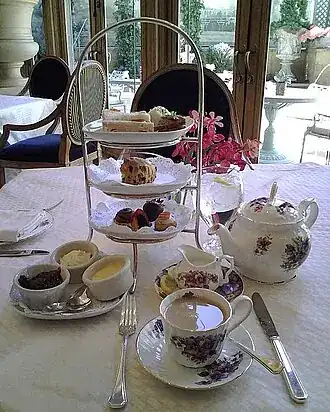
A tea shop is a small restaurant that serves soft drinks and light meals, often in a sedate atmosphere. Customers may eat a cream tea in Cornish or Devonshire style, served from a china set, and a scone with jam and clotted cream.
Pub food
The public house, or pub, is a famous English institution. In the mid-20th century, pubs were drinking establishments with little emphasis on the serving of food, other than "bar snacks", such as pork scratchings, pickled eggs, salted crisps, and peanuts, which helped to increase beer sales. If a pub served meals these were usually basic cold dishes such as a ploughman's lunch, invented in the 1950s.
In the 1950s some British pubs started to offer "a pie and a pint", with hot individual steak and ale pies made on the premises by the landlord or his wife. In the 1960s this was developed into the then-fashionable "chicken in a basket", a portion of roast chicken with chips, served on a napkin, in a wicker basket, by the Mill pub at Withington. Quality dropped but variety increased with the introduction of microwave ovens and freezer food. "Pub grub" expanded to include British food items such as steak and kidney pudding, shepherd's pie, fish and chips, bangers and mash, Sunday roast, and pasties.
More to savor
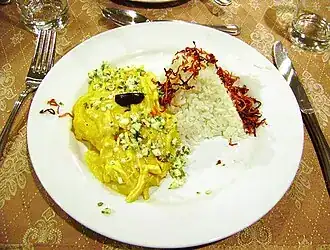
Ají de Gallina (Peruvian Chili Chicken)

English Breakfast
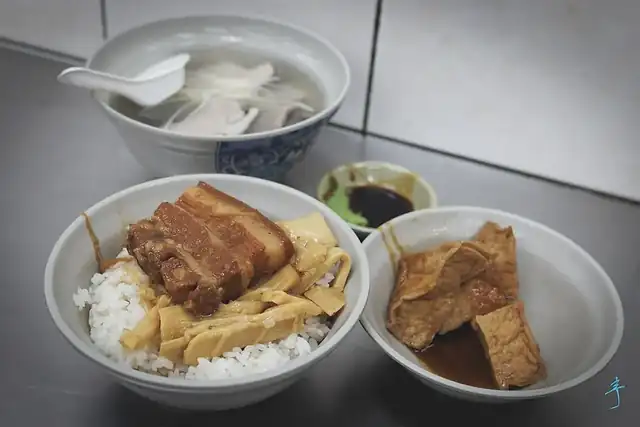
A Taste of Taiwan: Exploring the Food Behind the Table