
The dish is a starting point for exploring a wider food story. The guide below looks more closely at its background and different forms. When you want to cook, visit the recipe collection for ingredient quantities and step-by-step methods.
Overview
Falafel (فلافل) is a deep-fried ball or patty-shaped fritter of Egyptian origin that features in Middle Eastern cuisine, particularly Levantine cuisines. It is made from ground fava beans, chickpeas, or both, and mixed with herbs and spices before frying.
Falafel is often served in a flatbread such as pita, samoon, laffa, or taboon; falafel also frequently refers to a wrapped sandwich that is prepared in this way. The falafel balls may be topped with salads, pickled vegetables, and hot sauce, and drizzled with tahini-based sauces. Falafel balls may also be eaten alone as a snack or served as part of a meze tray.
Falafel is a popular street food eaten throughout the Middle East. In Egypt and the Arabian Peninsula, it is most often made with fava beans, while in the Levant, it is typically made with chickpeas or sometimes a blend of both.
Falafel has been the subject of gastronationalistic campaigns in many Middle Eastern countries, most notably in the Israeli–Palestinian conflict, where both sides have claimed ownership of the dish.
Etymology
The word falāfil (فلافل) is Arabic and is the plural of ALA-LC (فلفل) 'pepper', borrowed from Persian felfel (فلفل), cognate with the Sanskrit word pippalī (पिप्पली) 'long pepper'; or an earlier *filfal, from Aramaic pilpāl 'small round thing, peppercorn', derived from palpēl 'to be round, roll'.
The name falāfil is used world-wide. In English (where it has been written falafel, felafel, filafel and filafil), it is first attested in 1936.
Falafel is known as ṭaʿmiyya (طعمية) in Egypt and Sudan. The word is derived from a diminutive form of the Arabic word ALA-LC (طعام, 'food'); the particular form indicates a "unit" of the given root in this case Ṭ-ʕ-M (ط ع م, having to do with taste and food), thus meaning 'a little piece of food' or 'small tasty thing'.
The word falafel can refer to the fritters themselves or to sandwiches filled with them.
Middle East
Falafel is a common form of street food or fast food in Egypt, across the Levant, and in the wider Middle East. The croquettes are regularly eaten as part of meze. During Ramadan, falafel balls are sometimes eaten as part of the iftar, the meal that breaks the daily fast after sunset. Falafel became so popular that McDonald's for a time served a "McFalafel" in its breakfast menu in Egypt.
Falafel is still popular in the Coptic diet, and as such large volumes are cooked during religious holidays. Falafel is consumed as part of the Lenten diet by Arab Christians.
Chickpea-based falafel, common in many Levantine cuisines including Israeli and Palestinian, has become widely recognized as a national dish in Israel, where it is a popular street food.
The West
Waves of migration of Arabs and Turks took falafel through Europe to Germany in particular, where a large Turkish population had put down roots. At first it was a dish consumed principally by migrants. During the early 1970s, the appearance of Turkish food stalls and restaurants made falafel available to the Germans, resulting in a transformation of the recipe.
In North America, prior to the 1970s, falafel was largely found in Middle Eastern, Mediterranean and Jewish neighborhoods and restaurants. By the 1990s, it had begun to spread to the broader populace, first as an exoticized "eastern" dish but later it became normalized the dish is a common and popular street food in many cities throughout North America.
Vegetarianism
Falafel is popular with vegetarians worldwide.
Falafel became popular among vegetarians and vegans as an alternative to meat-based street foods. While traditionally thought of as being used to make veggie burgers, its use has expanded as more have adopted it as a source of protein. Falafel is used as a meat substitute in some vegetarian recipes for meatloaf, sloppy joes and spaghetti and meatballs.
Preparation and variations
Falafel is made from fava beans, chickpeas, or a combination of both. In Egypt, it is typically prepared with fava beans. In Israeli and Palestinian cuisine, chickpeas are commonly used, while in Jordan, Lebanon, Syria, and the wider Middle East, either chickpeas or a mix of both are used. The chickpea-based version is the most popular in the West. Some falafel include a filling inside the falafel dough; Palestinians make a variation of falafel stuffed with sumac and onions.
When chickpeas are used, they are not cooked prior to use (cooking the chickpeas will cause the falafel to fall apart, requiring adding some flour to use as a binder). Instead they are soaked (sometimes with baking soda) overnight, then ground together with various ingredients such as parsley, scallions, and garlic. Spices such as cumin and coriander are often added to the beans for added flavor. The dried fava beans are soaked in water and then stone ground with leek, parsley, green coriander, cumin and dry coriander. The mixture is shaped into balls or patties. This can be done by hand or with a tool called an aleb falafel (falafel mould). The mixture is usually deep-fried, or it can be oven-baked.
Falafel is typically ball-shaped, but is sometimes made in other shapes. The inside of falafel may be green (from green herbs such as parsley or green onion), or tan. Sometimes sesame seeds are added on top of the falafel before frying it.
When served as a sandwich, falafel is often wrapped with flatbread or stuffed in a hollow pita bread, or it can be served with flat or unleavened bread. Tomatoes, lettuce, cucumbers, and other garnishes can be added. Falafel is commonly accompanied by tahini sauce.
Politics
Falafel has taken on a politicized role in various middle eastern countries with arguments over its geographic origin, and accusations of cultural appropriation.
Arguments over the relative importance of the dish in various cuisines is an example of gastronationalism. In particular, discussion centers around the adoption of the dish into Israeli cuisine as an example of cultural appropriation. The chickpea version has been adopted into Israeli cuisine, where it features prominently and has been called a national dish of Israel, a designation Palestinians and other Arabs have criticized.
More to savor

English Breakfast

Austrian Napkin Dumpling (Serviettenknödel)
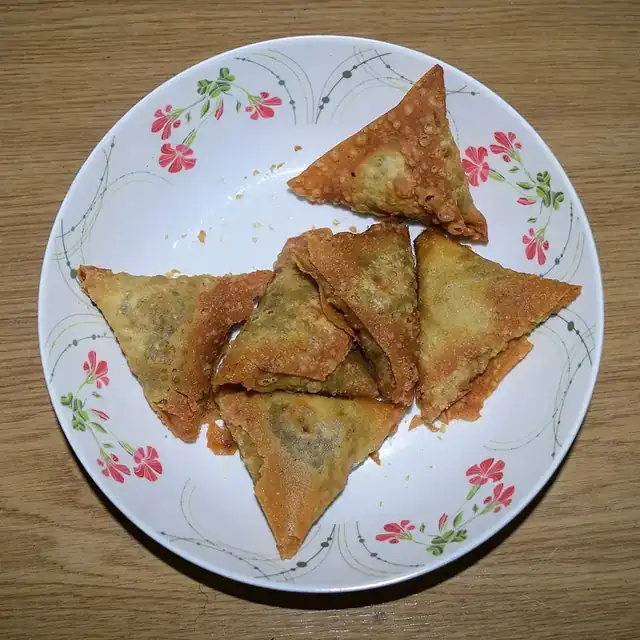
Samosas: The Pleasure of a Crisp Shell and Savory Filling