This longer reference provides the background behind the topic. Read it alongside the recipe collection when you want to connect an ingredient or food idea with a dish to prepare.
In this story
OverviewProductionUsesCookingDietary supplementAnimal feedFood additiveResearchTraditional medicineOverview
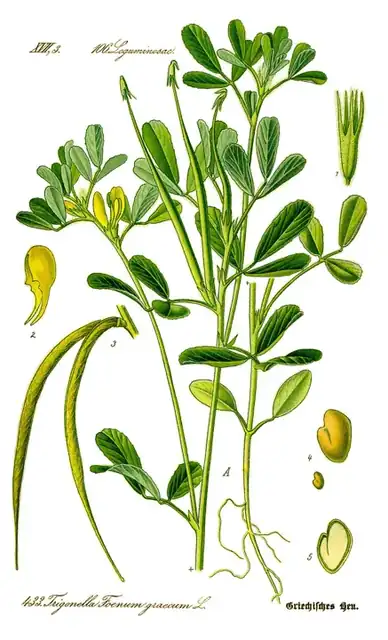
Fenugreek (Trigonella foenum-graecum) is an annual plant in the family Fabaceae, which includes beans, peas, and peanuts. It is distinguished by its three small obovate to oblong leaflets.
Most likely originating in the Near East, fenugreek is cultivated worldwide as a semiarid crop. Its leaves and seeds have been used as a culinary ingredient since ancient times, and are common ingredients in dishes from the Indian subcontinent. Its use as a food ingredient in small quantities is safe.
Although a common dietary supplement, no significant clinical evidence suggests that fenugreek has therapeutic properties. Commonly used in traditional medicine, fenugreek can increase the risk of serious adverse effects, including allergic reactions.
Production
India is the world's largest producer of fenugreek, with over 80% of its output coming from the state of Rajasthan.
Uses
Fenugreek is used as a herb (dried or fresh leaves), spice (seeds), and vegetable (fresh leaves, sprouts, and microgreens). Sotolon is the chemical responsible for the distinctive maple syrup smell of fenugreek.
Cuboid, yellow- to amber-coloured fenugreek seeds are frequently encountered in the cuisines of the Indian subcontinent, used both whole and powdered in the preparation of pickles, vegetable dishes, dal, and spice mixes such as panch phoron and sambar powder. They are often roasted to reduce inherent bitterness and to enhance flavour (Maillard browning).
Cooking
Fresh fenugreek leaves are an ingredient in some curries, such as with potatoes in Indian cuisines to make aloo methi (potato fenugreek) curry.
In Armenian cuisine, fenugreek seed powder is used to make a paste that is an important ingredient to cover dried and cured beef to make basturma.
In Iranian cuisine, fenugreek leaves are called shambalileh. They are one of several greens incorporated into the herb stew ghormeh sabzi, the herb frittata kuku sabzi, and the soup eshkeneh.
In Georgian cuisine, a related species—Trigonella caerulea, called "blue fenugreek"—is used.
In Egyptian cuisine, fenugreek is known by the Arabic name hilba or helba حلبة. Seeds are boiled to make a drink that is consumed at home and in coffee shops. Fellah in Upper Egypt add fenugreek seeds and maize to their pita bread to produce aish merahrah, a staple of their diet. Basterma, a cured, dried beef, gets its distinctive flavour from the fenugreek used as a coating.
In the same way in Turkish cuisine, fenugreek seed powder, called çemen, is used to make a paste with paprika powder and garlic to cover dried and cured beef in making pastirma/basturma. (Its name comes from the Turkish verb bastırmak, meaning "to press").
In Palestinian cuisine, fenugreek is used as an ingredient in a cake called fenugreek cake or hilbeh.
In Moroccan cuisine, fenugreek is used in rfissa, a dish associated with the countryside.
Fenugreek is used in Eritrean and Ethiopian cuisines. The word for fenugreek in Amharic is abesh (or abish), and the seed is used in Ethiopia as a natural herbal medicine in the treatment of diabetes.
Yemenite Jews following the interpretation of Rabbi Shelomo Yitzchak (Rashi) believe fenugreek, which they call hilbah, hilbeh, hilba, helba, or halba "חילבה", to be the Talmudic rubia. When the seed kernels are ground and mixed with water, they greatly expand; hot spices, turmeric, and lemon juice are added to produce a frothy relish eaten with a sop. The relish is reminiscent of curry. It is eaten daily and ceremonially during the meal of the first and/or second night of the Jewish New Year, Rosh Hashana.
In Yemen, a small amount of oud al hilba (عود الحلبة), which appears to be the same as ashwagandha, is traditionally added to ground fenugreek seeds before they are mixed with water to prepare the hulbah paste. This is believed to aid in digestion and more importantly to prevent or lessen the maple-syrup smell that usually occurs when consuming fenugreek.
Dietary supplement
Fenugreek dietary supplements are manufactured from powdered seeds into capsules, loose powders, teas, and liquid extracts in many countries. No high-quality evidence supports that these products have any clinical effectiveness.
Animal feed
Fenugreek is sometimes used as animal feed. It provides a green fodder palatable to ruminants. The seeds are also used to feed fish and domestic rabbits.
Food additive
Fenugreek seeds and leaves contain sotolon, which imparts the aroma of fenugreek and curry in high concentrations, and maple syrup or caramel in lower concentrations. Fenugreek is used as a flavoring agent in imitation maple syrup or tea, and as a dietary supplement.
Research
Constituents of fenugreek seeds include flavonoids, alkaloids, coumarins, vitamins, and saponins; the most prevalent alkaloid is trigonelline and coumarins include cinnamic acid and scopoletin. Research into whether fenugreek reduces biomarkers in people with diabetes and with prediabetic conditions is of limited quality.
As of 2023, no high-quality evidence has been found for whether fenugreek is safe and effective in relieving dysmenorrhea or improving lactation during breastfeeding. Studies of fenugreek are characterized as having variable, poor experimental design and quality, including small numbers of subjects, failure to describe methods, inconsistency and duration of dosing, and not recording adverse effects.
Because research on the potential biological effects of consuming fenugreek has provided no high-quality evidence for health or antidisease effect, fenugreek is not approved or recommended for clinical use by the United States Food and Drug Administration.
Traditional medicine
Although once a folk remedy for an insufficient milk supply when nursing, no good evidence indicates that fenugreek is effective or safe for this use, nor is it useful in traditional practices for treating dysmenorrhea, inflammation, diabetes, or any human disorder.
More to savor

Chicken Vindaloo
Spaghetti alla Carbonara
A Closer Look at Turmeric: From Ingredient to Meal