This longer reference provides the background behind the topic. Read it alongside the recipe collection when you want to connect an ingredient or food idea with a dish to prepare.
In this story
OverviewDescriptionInflorescence, flower, and fruitPhytochemistryCulinaryTraditional usesIndicatorOverview
Turmeric , or Curcuma longa , is a flowering plant in the ginger family Zingiberaceae. It is a perennial, rhizomatous, herbaceous plant native to the Indian subcontinent and Southeast Asia that requires temperatures between 20 and 30 C and high annual rainfall to thrive. Plants are gathered each year for their rhizomes, some for propagation in the following season and some for consumption or dyeing.
The rhizomes can be used fresh, but they are often boiled in water and dried, after which they are ground into a deep orange-yellow shelf-stable spice powder commonly used as a coloring and flavoring agent in many Asian cuisines, especially for curries (curry powder). Turmeric powder has a warm, bitter, black pepper-like flavor and earthy, mustard-like aroma.
Although long used in Ayurvedic medicine, there is no high-quality clinical evidence that consuming turmeric or the principal turmeric constituent, curcumin, is effective for treating any disease. Curcumin, a bright yellow chemical produced by the turmeric plant, is approved as a food additive by the World Health Organization, European Union, and United States Food and Drug Administration. Turmeric and its extract curcumin are generally safe but have recently been linked, especially in high-bioavailability forms, to rare cases of immune-mediated acute liver injury that typically resolve after stopping use, though severe outcomes can occur if use continues.
Description
Turmeric is a perennial herbaceous plant that reaches up to 1 m tall. It has highly branched, yellow to orange, cylindrical, aromatic rhizomes.
The leaves are alternate and arranged in two rows. They are divided into leaf sheath, petiole, and leaf blade. From the leaf sheaths, a false stem is formed. The petiole is 50 to(-) long. The simple leaf blades are usually 76 to(-) long and rarely up to 230 cm. They have a width of 38 to 45 cm and are oblong to elliptical, narrowing at the tip.
Inflorescence, flower, and fruit
At the top of the inflorescence, stem bracts are present on which no flowers occur; these are white to green and sometimes tinged reddish-purple, and the upper ends are tapered.
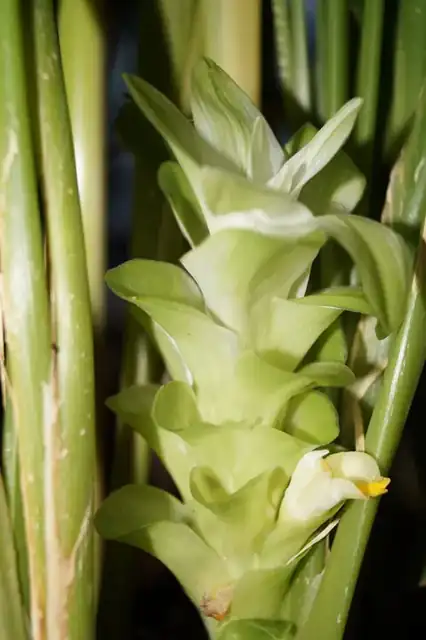
The hermaphrodite flowers are zygomorphic and threefold. The three sepals are 0.8 to 1.2 cm long, fused, and white, and have fluffy hairs; the three calyx teeth are unequal. The three bright-yellow petals are fused into a corolla tube up to 3 cm long. The three corolla lobes have a length of 1.0 to(-) and are triangular with soft-spiny upper ends. While the average corolla lobe is larger than the two lateral, only the median stamen of the inner circle is fertile. The dust bag is spurred at its base. All other stamens are converted to staminodes. The outer staminodes are shorter than the labellum. The labellum is yellowish, with a yellow ribbon in its center and it is obovate, with a length from 1.2 to 2.0 cm. Three carpels are under a constant, trilobed ovary adherent, which is sparsely hairy.
The fruit capsule opens with three compartments.
Phytochemistry
Turmeric powder is about 67% carbohydrates, 12% water, 9% protein, 3% fat, 3–7% dietary minerals, 3–7% essential oils, 22% dietary fiber, and 1–6% curcuminoids. The golden yellow color of turmeric is due to curcumin.
Phytochemical components of turmeric include diarylheptanoids, a class including numerous curcuminoids, such as curcumin, demethoxycurcumin, and bisdemethoxycurcumin. Curcumin constitutes an average of 3.14% by weight of assayed commercial samples of turmeric powder; curry powder contains much less (an average of 0.29%). Some 34 essential oils are present in turmeric, among which turmerone, germacrone, atlantone, and zingiberene are major constituents.
Culinary
Turmeric is one of the key ingredients in many Asian dishes, imparting a mustard-like, earthy aroma and pungent, slightly bitter flavor to foods. It is used mostly in savory dishes, but also is used in some sweet dishes, such as the Lebanese cake sfouf. In India, turmeric leaf is used to prepare special sweet dishes, patoleo, by layering rice flour and coconut-jaggery mixture on the leaf, then closing and steaming it in a special utensil (chondrõ).
Most turmeric is used in the form of rhizome powder to impart a golden yellow color. It is used in many products such as canned beverages, baked products, dairy products, ice cream, yogurt, yellow cakes, orange juice, biscuits, popcorn, cereals and sauces. It is a principal ingredient in curry powders. Although typically used in its dried, powdered form, turmeric also is used fresh, like ginger.
Turmeric is used widely as a spice in South Asian and Middle Eastern cooking. Various Iranian khoresh recipes begin with onions caramelized in oil and turmeric. The Moroccan spice mix ras el hanout typically includes turmeric. In South Africa, turmeric is used to give boiled white rice a golden color, known as geelrys (yellow rice) traditionally served with bobotie. In Vietnamese cuisine, turmeric powder is used to color and enhance the flavors of certain dishes, such as bánh xèo, bánh khọt, and mì Quảng. The staple Cambodian curry paste, kroeung, used in many dishes, including fish amok, typically contains fresh turmeric. In Indonesia, turmeric leaves are used for Minang or Padang curry base of Sumatra, such as rendang, sate padang, and many other varieties.
Traditional uses
In 2019, the European Medicines Agency concluded that although there was insufficient scientific evidence of efficacy, turmeric herbal teas, or other forms taken by mouth, could be used to relieve mild digestive problems, such as feelings of fullness and flatulence, on the basis of their long-standing traditional use.
Turmeric grows wild in the forests of South and Southeast Asia, where it is collected for use in classical Indian medicine (Siddha or Ayurveda). In Eastern India, the plant is used as one of the nine components of nabapatrika along with young plantain or banana plant, taro leaves, barley (jayanti), wood apple (bilva), pomegranate (darimba), Saraca indica, manaka (Arum), or manakochu, and rice paddy. The Haldi ceremony called gaye holud in Bengal (literally "yellow on the body") is a ceremony observed during wedding celebrations of people of Indian culture all throughout the Indian subcontinent.
Indicator
Turmeric paper, also called curcuma paper or in German literature curcumapapier, is paper steeped in a tincture of turmeric and allowed to dry. It is used in chemical analysis as a pH indicator. The paper is yellow in acidic and neutral solutions and turns brown to reddish-brown in alkaline solutions, with transition between pH of 7.4 and 9.2.
More to savor

Chicken Vindaloo

Koko da Kosai (Fermented Corn Porridge and Bean Fritters)
A Closer Look at Fenugreek: From Ingredient to Meal