This longer reference provides the background behind the topic. Read it alongside the recipe collection when you want to connect an ingredient or food idea with a dish to prepare.
In this story
OverviewDescriptionVarietiesProductionMaturationMechanicalCulinaryPreparation for spinningOverview
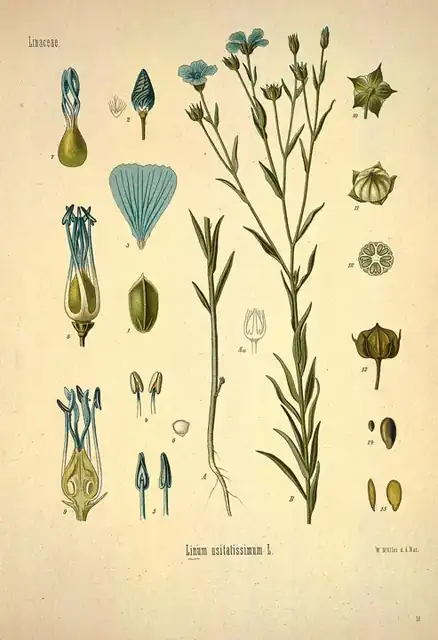
Flax, also known as common flax or line, is a flowering plant, Linum usitatissimum, in the family Linaceae. It is cultivated as a food and fiber crop in regions of the world with temperate climates.
Textiles made from flax are known in English as linen and are traditionally used for bed sheets, underclothes, and table linen. Its seeds are known as flaxseed or linseed and its oil is known as linseed oil. In addition to referring to the plant, the word "flax" may refer to the unspun fibers of the flax plant.
The plant species is known only as a cultivated plant and appears to have been domesticated just once from the wild species Linum bienne, called pale flax. The plants called "flax" in New Zealand are, by contrast, members of the genus Phormium.
Description
Several other species in the genus Linum are similar in appearance to L. usitatissimum, cultivated flax, including some that have similar blue flowers, and others with white, yellow, or red flowers. Some of these are perennial plants, unlike L. usitatissimum, which is an annual plant.
Cultivated flax plants grow to 1.2 m tall, with slender stems. The leaves are glaucous green, slender lanceolate, 2–4 cm long, and 3 mm broad.
The flowers are 15–25 mm in diameter with five petals, which can be coloured white, blue, yellow, and red depending on the species. The fruit is a round, dry capsule 5–9 mm in diameter, containing several glossy brown seeds shaped like apple pips, 4–7 mm long.
Varieties
According to Plants of the World Online the flax species has two botanical varieties, Linum usitatissimum var. usitatissimum and Linum usitatissimum var. stenophyllum.
Production
In 2022, world production of raw or retted flax was 875,995 tonnes, led by France with 75% of the total. One of the largest regions in France for flax production is Normandy with nearly one-third of the world's production.
Maturation
Flax is harvested for fiber production after about 100 days, or a month after the plants flower, and two weeks after the seed capsules form. The bases of the plants begin to turn yellow. If the plants are still green, the seed will not be useful, and the fiber will be underdeveloped. The fiber degrades once the plants turn brown.
Flax grown for seed is allowed to mature until the seed capsules are yellow and just starting to split; it is then harvested in various ways. A combine harvester may either cut only the heads of the plants, or the whole plant. These are then dried to extract the seed. The amount of weeds in the straw affects its marketability, and this, coupled with market prices, determines whether the farmer chooses to harvest the flax straw. If the flax straw is not harvested, typically, it is burned, since the stalks are quite tough and decompose slowly (i.e., not in a single season). Formed into windrows from the harvesting process, the straw often clogs up tillage and planting equipment.
Flax straw of insufficient quality for fiber use can be baled to build shelters for farm animals, sold as biofuel, or removed from the field in the spring.
Two ways are used to harvest flax fiber, one involving mechanized equipment (combines), and the second method, is more manual and targets maximum fiber length.
Mechanical
Flax for fiber production is usually harvested by a specialized flax harvester. Usually built on the same machine base as a combine, but instead of the cutting head, it has a flax puller. The flax plant is turned over and is gripped by rubber belts roughly 20–25 cm (8–10 inches) above ground, to avoid getting grasses and weeds in the flax. The rubber belts then pull the whole plant out of the ground with the roots so the whole length of the plant fiber can be used. The plants then pass over the machine and are placed on the field crosswise to the harvester's direction of travel. The plants are left in the field for field retting. The mature plant can also be cut with mowing equipment, similar to hay harvesting, and raked into windrows.
When dried sufficiently, a combine then harvests the seeds similar to wheat or oat harvesting.
Culinary
Whole flax seeds are chemically stable, but ground flax seed meal, because of oxidation, may go rancid when left exposed to air at room temperature in as little as a week. Refrigeration and storage in sealed containers will keep ground flax seed meal for a longer period before it turns rancid. Under conditions similar to those found in commercial bakeries, trained sensory panelists could not detect differences between bread made with freshly ground flax seed and bread made with flax seed that had been milled four months earlier and stored at room temperature. If packed immediately without exposure to air and light, milled flax seed is stable against excessive oxidation when stored for nine months at room temperature, and under warehouse conditions, for 20 months at ambient temperatures.
Three phenolic glucosides—secoisolariciresinol diglucoside, p-coumaric acid glucoside, and ferulic acid glucoside—are present in commercial bread containing flax seed.
Preparation for spinning
Before the flax fibers can be spun into linen, they must be separated from the rest of the stalk. The first step in this process is retting, which is the process of rotting away the inner stalk, leaving the outer parts intact. At this point, straw, or coarse outer stem (cortex and epidermis), is still remaining. To remove this, the flax is "broken", the straw is broken up into small, short bits, while the actual fiber is left unharmed. Scutching scrapes the outer straw from the fiber. The stems are then pulled through "hackles", which act like combs to remove the straw and some shorter fibers out of the long fiber.
More to savor

Chicken Vindaloo
Stir Fried Seafood with Noodles
Truffle in the Kitchen: Exploring an Everyday Ingredient