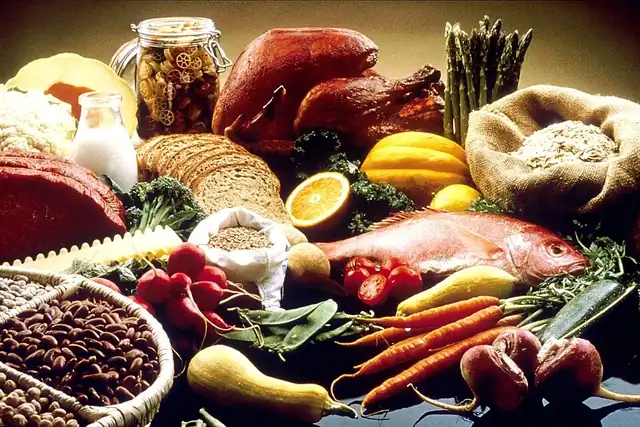
This longer reference provides the background behind the topic. Read it alongside the recipe collection when you want to connect an ingredient or food idea with a dish to prepare.
In this story
OverviewDefinition and classificationFood sourcesPhotosynthesisMicroorganismsTasteFood safetyOverview
Food is any substance that is consumed by an organism for nutritional support. Food usually consists of plant, animal, or fungal origin and contains essential nutrients such as carbohydrates, fats, proteins, vitamins, or minerals. The substance is ingested by an organism and assimilated by the organism's cells to provide energy, maintain life, encourage physical requirements, and support growth. Different species of animals have different feeding behaviours that satisfy the needs of their metabolisms and have evolved to fill specific ecological niches within specific geographical contexts.
Omnivorous humans are highly adaptable and have adapted to obtaining food in many different ecosystems. Humans generally use cooking to prepare food for consumption. The majority of the food energy required is supplied by the industrial food industry, which produces food through intensive agriculture and distributes it through complex food processing and food distribution systems. This system of conventional agriculture relies heavily on fossil fuels, which means food and agricultural systems are one of the major contributors to climate change, accounting for as much as 37% of total greenhouse gas emissions.
Definition and classification
Food is any substance consumed to provide nutritional support and energy to an organism. It can be raw, processed, or formulated and is consumed orally by animals for growth, health, or pleasure. Food is mainly composed of water, lipids, proteins, and carbohydrates. Other organic substances (e.g., vitamins) and minerals (e.g., salts) can also be found in food. Plants, algae, and some microorganisms use photosynthesis to make some of their own nutrients. Water is found in nearly all foods and has been defined as food by itself. Water has no food energy, and fibers have low energy densities, or food energy relative to volume, some providing none, while fat is the most energy-dense component. Some inorganic substances are also essential for plant and animal functioning.
Food sources
In a given ecosystem, food forms a web of interlocking chains with primary producers at the bottom and apex predators at the top. Other aspects of the web include detritivores (that eat detritis) and decomposers (that break down dead organisms). Primary producers include algae, plants, bacteria and protists that acquire their energy from sunlight. Primary consumers are the herbivores that consume the plants, and secondary consumers are the carnivores that consume those herbivores. Some organisms, including most mammals and birds, have diets consisting of both animals and plants, and are considered omnivores. The chain ends with the apex predators, the animals that have no known predators in its ecosystem. Humans are considered apex predators.
Humans are omnivores, finding sustenance in vegetables, fruits, cooked meat, milk, eggs, mushrooms and seaweed. Cereal grain is a staple food that provides more food energy worldwide than any other type of crop. Corn (maize), wheat, and rice account for 87% of all grain production worldwide. Just over half of the world's crops are used to feed humans (55 percent), with 36 percent grown as animal feed and 9 percent for biofuels. Fungi and bacteria are also used in the preparation of fermented foods like bread, wine, cheese and yogurt.
Photosynthesis
During photosynthesis, energy from the sun is absorbed and used to transform water and carbon dioxide in the air or soil into oxygen and glucose. The oxygen is then released, and the glucose stored as an energy reserve. Photosynthetic plants, algae and certain bacteria often represent the lowest point of the food chains, making photosynthesis the primary source of energy and food for nearly all life on earth.
Plants also absorb important nutrients and minerals from the air, natural waters, and soil. Carbon, oxygen and hydrogen are absorbed from the air or water and are the basic nutrients needed for plant survival. The three main nutrients absorbed from the soil for plant growth are nitrogen, phosphorus and potassium, with other important nutrients including calcium, sulfur, magnesium, iron boron, chlorine, manganese, zinc, copper molybdenum and nickel.
Microorganisms
Bacteria and other microorganisms also form the lower rungs of the food chain. They obtain their energy from photosynthesis or by breaking down dead organisms, waste or chemical compounds. Some form symbiotic relationships with other organisms to obtain their nutrients. Bacteria provide a source of food for protozoa, who in turn provide a source of food for other organisms such as small invertebrates. Other organisms that feed on bacteria include nematodes, fan worms, shellfish and a species of snail.
Taste
Animals, specifically humans, typically have five different types of taste sense: sweet, sour, salty, bitter, and umami. The differing tastes are important for distinguishing between foods that are nutritionally beneficial and those which may contain toxins. As animals have evolved, the tastes that provide the most energy are the most pleasant to eat while others are not enjoyable, although humans in particular can acquire a preference for some substances which are initially unenjoyable. Water, while important for survival, has no taste.
Sweetness is almost always caused by a type of simple sugar, such as glucose or fructose, or disaccharides, such as sucrose, a molecule combining glucose and fructose. Sourness is caused by acids, such as vinegar. Sour foods include citrus, especially lemons and limes. Sour is evolutionarily significant as it can signal a food that may have gone rancid due to bacteria. Saltiness is the taste of alkali metal ions such as sodium and potassium. It is found in almost every food in low to moderate proportions and enhances flavor. Bitter taste is a sensation considered unpleasant, caused by foods such as unsweetened dark chocolate, caffeine, lemon rind, and some types of fruit. Umami, commonly described as savory, is a marker of proteins and characteristic of broths and cooked meats.
Food safety
According to the World Health Organization (WHO), about 600 million people worldwide get sick, and 420,000 die each year, from eating contaminated food. Diarrhea is the most common illness caused by consuming contaminated food, with about 550 million cases and 230,000 deaths from diarrhea each year. Children under five years of age account for 40% of the burden of foodborne illness, with 125,000 deaths each year.
A 2003 World Health Organization (WHO) report concluded that about 30% of reported food poisoning outbreaks in the WHO European Region occur in private homes. According to the WHO and CDC, in the US alone, annually, there are 76 million cases of foodborne illness leading to 325,000 hospitalizations and 5,000 deaths.
More to savor
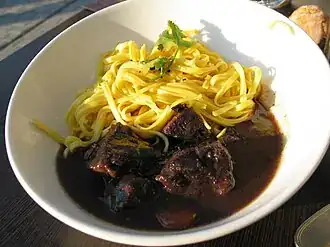
Boeuf Bourguignon

Salată de Boeuf (Romanian Beef Salad)

Food preservation: A Closer Look at Food and How We Eat