This longer reference provides the background behind the topic. Read it alongside the recipe collection when you want to connect an ingredient or food idea with a dish to prepare.
In this story
OverviewHorticultureProductionProduction in IndiaGinger farmingCulinarySimilar ingredientsOverview
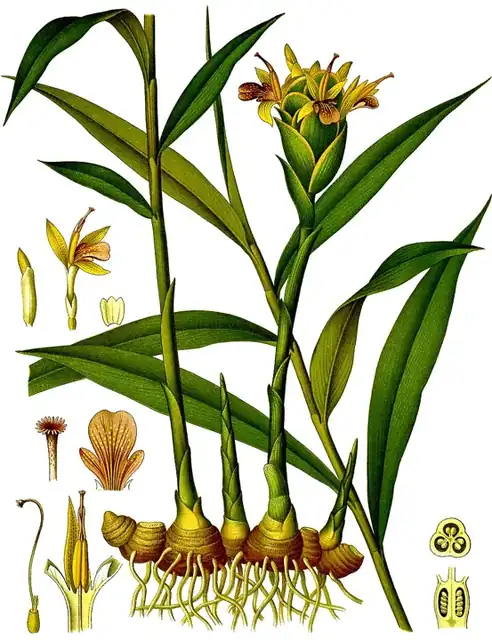
Ginger (Zingiber officinale) is a flowering plant whose rhizome, ginger root or ginger, is widely used as a spice and a folk medicine. It is an herbaceous perennial that grows annual pseudostems (false stems made of the rolled bases of leaves) about one meter tall, bearing narrow leaf blades. The inflorescences bear flowers having pale yellow petals with purple edges, and arise directly from the rhizome on separate shoots.
Ginger is in the family Zingiberaceae, which also includes turmeric (Curcuma longa), cardamom (Elettaria cardamomum), and galangal. Ginger originated in Maritime Southeast Asia and was likely domesticated first by the Austronesian peoples. It was transported with them throughout the Indo-Pacific during the Austronesian expansion (c. 5,000 BP), reaching as far as Hawaii. Ginger is one of the first spices to have been exported from Asia, arriving in Europe with the spice trade, and was used by ancient Greeks and Romans. The distantly related dicots in the genus Asarum are commonly called wild ginger because of their similar taste.
Ginger has been used in traditional medicine in China, India and Japan for centuries, and as a modern dietary supplement. Ginger may offer benefits over placebo for nausea and vomiting during pregnancy, but there is no good evidence that it helps with nausea during chemotherapy. It remains uncertain whether ginger is effective for treating any disease. In 2023, world production of ginger was 4.9 million tonnes, led by India with 45% of the total.
Horticulture
Ginger produces clusters of white and pink flower buds that bloom into yellow flowers. Because of its aesthetic appeal and the adaptation of the plant to warm climates, it is often used as landscaping around subtropical homes. It is a perennial reed-like plant with annual leafy stems, about a meter (3 to 4 feet) tall. Traditionally, the rhizome is gathered when the stalk withers; it is immediately scalded, or washed and scraped, to kill it and prevent sprouting. The fragrant perisperm of the Zingiberaceae is used as sweetmeats by Bantu, and also as a condiment and sialogogue.
Production
In 2023, world production of raw ginger was 4.9 million tonnes, led by India with 45% of the total, and Nigeria and China as secondary producers.
Production in India
Though it is grown in many areas across the globe, ginger is "among the earliest recorded spices to be cultivated and exported from southwest India". India holds the seventh position in ginger export worldwide, however is the "largest producer of ginger in the world". Regions in southwest and Northeast India are most suitable for ginger production due to their warm and humid climate, average rainfall and land space.
Ginger has the ability to grow in a wide variety of land types and areas, however is best produced when grown in a warm, humid environment, at an elevation between 300 and 900 m, and in well-drained soils at least 30 cm deep. A period of low rainfall prior to growing and well-distributed rainfall during growing are also essential for the ginger to thrive well in the soil.
Ginger produced in India is most often farmed through homestead farming, with work adaptively shared by available family and community members.
Ginger farming
The size of the ginger rhizome is essential to the production of ginger. The larger the rhizome piece, the faster ginger will be produced and therefore the faster it will be sold onto the market. Prior to planting the seed rhizomes, farmers are required to treat the seeds to prevent pests, and rhizome rot and other seed-borne diseases. Various ways Indian farmers do seed treatment include dipping the seeds in cow dung emulsion, smoking the seeds before storage, and hot water treatment.
Once the seeds are properly treated, the farmland in which they are to be planted must be thoroughly dug or ploughed by the farmer to break up the soil. After the soil is sufficiently ploughed (at least 3–5 times), water channels are made 60–80 ft apart to irrigate the crop.
The next step is planting the rhizome seed. In India, planting the irrigated ginger crop is usually done in the months between March and June as those months account for the beginning of the monsoon, or rainy season. Once the planting stage is done, farmers go on to mulch the crop to conserve moisture and check weed growth, as well as check surface run-off to conserve soil. Mulching is done by applying mulch (green leaves for example) to the plant beds directly after planting and again 45 and 90 days into growth. After mulching comes hilling, which is the stirring and breaking up of soil to check weed growth, break the firmness of the soil from rain, and conserve soil moisture.
Farmers must ensure that their ginger crops are receiving supplemental irrigation if rainfall is low in their region. In India, farmers must irrigate their ginger crops every two weeks at the least between September and November (when the monsoon is over) to ensure maximum yield and high quality product.
Culinary
Ginger is a common spice used worldwide, whether for meals or as a folk medicine. Ginger can be used for a variety of food items such as vegetables, candy, soda, pickles, and alcoholic beverages.
Ginger is a fragrant kitchen spice. Young ginger rhizomes are juicy and fleshy with a mild taste. They are often pickled in vinegar or sherry as a snack or cooked as an ingredient in many dishes. They can be steeped in boiling water to make ginger herb tea, to which honey may be added. Ginger can be made into candy or ginger wine.
Similar ingredients
Other members of the family Zingiberaceae are used in similar ways. They include the myoga (Zingiber mioga), the several types of galangal, the fingerroot (Boesenbergia rotunda), and the bitter ginger (Zingiber zerumbet).
A dicotyledonous native species of eastern North America, Asarum canadense, is also known as "wild ginger", and its root has similar aromatic properties, but it is not related to true ginger. The plant contains aristolochic acid, a carcinogenic compound. The United States Food and Drug Administration warns that consumption of aristolochic acid-containing products is associated with "permanent kidney damage, sometimes resulting in kidney failure that has required kidney dialysis or kidney transplantation. In addition, some patients have developed certain types of cancers, most often occurring in the urinary tract."
More to savor
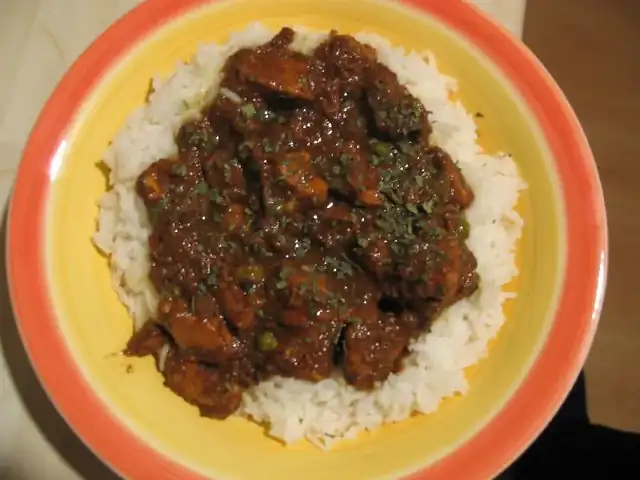
Chicken Vindaloo
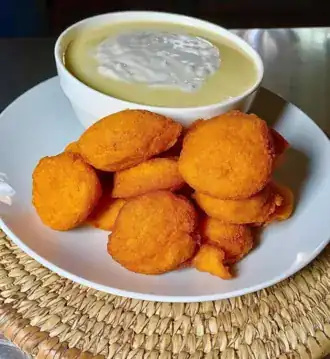
Koko da Kosai (Fermented Corn Porridge and Bean Fritters)
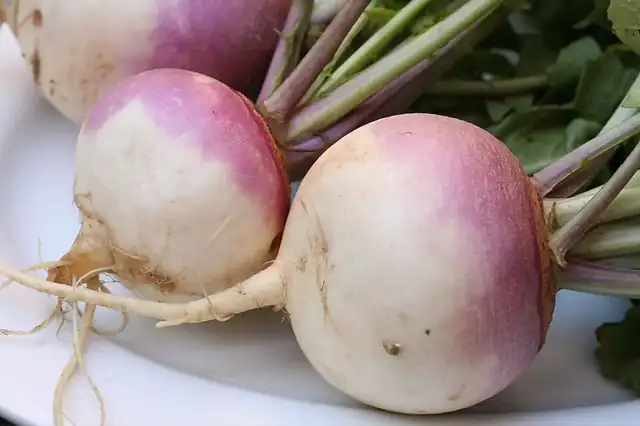
Beyond the Shopping List: The Story of Turnip