The dish is a starting point for exploring a wider food story. The guide below looks more closely at its background and different forms. When you want to cook, visit the recipe collection for ingredient quantities and step-by-step methods.
In this story
OverviewGulyásHungarian varietiesPaprikás krumpliOutside HungaryAustriaBosnia and HerzegovinaOverview
Goulash (Gulyás) is a meal made of meat and vegetables seasoned with paprika and other spices. Originating in Hungary, goulash is a common meal predominantly eaten in Central Europe but also in other parts of Europe. It is one of the national dishes of Hungary and a symbol of the country.
Its origins may be traced back as far as the 10th century to stews eaten by Hungarian shepherds. At that time, the cooked and flavoured meat was sun-dried and packed into bags produced from sheep's stomachs, needing only water to make it into a meal. Earlier versions of goulash did not include paprika, as it was not introduced to Europe until the 16th century.
Gulyás
In Hungarian cuisine, traditional gulyás, pörkölt, and paprikás are dishes which evolved from the food of the cattle herders of the Hungarian plains.
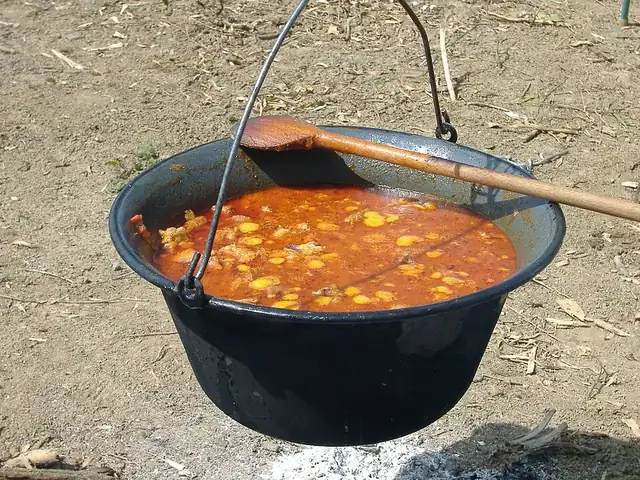
In present-day Hungary, gulyás is known as a soup. It is also called gulyásleves, which translates to gulyás soup, although gulyás is understood commonly as a soup without specifying. While it may have more solid parts than broth and some versions may be called by English speakers a stew, the Hungarian language makes a strict distinction between stews and gulyás. The dish called gulyás is quite conservative with very little variations through the country. The basic ingredients include beef, onions, paprika, caraway seeds, potatoes, carrots and fresh noodles added directly to the soup (csipetke). Altered versions have their own name, like babgulyás which has beans or hamisgulyás ("fake goulash") which is meatless. Bográcsgulyás means a gulyás prepared traditionally in a kettle or cauldron, called bogrács, outdoors, over open fire.
It can be prepared anywhere because it needs only the bogrács, an iron tripod, a chain and a campfire. Every type of gulyás is a strictly one-pot dish and considered a main course, even if it is a more soupy version.
Except for paprikás, Hungarian stews do not rely on flour or roux for thickening. Original Hungarian recipes rarely use tomatoes and only in small quantities, the deep red colors come all from the authentic Hungarian paprika spice.
Modern gulyás is made from beef, while the original herdsmen had more access to mutton (called birkagulyás). Typical cuts include the shank, shin, or shoulder; in Hungary beef from older cattle is more common, which takes longer to cook but is perceived by some diners as more tasty. Meat is cut into chunks, seasoned with salt, and then browned with sliced onion in a pot with oil or lard. Paprika is added, along with water. After that the gulyás is left to simmer. After cooking a while, whole or ground caraway seed, and soup vegetables like potato, carrot, or parsley root are added. However, paprika and potatoes are post-16th century additions, while gulyás traces its origin back to the Hungarians' nomadic past. At the end small egg noodles called csipetke can be added.
The name csipetke comes from pinching small, fingernail-sized bits out of fresh dough (csipet being Hungarian for 'pinch') before adding them to the boiling soup. Stew-like versions of gulyás are made the same way with letting the broth simmer down.
Restaurants use altered recipes, where the extreme long cooking time is replaced with broth, and the csipetke noodles are substituted by nokedli.
International goulash is a dish closer to the Hungarian dish pörkölt, a stew which evolved from the original gulyás, or paprikás, the version of pörkölt with sour cream. After the former herdsmen's dish became popular throughout the whole of Hungarian society, variations arose which did not strictly adhere to the techniques used for outdoor cooking. Nokedli or galuska, a Hungarian version of the traditional German noodle Spaetzle, became a side dish for stews. Nokedli is made by grating liquid dough into boiling water. While gulyás is always made of beef or mutton, pörkölt and paprikás can have a wider variety of meats like chicken or pork. The type of the meat is marked in the name of the dishes, usually: marhapörkölt (beef), sertéspörkölt (pork), csirkepörkölt (chicken) or kakaspörkölt (rooster). These don't include fish with the notable exception of harcsapaprikás (catfish paprikás).
Hungarian varieties
Hungarian goulash variations include:
Bográcsgulyás. Gulyásleves prepared in a kettle or cauldron, called bogrács.
Székely Gulyás. Omit the potatoes and add sauerkraut and sour cream.
Gulyás Hungarian Plain Style. Omit the homemade soup pasta (csipetke) and add vegetables
Mock Gulyás. Substitute beef bones for the meat and add vegetables. Also called Hamisgulyás (fake goulash)
Bean Gulyás. Omit the potatoes and the caraway seeds. Use kidney beans instead.
Csángó Gulyás. Add sauerkraut instead of pasta and potatoes.
Betyár Gulyás. Use smoked beef or smoked pork for meat.
Likócsi Pork Gulyás. Use pork and thin vermicelli in the goulash instead of potato and soup pasta. Flavour with lemon juice.
Mutton Gulyás or Birkagulyás. Made with mutton. Add red wine for flavour.
A thicker and richer goulash, similar to a stew, originally made with three kinds of meat, is called Székely gulyás, named after the Hungarian writer, journalist and archivist József Székely (1825–1895).
Paprikás krumpli
"Paprikás krumpli" is a traditional paprika-based potato stew with diced potatoes, onion, ground paprika, and some bacon or sliced spicy sausage, like the smoked Debrecener, in lieu of beef.
In German-speaking countries, this inexpensive peasant stew is made with sausage and known as Kartoffelgulasch ("potato goulash"). Bell pepper is sometimes added.
Outside Hungary
Thick stews similar to pörkölt and the original cattlemen stew are popular throughout almost all the former Austrian-Hungarian Empire, from Northeast Italy to the Carpathians. Like pörkölt, these stews are generally served with boiled or mashed potato, polenta, dumplings (e.g. nokedli, or galuska), spätzle or, alternatively, as a stand-alone dish with bread. Romani people have their own version of goulash.
Austria
In Vienna, the former center of the Austro-Hungarian Empire, a special kind of goulash has developed. The Wiener Saftgulasch or the Fiakergulasch (Fiacre being a horse-drawn cab) on the menu in traditional restaurants is a rich pörkölt-like stew; more onions but no tomatoes or other vegetables are used, and it usually comes just with dark bread. A variation of the Wiener Saftgulasch is the Fiakergulasch, which is served with fried egg, fried sausage, pickles, and dumplings named Semmelknödel.
Bosnia and Herzegovina
In Bosnia and Herzegovina, goulash (gulaš) is a very popular and traditional dish. Introduced during the Austro-Hungarian Empire, it has become a staple with the Bosnian variant consisting of a thicker consistency, with emphasis on slow-cooked onions and meat. It is typically served with bread, mashed potatoes, or polenta, and regional variations may include veal, carrots, or beans.
More to savor
Tattie Scones

Austrian Napkin Dumpling (Serviettenknödel)
Cassoulet: A Slow-Cooked Story from Southern France