The dish is a starting point for exploring a wider food story. The guide below looks more closely at its background and different forms. When you want to cook, visit the recipe collection for ingredient quantities and step-by-step methods.
Overview
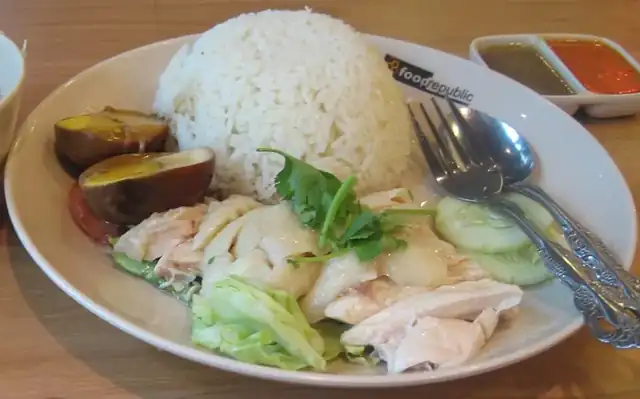
Hainanese chicken rice is a dish of poached or roasted chicken with seasoned rice, served with chilli sauce and usually with cucumbers, tomato slices or cilantro garnishes. It was created by immigrants from Hainan in southern China and adapted from the Hainanese dishes of Wenchang chicken and Wenchang chicken rice.
The dish can be found throughout Southeast Asia where Hainanese people settled, particularly in Indonesia, Malaysia, Thailand, and Vietnam, where it remains a culinary staple. It is widely considered one of the national dishes of Singapore, and is commonly associated with Singaporean cuisine, being widely available in most food courts and hawker centres around the country.
Reception
Catherine Ling of CNN called Hainanese chicken rice one of the "40 Singapore foods we can't live without". It was listed as one of the "World's 50 best foods" by CNN in 2018. David Farley of the BBC called it "the dish worth the 15-hour flight" and said it was "deceptively simple – which is good, because on paper it sounds awfully boring." Saveur called it "one of the most beloved culinary exports of Southeast Asia."
Malaysia
In Malaysia, nasi ayam ( "chicken rice" in Bahasa Melayu) is "a culinary staple" and a popular street food, particularly in Ipoh, a center of Hainanese immigration.
The general term nasi ayam can refer to multiple variations including roasted and fried chicken, can be served with a variety of sauces including barbecue, and can be accompanied by a variety of side dishes including steamed rice rather than seasoned 'oily' rice, soup, or chicken offal.
In Malacca and Muar, the rice is served in balls rather than in bowls; this dish is commonly known as Chicken rice balls. Steamed rice is shaped into golf ball-sized orbs and served alongside the chopped chicken.
Singapore
In Singapore, the dish was born out of frugality, created by servant-class immigrants trying to utilise limited sources to its maximum. An old hen which had passed its egg-laying years would be slaughtered to be cooked into broth and rice to extract the chicken flavour.
The first chicken rice restaurants opened in Singapore during Japanese occupation in World War II, when the British were forced out and their Hainanese servants lost their source of income. One of the first was Yet Con, which opened in the early 1940s. There were also sources stating that Wang Yiyuan, a street hawker, first started selling "chicken rice balls wrapped in banana leaves" in Singapore during the 1920s. The dish was popularised in Singapore in the 1950s by Moh Lee Twee, whose Swee Kee Chicken Rice Restaurant operated from 1947 to 1997. Hong Kong food critic Chua Lam credits Moh with the creation of the dish.
Hainanese chicken rice is considered one of Singapore's national dishes. It is eaten "everywhere, every day" in Singapore and is a "ubiquitous sight in hawker centres across the country". The chicken is typically served with seasoned rice, with chilli sauce and usually with cucumber garnishes. While most commonly associated with Singaporean cuisine, the dish is also seen throughout Southeast Asia and in parts of the United States, where the dish is named "Singapore chicken rice" in some places. The dish is widely popular in Singapore and can be found in hawker centres, restaurants and hotels.
The chicken is prepared in accordance with traditional Hainanese methods, which involve poaching the entire chicken at sub-boiling temperatures to both cook the chicken and produce the stock. The chicken is dipped in ice after cooking to produce a jelly-like skin finishing and hung to dry.
The stock is skimmed of fat and some of the fat and liquid, along with ginger, garlic, and pandan leaves, are used in the cooking of the rice, producing an oily, flavourful rice sometimes known as "oily rice". In Singapore "the most important part of chicken rice is not the chicken, but the rice."
The dish is served with a dipping sauce of freshly minced red chilli and garlic, usually accompanied with dark soy sauce and freshly ground ginger. Fresh cucumber boiled in the chicken broth and light soy sauce with a dash of sesame oil is served with the chicken, which is usually served at room temperature. Some stalls may also serve Nonya acar as an additional side.
Thailand
Hainanese chicken rice is a common dish in Thailand where it is called khao man kai (ข้าวมันไก่), literally meaning "chicken oily rice". The chickens used in Thailand for this dish are usually free range chickens of local breeds, resulting in a leaner and tastier texture; however, meat from chickens of large-scale poultry farms is increasingly being used. Khao man kai is served with a garnish of cucumbers and occasionally chicken blood tofu and fresh coriander, along with a bowl of nam sup, a clear chicken broth which often contains sliced daikon. The accompanying sauce is most often made with tauchu (also known as yellow soybean paste), thick soy sauce, chilli, ginger, garlic and vinegar.
One famous Bangkok neighbourhood for Khao man kai is Pratunam in Ratchathewi district, located near to Platinum Fashion Mall, CentralWorld and Ratchaprasong Intersection. A restaurant in Pratunam received Bib Gourmand awards from the 2018 Michelin Guide. Khao man kai is also well known in other areas, including Pracha Chuen, Yaowarat and Phasi Charoen near Bang Wa BTS station and Phyathai 3 Hospital including various places are Thanon Tok near Rama III Bridge, Thong Lor on Sukhumvit Road, Wat Suthiwararam, Sathu Pradit, Bang Kapi, Wat Saket, and Saphan Kwai neighbourhoods.
Vietnam
The dish is known as Cơm Gà Hải Nam in Vietnamese, and is common in South Vietnam.
Cambodia
In Cambodia, the dish is known as bay moan (បាយមាន់) in Khmer, which translates to "chicken rice". An assortment of pickled vegetables is served alongside as a street food. Its origins can be traced back to the 17th century, where it is believed to have been introduced by Hokkien and Hainanese immigrants.
More to savor

Chicken Vindaloo
Cholley (Chickpea Curry)

Hot Dogs: A Sausage, a Bun, and a Food Story