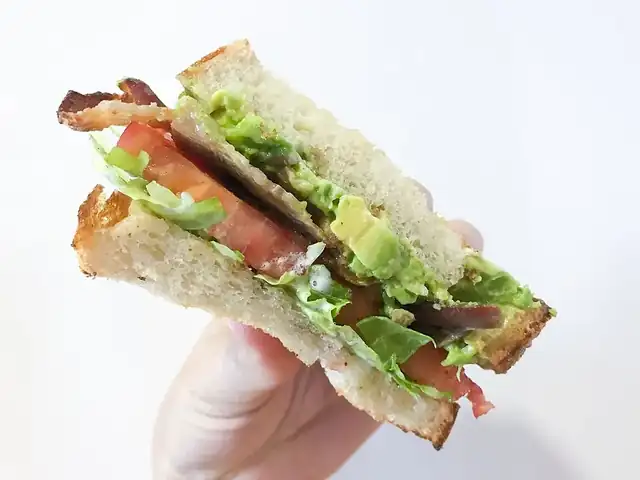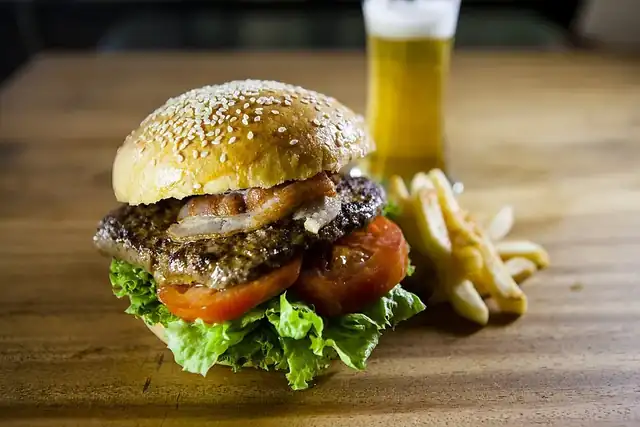
The dish is a starting point for exploring a wider food story. The guide below looks more closely at its background and different forms. When you want to cook, visit the recipe collection for ingredient quantities and step-by-step methods.
In this story
OverviewClaims of inventionLouis LassenCharlie NagreenOther hamburger-steak claimsOther meatsFast foodOverview
A hamburger, often known as a burger, consists of fillings—usually a patty of panfried or grilled ground meat, typically beef—placed inside a sliced bun, sesame seed bun, or bread roll. These patties are often served with lettuce, tomato, onion, pickles, bacon, or chilis, together in the bun or roll. The filling of the burger can be topped with condiments such as ketchup, mustard, mayonnaise, relish, or a "special sauce", often a variation of Thousand Island dressing. A burger with the patty topped with cheese is called a cheeseburger. Under some definitions, a hamburger is considered a sandwich.
Hamburgers are commonly prepared at home and typically associated with fast-food restaurants but are also sold at other restaurants, including high-end establishments. There are many international and regional variations of hamburgers. Some of the largest multinational fast-food chains feature burgers as one of their core products: McDonald's Big Mac and Burger King's Whopper have become global icons of American culture. Hamburgers are staples of fast food and are most commonly served with a side of French fries.
Claims of invention
"Hamburger steak sandwiches" have been advertised in U.S. newspapers from New York to Hawaii since at least the 1890s, but the inventor is unclear.
The invention of hamburgers is attributed to various people, including Charlie Nagreen, Frank and Charles Menches, Oscar Weber Bilby, Fletcher Davis, and Louis Lassen. White Castle traces the origin of the hamburger to Otto Krause in Hamburg, Germany. Some have pointed to a recipe for "Hamburgh sausages" on toasted bread, published in The Art of Cookery Made Plain and Easy by Hannah Glasse in 1758, as a notable first source of the dish.
Hamburgers gained national recognition in the U.S. at the 1904 St. Louis World's Fair when the New York Tribune referred to the hamburger as "the innovation of a food vendor on the pike." No conclusive argument has ended the dispute over invention. An article from ABC News sums up: "One problem is that there is little written history. Another issue is that the burger spread happened largely at the World's Fair, from tiny vendors that came and went instantly. And it is entirely possible that more than one person came up with the idea at the same time in different parts of the country."
Louis Lassen
The restaurant Louis' Lunch in New Haven, Connecticut, founded in 1895, has long claimed to be the "birthplace of the hamburger sandwich". Ostensibly, around 1900, Danish immigrant Louis Lassen found himself out of steaks when a customer ordered a quick hot meal. Taking ground beef trimmings, Louis made a patty and grilled it, putting it between two slices of toast. (Some critics, such as New York Magazine food editor Joshua Ozersky, claim that this sandwich was not a hamburger because the bread was toasted.) New York Magazine wrote in 1977 that, supposedly, "The dish actually had no name until some rowdy sailors from Hamburg named the meat on a bun after themselves years later".
This origin story has been amplified by Connecticut Congresswoman Rosa DeLauro and the Library of Congress—notwithstanding earlier references to hamburgers elsewhere in the country.
Charlie Nagreen
One of the earliest claims of hamburger invention comes from Charlie Nagreen, who in 1885 sold a meatball between two slices of bread at the Seymour Fair now sometimes called the Outagamie County Fair. The Seymour Community Historical Society of Seymour, Wisconsin, credits Nagreen, also referred to as "Hamburger Charlie", with the invention. Nagreen was 15 when he reportedly sold pork sandwiches at the 1885 Seymour Fair so customers could eat while walking. The Historical Society explains that Nagreen named the hamburger after the Hamburg steak with which local German immigrants were familiar.
Other hamburger-steak claims
Various claims of the invention relate to the term "hamburger steak" without mention of its being a sandwich. The alleged first printed American menu listing hamburgers is an 1834 menu from Delmonico's in New York. However, the printer of the original menu was not yet in business in 1834. In 1889, a menu from Walla Walla Union in Washington offered hamburger steak as a menu item.
Between 1871 and 1884, "Hamburg Beefsteak" was on the "Breakfast and Supper Menu" of the Clipper Restaurant at 311/313 Pacific Street in San Fernando, California. It cost 10 cents—the same price as mutton chops, pig's feet in batter, and stewed veal. It was not, however, on the dinner menu. Only "Pig's Head", "Calf Tongue", and "Stewed Kidneys" were listed. Another claim ties the hamburger to Summit County, in New York or Ohio. Summit County, Ohio, exists, but Summit County, New York, does not.
Other meats
Burgers can also be made with meat other than beef. Examples include:
Turkey burger
Chicken burger:
Ground chicken meat
Chicken breast (marinated or not)
Fried chicken
Buffalo burger
Venison burger
Lamb burger
Veal burger
Fish burger
Fast food
Hamburgers are often a feature of fast food restaurants. In the United States, the hamburger patties served by major fast food chains are usually mass-produced in factories and then frozen for delivery to the site. These hamburgers are relatively thin, differing from the traditional American hamburger prepared in homes and conventional restaurants, which is thicker and prepared by hand from ground beef. Most American hamburgers are round, but some fast-food chains, such as Wendy's, Krystal, and White Castle sell square-cut hamburgers. Hamburgers in fast food restaurants are usually grilled on a flat top, but some establishments, such as Burger King, use a gas flame grilling process. At conventional American restaurants, hamburgers may be ordered "rare" but normally are served medium-well or well-done for food safety reasons. Fast food restaurants do not usually offer this option.
The McDonald's fast-food chain sells the Big Mac, one of the world's top-selling hamburgers, with an estimated 550 million sold annually in the United States. Many other major fast-food chains, also rely heavily on hamburger sales, including Burger King (known as Hungry Jack's in Australia), A&W, Culver's, Whataburger, Carl's Jr./Hardee's chain, Wendy's, Jack in the Box, Krystal, White Castle, Cook Out, Harvey's, Hesburger, Supermac's, Shake Shack, In-N-Out Burger, Five Guys, Fatburger, Vera's, Burgerville, Back Yard Burgers, Lick's Homeburger, Roy Rogers, Smashburger, and Sonic. Fuddruckers and Red Robin are hamburger chains that specialize in the mid-tier "restaurant-style" variety of hamburgers.
More to savor

French Onion Soup

Ugali (Rwandan Cornmeal Porridge)
Hot Dogs: A Sausage, a Bun, and a Food Story