This longer reference provides the background behind the topic. Read it alongside the recipe collection when you want to connect an ingredient or food idea with a dish to prepare.
Overview
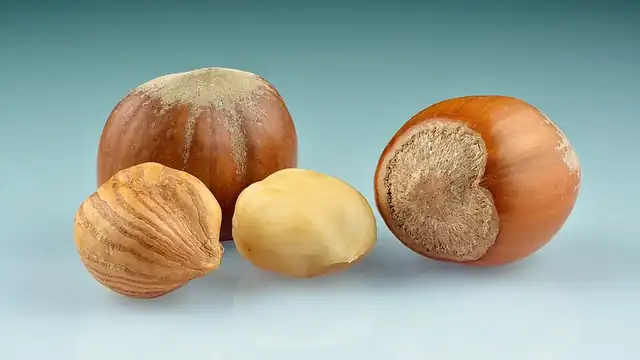
The hazelnut is the fruit of the hazel tree and therefore includes any of the nuts deriving from species of the genus Corylus, especially the nuts of the species Corylus avellana. They are also known as cobnuts or filberts according to species.
Hazelnuts are used as a snack food, in baking and desserts, and in breakfast cereals such as muesli. In confectionery, they are used to make praline, and also used in combination with chocolate for chocolate truffles and products such as chocolate bars and hazelnut cocoa spreads such as Nutella. They are also used in Frangelico liqueur. Hazelnut oil, pressed from hazelnuts, is strongly flavored and high in monounsaturated fat. It is used as a cooking oil and as a salad or vegetable dressing.
In 2023, Turkey was the world's largest producer of hazelnuts, accounting for 57.7% of total production.
Description
A hazelnut cob is roughly spherical to oval, about 15–25 mm long and 10–15 mm in diameter, with an outer fibrous husk surrounding a smooth shell, while a filbert is more elongated, being about twice as long as its diameter. The nut falls out of the husk when ripe, about seven to eight months after pollination. The seed is edible and consumed raw, roasted, or ground into a paste. The seed has a thin, dark brown skin, which is sometimes removed before cooking.
Nuts make up between 33.2% to 49.5% of the fruit, depending on the cultivar grown. Cultivars close to the Mediterranean Sea have the largest nut to fruit ratio.
Cultivars
The many cultivars of the hazel include 'Atababa', 'Barcelona', 'Butler', 'Casina', 'Clark', 'Cosford', 'Daviana', 'Delle Langhe', 'England', 'Ennis', 'Halls Giant', 'Jemtegaard', 'Kent Cob', 'Lewis', 'Tokolyi', 'Tonda Gentile', 'Tonda di Giffoni', 'Tonda Romana', 'Wanliss Pride', and 'Willamette'. Some of these are grown for specific qualities of the nut, including large nut size or early or late fruiting, whereas others are grown as pollinators. The majority of commercial hazelnuts are propagated from root sprouts. Some cultivars are of hybrid origin between common hazel and filbert.
In Ireland and the United Kingdom, hazelnuts are sometimes referred to as cobnuts, for which a specific cultivated variety – Kentish cobnuts – is the main variety cultivated in fields known as plats, hand-picked, and eaten green. According to the BBC, a national collection of cobnut varieties exists at Roughway Farm, near Plaxtol in Kent. They are called cobnuts because cob was a word used to refer to the head or "noggin," and children had a game in which they would tie a string to a hazelnut and use it to try to hit an opponent on the head.
Cropping system
In Europe hazelnuts are traditionally grown as multi-trunk trees where the rootstock is formed by the variety itself. To enhance the possibility for mechanization and to prevent suckering, a single-trunk tree can be formed by grafting a scion of the desired variety on a Corylus colurna rootstock.
There are different approaches in orchard floor management. Strong infestations of certain weeds can lower the yield. Therefore, to prevent yield loss by competition, herbicides are used to create bare soil. Using cover crops protects the soil and suppresses weed establishment without a yield reduction.
Silvopastoral systems where animals like pigs are kept in the orchard or silvoarable systems where crops are grown between the rows could introduce new sources of revenue into the hazelnut production and may have beneficial effects on hazelnut yield by fertilizing the soil through nitrogen fixation or animal dung. These systems limit the plant protection measures, potentially impacting the yield quality and level. There are very few studies on these systems, leading to a higher uncertainty for the producer.
Harvesting
Hazelnuts are harvested annually in mid-autumn. As autumn comes to a close, the trees drop their nuts and leaves. Most commercial growers wait for the nuts to drop rather than using equipment to shake them from the tree. The harvesting of hazelnuts is performed either by hand or by manual or mechanical raking of fallen nuts.
Four primary pieces of equipment are used in commercial harvesting: the sweeper, the harvester, the nut cart, and the forklift. The sweeper moves the nuts into the center of the rows, the harvester lifts and separates the nuts from any debris (i.e., twigs and leaves), the nut cart holds the nuts picked up by the harvester, and the forklift brings a tote to offload the nuts from the nut cart and then stacks the totes to be shipped to the processor (nut dryer).
The sweeper is a low-to-the-ground machine that makes two passes in each tree row. It has a 2 m belt attached to the front that rotates to sweep leaves, nuts, and small twigs from left to right, depositing the material in the center of the row as it drives forward. On the rear of the sweeper is a powerful blower to blow material left into the adjacent row with air speeds up to 90 m/s. Careful grooming during the year and patient blowing at harvest may eliminate the need for hand raking around the tree trunk, where nuts may accumulate. The sweeper prepares a single center row of nuts, narrow enough for the harvesting tractor to drive over without driving on the center row.
Production
In 2023, world production of hazelnuts (in shells) was 1.13 million tonnes led by Turkey with 57.7% of the total, and Italy and the United States as other major producers (table).
Production in the United States is centered almost entirely within the Willamette Valley of Oregon.
Food
Hazelnuts are used in confections to make pralines, chocolate truffles, and hazelnut paste products including nougat. The combination of ground hazelnuts with chocolate developed around Turin, Italy, is called gianduja; with finer pulverization of the hazelnuts, this subsequently developed into gianduiotto and Nutella. In Austria, hazelnut paste is an ingredient for making tortes, such as Viennese hazelnut torte. In Kyiv cake, hazelnut flour is used to flavor its meringue body, and crushed hazelnuts are sprinkled over its sides. Dacquoise, a French dessert cake, often contains a layer of hazelnut meringue. Hazelnuts are used in Turkish cuisine and Georgian cuisine; the snack churchkhela and sauce satsivi are used, often with walnuts. Hazelnuts are also a common constituent of muesli. The nuts may be eaten fresh or dried, having different flavors.
More to savor

Chicken Vindaloo

Chicken Tikka Masala
Cranberry at the Table: The Food Behind the Name