This longer reference provides the background behind the topic. Read it alongside the recipe collection when you want to connect an ingredient or food idea with a dish to prepare.
In this story
OverviewDescriptionSimilar speciesSpeciesDistribution and habitatGeography and bog methodPropagationRipening and harvestProductionOverview
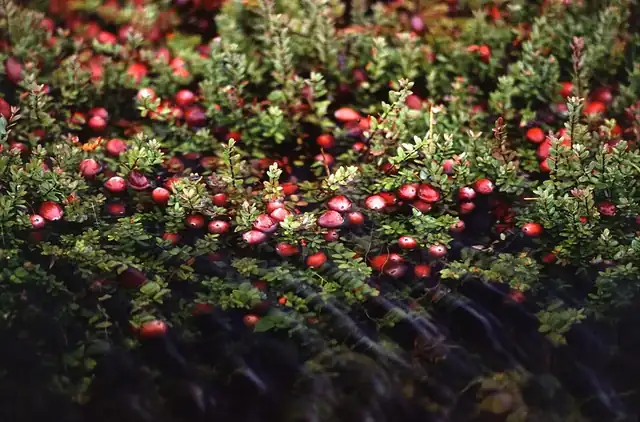
Cranberries are a group of evergreen dwarf shrubs or trailing vines in the subgenus Oxycoccus of the genus Vaccinium. Cranberries are low, creeping shrubs or vines up to 2 m long and 5 to 20 cm in height; they have slender stems that are not thickly woody and have small evergreen leaves. The flowers are dark pink. The fruit is a berry that is larger than the leaves of the plant; it is initially light green, turning red when ripe. The raw berry is edible and has a tart taste due to the low sugar content and high acidity.
In Britain, cranberry may refer to the native species Vaccinium oxycoccos, while in North America, it may refer to V. macrocarpon. The former is cultivated in central and northern Europe, while the latter is cultivated throughout the northern United States, Canada, and Chile. In 2020, the U.S., Canada, and Chile accounted for 97% of the world production of cranberries. Most cranberries are processed into products such as juice, sauce, jam, and sweetened dried cranberries, with the remainder sold fresh to consumers. Cranberry sauce is a traditional accompaniment to turkey at Christmas and Thanksgiving dinners in the U.S. and Canada, and at Christmas dinners in the United Kingdom.
Description
Cranberries are low, creeping shrubs or vines up to 2 m long and 5 to 20 cm in height; they have slender, wiry stems that are not thickly woody and have small evergreen leaves. The flowers are dark pink, with very distinct reflexed petals, leaving the style and stamens fully exposed and pointing forward. They are pollinated by bees. The fruit is a berry that is larger than the leaves of the plant; it is initially light green, turning red when ripe. It has an acidic taste which usually overwhelms its sweetness.
Similar species
Cranberries are related to bilberries, blueberries, and huckleberries, all in Vaccinium subgenus Vaccinium. These differ in having bell-shaped flowers, petals that are not reflexed, and woodier stems, forming taller shrubs.
Species
There are 4–5 species of cranberry, classified by subgenus:
Distribution and habitat
Cranberries can be found in acidic bogs throughout the cooler regions of the Northern Hemisphere.
Geography and bog method
Historically, cranberry beds were constructed in wetlands. Today's cranberry beds are constructed in upland areas with a shallow water table. The topsoil is scraped off to form dykes around the bed perimeter. Clean sand is hauled in and spread to a depth of 10 to 20 cm. The surface is laser leveled flat to provide even drainage. Beds are frequently drained with socked tile in addition to the perimeter ditch. In addition to making it possible to hold water, the dykes allow equipment to service the beds without driving on the vines. Irrigation equipment is installed in the bed to provide irrigation for vine growth and for spring and autumn frost protection.
A common misconception about cranberry production is that the beds remain flooded throughout the year. During the growing season cranberry beds are not flooded, but are irrigated regularly to maintain soil moisture. Beds are flooded in the autumn to facilitate harvest and again during the winter to protect against low temperatures. In cold climates like Wisconsin, New England, and eastern Canada, the winter flood typically freezes into ice, while in warmer climates the water remains liquid. When ice forms on the beds, trucks can be driven onto the ice to spread a thin layer of sand to control pests and rejuvenate the vines. Sanding is done every three to five years.
Propagation
Cranberry vines are propagated by moving vines from an established bed. The vines are spread on the surface of the sand of the new bed and pushed into the sand with a blunt disk. The vines are watered frequently during the first few weeks until roots form and new shoots grow. Beds are given frequent, light application of nitrogen fertilizer during the first year. The cost of renovating cranberry beds is estimated to be between 30000 and 50000 $/acre.
Ripening and harvest
Cranberries are harvested in the fall when the fruit takes on its distinctive deep red color, and most ideally after the first frost. This is usually in September through the first part of November. Berries that receive sun turn a deep red when fully ripe, while those that do not fully mature are a pale pink or white color. To harvest cranberries, the beds are flooded with 15 to 20 cm of water above the vines. A harvester is driven through the beds to remove the fruit from the vines. Since the 1960s, water reel type harvesters have been used. Harvested cranberries float in the water and can be corralled into a corner of the bed and conveyed or pumped from the bed.
From the farm, cranberries are taken to receiving stations where they are cleaned, sorted, and stored prior to packaging or processing. While cranberries are harvested when they take on their deep red color, they can also be harvested beforehand when they are still white, which is how white cranberry juice is made. Yields are lower on beds harvested early and the early flooding tends to damage vines, but not severely. Vines can also be trained through dry picking to help avoid damage in subsequent harvests.
Although most cranberries are wet-picked as described above, 5–10% of the US crop is still dry-picked. This entails higher labor costs and lower yield, but dry-picked berries are less bruised and can be sold as fresh fruit instead of having to be immediately frozen or processed. Originally performed with two-handed comb scoops, dry picking is today accomplished by motorized, walk-behind harvesters which must be small enough to traverse beds without damaging the vines.
Production
In 2024, world production of cranberry was 621,495 tonnes, with the United States (65%) and Canada (34%) together accounting for 99% of the total. Wisconsin (59% of US production) and Quebec (60% of Canadian production) are the largest producers of cranberries in the two countries, respectively. Cranberries are also a major commercial crop in Massachusetts, New Jersey, Oregon, and Washington, as well as in the Canadian province of British Columbia (33% of Canadian production).
More to savor

Chicken Vindaloo

Maja Blanca (Coconut Milk Pudding)
Hazelnut at the Table: The Food Behind the Name