The dish is a starting point for exploring a wider food story. The guide below looks more closely at its background and different forms. When you want to cook, visit the recipe collection for ingredient quantities and step-by-step methods.
In this story
OverviewTerminologyAt the time of European contactIntroduction to EuropeConsumptionAdd-onsEuropeOverview
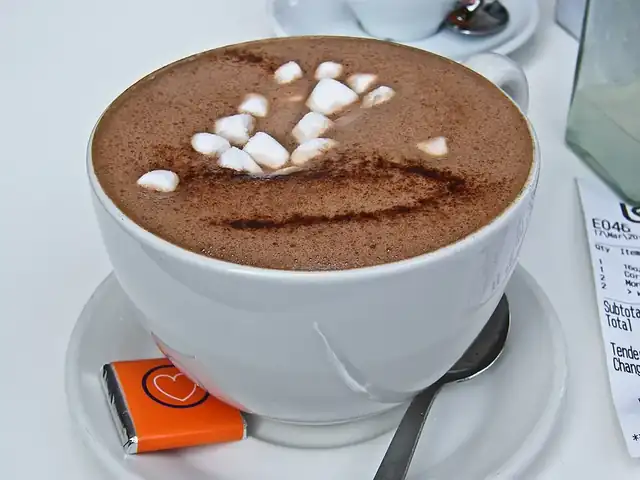
Hot chocolate, also known as hot cocoa or drinking chocolate, is a heated drink consisting of shaved or melted chocolate or cocoa powder, and heated milk or water. It usually contains a sweetener, such as sugar, and is often garnished with whipped cream or marshmallows or both. Hot chocolate made with melted chocolate is characterized by less sweetness and a thicker consistency.
Cacao was first domesticated at least 5,300 years ago, in the Mayo-Chinchipe culture in what is present-day Ecuador, and cacao beverages were consumed by the period 2,500–3,000 years ago by the Maya. A chocolate drink was an essential part of Aztec culture by 1400 AD. The drink became popular in Europe after being introduced from Mexico in the New World and has undergone multiple changes since then. Until the 19th century, hot chocolate was used medicinally to treat ailments such as liver and stomach diseases.
Hot chocolate is consumed throughout the world in versions including the spiced chocolate para mesa of Latin America, the very thick cioccolata calda served in Italy and chocolate a la taza served in Spain, and the thinner hot cocoa consumed in the United States. Prepared hot chocolate can be purchased from a range of establishments, including cafeterias, fast food restaurants, coffeehouses and teahouses. Powdered hot chocolate mixes, which can be added to boiling water or hot milk to make the drink at home, are sold at grocery stores and online.
Terminology
A distinction is sometimes made between "hot cocoa", made from cocoa powder (ground cacao beans from which much of the cocoa butter has been removed), and "hot chocolate", made directly from bar chocolate, which already contains cocoa, sugar, and cocoa butter. Thus, the major difference between the two is the cocoa butter, the absence of which makes hot cocoa significantly lower in fat than hot chocolate while still preserving all the antioxidants found in chocolate.
Hot chocolate can be made with dark, semisweet, or bittersweet chocolate grated or chopped into small pieces and stirred into milk with the addition of sugar.
Cocoa usually refers to a drink made with cocoa powder, hot milk or water, and sweetened to taste with sugar (or not sweetened at all).
At the time of European contact
As the Europeans came upon the Americas, they found the Maya made a chocolate drink. Served cold, the Maya ground cocoa seeds into a paste and mixed it with water, vanilla, cornmeal, chili peppers, and other ingredients. They then poured the drink back and forth from a cup to a pot until a thick foam developed. It was available to Maya of all social classes, while among the Aztecs chocolate was a sign of high status: it was a bad omen for someone low or common to drink it.
Within Mesoamerica many drinks were made from cacao beans, and further flavored with flowers like vanilla. The Aztecs, or Mexica, required conquered people to provide them with chocolate. Cups, gourds, cacao beans, as well as other things they acquired were listed in The Essential Codex Mendoza. Cacao became used as a currency throughout Mesoamerica.
Chocolate was initially considered an acquired taste among conquistadors. The drink tasted spicy and bitter as opposed to sweetened modern hot chocolate, and José de Acosta, a Spanish Jesuit missionary who lived in Peru and then Mexico in the later 16th century, described chocolate as:Loathsome to such as are not acquainted with it, having a scum or froth that is very unpleasant taste. Yet it is a drink very much esteemed among the Indians, where with they feast noble men who pass through their country. The Spaniards, both men and women, that are accustomed to the country, are very greedy of this Chocolate.
Introduction to Europe
After its introduction to Europe, the drink slowly gained popularity. The imperial court of Emperor Charles V soon adopted the drink, and chocolate became a fashionable drink popular with the Spanish upper class. Additionally, cocoa was given as a dowry when members of the Spanish royal family married other European aristocrats. At the time, chocolate was very expensive in Europe because the cocoa beans only grew in South America.
Hot chocolate had become a luxury item among the European nobility by the 17th century. Even when the first Chocolate House (an establishment similar to a modern coffee shop) opened in 1657, chocolate was still very expensive, costing 50 to 75 pence (approximately 10–15 shillings) a pound (roughly £45–65 in 2016). At the time, hot chocolate was often mixed with spices for flavor; one notable recipe was hot chocolate "infused with fresh jasmine flowers, amber, musk, vanilla and ambergris." In the late 17th century, Sir Hans Sloane, president of the Royal College of Physicians, visited Jamaica, where he was introduced to cocoa. He found it 'nauseous' but by mixing it with milk made it more palatable. When Sloane returned to England, he brought the recipe with him, introducing milk chocolate to England.
Consumption
Today, hot chocolate in the form of drinking chocolate or cocoa is considered a comfort food and is widely consumed in many parts of the world. European hot chocolate tends to be relatively thick and rich, while in the United States the thinner instant version is consumed more often. Many regions have distinctive additives or toppings, ranging from marshmallow and whipped cream to cheese.
Add-ons
Whipped cream and marshmallows are frequently added to hot chocolate. Theobromine found in the fat-free cocoa solids of the cocoa bean is fat soluble. Cocoa beans contain significant amount of fats, but cocoa powder is usually defatted. However, adding fat to defatted cocoa powder will increase its bioavailability.
Rum is added to hot chocolate to make a Lumumba.
Europe
In mainland Europe (particularly Spain and Italy), hot chocolate is sometimes served very thick due to the use of a thickening agent such as cornstarch. One of the thick forms of hot chocolate served in Europe is the Italian cioccolata calda.
Hot chocolate with churros is a traditional breakfast in Spain. This style of hot chocolate can be extremely thick, often having the consistency of warm chocolate pudding. In the Netherlands, hot chocolate is a very popular drink, known as warme chocolademelk. It is often served at home or in cafes. In France, hot chocolate is often served at breakfast time. Sometimes sliced bread spread with butter, jam, honey, or Nutella is dunked into the hot chocolate.
More to savor
Spaghetti alla Carbonara

Austrian Napkin Dumpling (Serviettenknödel)
Stew: The Comfort of a Meal Cooked Together