The dish is a starting point for exploring a wider food story. The guide below looks more closely at its background and different forms. When you want to cook, visit the recipe collection for ingredient quantities and step-by-step methods.
Overview
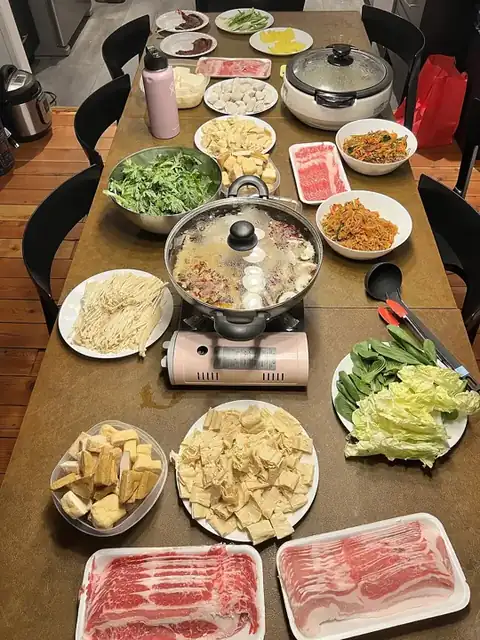
Hot pot or hotpot , also known as steamboat, is a dish of soup or stock kept simmering in a pot by a heat source on the table, accompanied by an array of raw meats, vegetables and soy-based foods which diners quickly cook by dipping in the broth.
Description
Hot pot is a type of broth traditionally served inside a large metal pot. There are many local varieties and styles of hot pot, like Chongqing hot pot, Beijing hot pot, Yunnan hot pot, and so on. The broth is brought to a boil and left simmering for the duration of the meal. Raw ingredients, such as meat and vegetables, are placed into the simmering broth and thus cooked. The cooked pieces are dipped into dipping sauces for additional flavor. Hot pot is considered a main course and may be served without rice or noodles on the side.
Typical hot pot ingredients include thinly sliced meat (typically mutton or beef), leaf vegetables, mushrooms, vermicelli, sliced potatoes, bean products, egg dumplings, tofu, and seafood. Raw ingredients are sliced into thin sections that will cook quickly and consistently in the simmering broth, which is kept at a gentle boiling temperature. Most raw foods can be cooked in a hot pot, although they may have different cooking times, and must be immersed in the soup and then removed accordingly. In turn, the various food items dipped in the hot pot provide additional flavour to the broth.
China
Chinese hot pots are often divided into "Southern style" and "Northern style", paralleling the northern and southern Chinese cultural divide. Although there are wide regional variations, in general, Southern styles tend to have spicy broths and complex dipping sauces, and are heavier on seafood, vegetables and mushrooms, while Northern styles are simpler and focus more on meat, particularly mutton.
According to research, 67 different spices and condiments are commonly used in traditional Chinese hotpot, involving 82 plant species of 50 genera in 26 families.
Northern styles
Instant-boiled mutton could be viewed as representative of "northern style hot pot", which focus on the main ingredients rather than the soup base. Water is used as the main ingredient of the hotpot instead of the flavored broth.
The Manchu hot pot uses plenty of suan cai (Chinese cabbage pickle) to make the broth sour.
In Hubei cuisine, hot pot is normally prepared with hot spices and Sichuan pepper. Items supplied to be cooked in this broth include mushrooms, thinly shaved beef or lamb, lettuce, and various other green vegetables.
Southern styles
One of the most famous Southern variations is the Chongqing hot pot (Chinese:重慶火鍋), which uses mala seasoning flavored with chili and Sichuan pepper for a spicy and numbing flavor. Chongqing hotpots often feature a wide variety of different meats and ingredients, and offer many sauces and condiments to flavor the meat. The typical dipping sauce contains sesame oil and is mixed with crushed fresh garlic and chopped spring onions.
Sichuan also has a number of "dry" hot pots such as mala xiangguo (Chinese: 麻辣香鍋), which are similar to mala hot pot in ingredients and seasoning, but stir-fried instead of being cooked in broth.
In Yunnan, there is another predominant type of hot pot made with various mushrooms, wild or farmed. It is called the wild mushroom hot pot . Due to the vast forests and abundant natural resources in Yunnan, people can find a wide variety of edible mushrooms. The easily accessible and fresh mushroom resources lead to the high popularity of the wild mushroom hot pot. The big difference between the mushroom hot pot and the spicy hot pot is that the former omits strong spice and chili, and the latter preserves the original flavor of the mushrooms. The mushroom hot pot is also seasonal, depending on the availability of local mushrooms.
A Cantonese variation includes mixing a raw egg with the condiments to reduce the amount of "heat" absorbed by the food, thereby reducing the likelihood of a sore throat after the steamboat meal, according to Chinese herbalist theories.
In Hainan cuisine, hot pot is generally served in small woks with a prepared broth containing pieces of meat. At the time of serving, the meat is not fully cooked, and approximately fifteen minutes are required before it is ready to eat. Items supplied to be cooked in this type of hot pot include mushrooms, thinly shaved beef or goat meat, lettuce, and other green vegetables. This dish varies somewhat in different parts of the province. Coconut milk and juice is commonly added into the hot pot.
In Jiangsu and Zhejiang cuisine, chrysanthemum flowers are cooked in the broth to give it a floral essence.
In Teochew cuisine, a popular choice is Chaoshan beef hotpot (潮汕牛肉火锅) which originates from the Chaoshan region in Guangdong. Chaoshan beef hotpot is distinctively different from other Chinese hot pot styles due to its clear broth, which is typically made from beef bones and sometimes chicken. Chaoshan beef hotpot is served with roughly 7 cuts of beef and a variety of dipping sauces, most commonly a mixture of Shacha sauce, soy sauce, garlic, chili, and others.
Japan
In Japan, hot pots are known as nabemono. There are many variations, including sukiyaki, yosenabe, shabu-shabu, oden, and chankonabe.
The Chinese-style hot pot is transliterated as hinabe.
Similar dishes
Instant-boiled mutton
Jeongol - Korea
Sinseollo
Nabemono - Japan
Shabu-shabu
Sukiyaki
Oden
Chankonabe
Yao hon (យ៉ាវហន) or chhnang pleurng (ឆ្នាំងភ្លើង) - Cambodia
Buttered chhnang pleurng
Thai suki
Mu kratha – also called "Thai hot pot" or mookata
Clay pot cooking – referred to as "hot pot" or "hotpot" on Chinese restaurant menus in English-speaking regions
Lancashire hotpot – a dish referred to as "hot pot" (or "hotpot") in Britain
Stew – may include similar ingredients but is not necessarily cooked the same way
Yong tau foo
Fondue bourguignonne and fondue chinoise
More to savor

Chicken Vindaloo

Vanillekipferl (Almond Crescent Cookies)

Hot Chocolate: The Drink That Turns Cocoa into Comfort