
This longer reference provides the background behind the topic. Read it alongside the recipe collection when you want to connect an ingredient or food idea with a dish to prepare.
In this story
OverviewRecommended Dietary AllowancesNutrientsCarbohydratesFatEssential fatty acidsFiberOverview
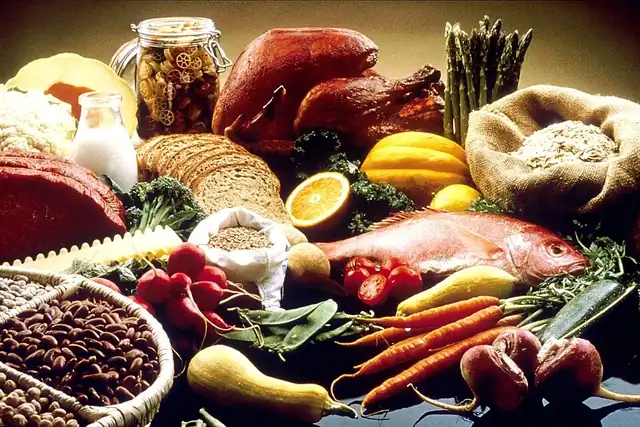
Human nutrition deals with the provision of essential nutrients in food that are necessary to support human life and good health. Poor nutrition is a chronic problem often linked to poverty, food security, or a poor understanding of nutritional requirements. Malnutrition and its consequences are large contributors to deaths, physical deformities, and disabilities worldwide. Good nutrition is necessary for children to grow physically and mentally, and for normal human biological development.
Recommended Dietary Allowances
The Recommended Dietary Allowances (RDAs) are scientifically determined levels of essential nutrient intake, deemed sufficient by the Food and Nutrition Board to meet the nutritional needs of nearly all healthy individuals.
The first RDAs were published in 1943, during World War II, with the aim of setting standards for optimal nutrition. The initial editions outlined daily nutrient recommendations for various age groups, reflecting the latest scientific insights at the time (NRC, 1943). The history and evolution of the RDAs have been extensively detailed by the chair of the first Committee on Recommended Dietary Allowances (Roberts, 1958). Over the years, the RDAs have been periodically updated, with the current version being the tenth edition.
Nutrients
The seven major classes of nutrients are carbohydrates, fats, fiber, minerals, proteins, vitamins, and water. Nutrients can be grouped as either macronutrients or micronutrients (needed in small quantities). Carbohydrates, fats, and proteins are macronutrients, and provide energy. Water and fiber are macronutrients, but do not provide energy. The micronutrients are minerals and vitamins.
The macronutrients (excluding fiber and water) provide structural material (amino acids from which proteins are built, and lipids from which cell membranes and some signaling molecules are built), and energy. Some of the structural material can also be used to generate energy internally, and in either case it is measured in joules or kilocalories (often called "Calories" and written with a capital 'C' to distinguish them from little 'c' calories). Carbohydrates and proteins provide 17 kJ (approximately 4 kcal) of energy per gram, while fats provide 37 kJ (9 kcal) per gram. However, the net energy derived from the macronutrients depends on such factors as absorption and digestive effort, which vary substantially from instance to instance.
Carbohydrates
Carbohydrates may be classified as monosaccharides, disaccharides or polysaccharides depending on the number of monomer (sugar) units they contain. They are a diverse group of substances, with a range of chemical, physical and physiological properties. They make up a large part of foods such as rice, noodles, bread, and other grain-based products, but they are not an essential nutrient, meaning a human does not need to eat carbohydrates.
Monosaccharides contain one sugar unit, disaccharides two, and polysaccharides three or more. Monosaccharides include glucose, fructose and galactose. Disaccharides include sucrose, lactose, and maltose; purified sucrose, for instance, is used as table sugar. Polysaccharides, which include starch and glycogen, are often referred to as 'complex' carbohydrates because they are typically long multiple-branched chains of sugar units.
Fat
A molecule of dietary fat typically consists of several fatty acids (containing long chains of carbon and hydrogen atoms), bonded to a glycerol. They are typically found as triglycerides (three fatty acids attached to one glycerol backbone). Fats may be classified as saturated or unsaturated depending on the chemical structure of the fatty acids involved. Saturated fats have all of the carbon atoms in their fatty acid chains bonded to hydrogen atoms, whereas unsaturated fats have some of these carbon atoms double-bonded, so their molecules have relatively fewer hydrogen atoms than a saturated fatty acid of the same length. Unsaturated fats may be further classified as monounsaturated (one double-bond) or polyunsaturated (many double-bonds).
Furthermore, depending on the location of the double-bond in the fatty acid chain, unsaturated fatty acids are classified as omega-3 or omega-6 fatty acids. Trans fats are a type of unsaturated fat with trans-isomer bonds; these are rare in nature and in foods from natural sources; they are typically created in an industrial process called (partial) hydrogenation. There are nine kilocalories in each gram of fat. Fatty acids such as conjugated linoleic acid, catalpic acid, eleostearic acid and punicic acid, in addition to providing energy, represent potent immune modulatory molecules.
Essential fatty acids
Most fatty acids are non-essential, meaning the body can produce them as needed, generally from other fatty acids and always by expending energy to do so. However, in humans, at least two fatty acids are essential and must be included in the diet. An appropriate balance of essential fatty acids—omega-3 and omega-6 fatty acids—seems also important for health, although definitive experimental demonstration has been elusive. Both of these "omega" long-chain polyunsaturated fatty acids are substrates for a class of eicosanoids known as prostaglandins, which have roles throughout the human body.
The omega-3 eicosapentaenoic acid (EPA), which can be made in the human body from the omega-3 essential fatty acid alpha-linolenic acid (ALA), or taken in through marine food sources, serves as a building block for series 3 prostaglandins (e.g., weakly inflammatory PGE3). The omega-6 dihomo-gamma-linolenic acid (DGLA) serves as a building block for series 1 prostaglandins (e.g. anti-inflammatory PGE1), whereas arachidonic acid (AA) serves as a building block for series 2 prostaglandins (e.g. pro-inflammatory PGE 2). Both DGLA and AA can be made from the omega-6 linoleic acid (LA) in the human body, or can be taken in directly through food. An appropriately balanced intake of omega-3 and omega-6 partly determines the relative production of different prostaglandins.
In industrialized societies, people typically consume large amounts of processed vegetable oils, which have reduced amounts of the essential fatty acids along with too much of omega-6 fatty acids relative to omega-3 fatty acids.
Fiber
Dietary fiber is a carbohydrate, specifically a polysaccharide, which is incompletely absorbed in humans and in some animals. Fiber slows down the absorption of sugar in the gut. The microbiome converts fiber into signals that stimulate gut hormones, which in turn control how quickly the stomach empties, regulate blood sugar levels, and influence feelings of hunger. Like all carbohydrates, when fiber is digested, it can produce four calories (kilocalories) of energy per gram, but in most circumstances, it accounts for less than that because of its limited absorption and digestibility.
The two subcategories are insoluble and soluble fiber.
Insoluble dietary fiber
More to savor

Reuben Sandwich

Basic Omelet
Food: A Closer Look at Food and How We Eat