Use the regional background below as a starting point for exploring the food, rather than expecting one dish to represent every household. Food traditions differ within a country and continue to change through travel, migration, and everyday cooking.
Overview
Japanese cuisine encompasses the regional and traditional foods of Japan, which have developed through centuries of political, economic, and social changes. The traditional cuisine of Japan (Japanese: washoku) is based on rice with miso soup and other dishes with an emphasis on seasonal ingredients. Side dishes often consist of fish, pickled vegetables, tamagoyaki, and vegetables cooked in broth. Common seafood is often grilled, but it is also sometimes served raw as sashimi or as sushi. Seafood and vegetables are also deep-fried in a light batter, as tempura. Apart from rice, a staple includes noodles, such as soba and udon. Japan also has many simmered dishes, such as fish products in broth called oden, or beef in sukiyaki and nikujaga.
Historically influenced by Chinese cuisine, Japanese cuisine has also opened up to influence from Western cuisines in the modern era. Dishes inspired by foreign food—in particular Chinese food—like ramen and gyōza, as well as foods like spaghetti, curry and hamburgers, have been adapted to Japanese tastes and ingredients. Traditionally, the Japanese shunned meat as a result of adherence to Buddhism, but with the modernization of Japan in the 1880s, meat-based dishes such as tonkatsu and yakiniku have become common. Since this time, Japanese cuisine, particularly sushi and ramen, has become popular globally.
Traditional table settings
The traditional Japanese table setting has varied considerably over the centuries, depending primarily on the type of table common during a given era. Before the 19th century, small individual box tables (hakozen, 箱膳) or flat floor trays were set before each diner. Larger low tables (chabudai, ちゃぶ台) that accommodated entire families were gaining popularity by the beginning of the 20th century, but these gave way to Western-style dining tables and chairs by the end of the 20th century.
The traditional Japanese table setting is to place a bowl of rice on the diner's left and to place a bowl of miso soup on the diner's right side at the table. Behind these, each okazu is served on its own individual plate. Based on the standard three-okazu formula, behind the rice and soup are three flat plates to hold the three okazu; one to far back left, one at far back right, and one in the center. Pickled vegetables are often served on the side but are not counted as part of the three okazu. Chopsticks are generally placed at the very front of the tray near the diner with pointed ends facing left and supported by a chopstick rest, or hashioki.
Dining etiquette
Many restaurants and homes in Japan are equipped with Western-style chairs and tables. However, traditional Japanese low tables and cushions, usually found on tatami floors, are also very common. Tatami mats, which are made of straw, can be easily damaged and are hard to clean, thus shoes or any type of footwear are always taken off when stepping on tatami floors.
When dining in a traditional tatami room, sitting upright on the floor is common. In a casual setting, men usually sit with their feet crossed and women sit with both legs to one side. Only men are supposed to sit cross-legged. The formal way of sitting for both sexes is a kneeling style known as seiza. To sit in a seiza position, one kneels on the floor with legs folded under the thighs and the buttocks resting on the heels.
Seasonality
Emphasis is placed on seasonality of food or shun, and dishes are designed to herald the arrival of the four seasons or calendar months.
Seasonality means taking advantage of the "fruit of the mountains" (for example, bamboo shoots in spring, chestnuts in the autumn) as well as the "fruit of the sea" as they come into season. Thus the first catch of skipjack tunas that arrives with the Kuroshio Current has traditionally been greatly prized.
Rice
Rice has historically been the staple food of the Japanese people. Its fundamental importance is evident from the fact that the word for cooked rice, gohan or meshi, also stands for a "meal". While rice has an ancient history of cultivation in Japan, its use as a staple has not been universal. Notably, in northern areas (northern Honshū and Hokkaidō), other grains such as wheat were more common into the 19th century.
In most of Japan, rice used to be consumed for almost every meal, and although a 2007 survey showed that 70% of Japanese still eat it once or twice a day, its popularity is now declining. In the 20th century there has been a shift in dietary habits, with an increasing number of people choosing wheat-based products (such as bread and noodles) over rice.
Noodles
Japanese noodles often substitute for a rice-based meal. Soba (thin, grayish-brown noodles containing buckwheat flour) and udon (thick wheat noodles) are the main traditional noodles, while ramen is a modern import and now very popular. There are also other, common noodles, such as somen (thin, white noodles containing wheat flour). Cold somen noodles are often eaten during the hot summer. Hiyashi chūka are also popular noodles in the summer.
Japanese noodles, such as soba and udon, are eaten as a standalone, and usually not with a side dish, in terms of general custom. It may have toppings, but they are called gu. The fried battered shrimp tempura sitting in a bowl of tempura-soba would be referred to as "the shrimp" or "the tempura", and not so much be referred to as a topping (gu). The identical toppings, if served as a dish to be eaten with plain white rice could be called okazu, so these terms are context-sensitive. Some noodle dishes derive their name from Japanese folklore, such as kitsune and tanuki, reflecting dishes in which the noodles can be changed, but the broth and garnishes correspond to their respective legend.
Dishes
In ichijū-sansai, the word sai has the basic meaning of "vegetable", but secondarily means any accompanying dish (whether it uses fish or meat), with the more familiar combined form sōzaisōzai, which is a term for any side dish, such as the vast selections sold at Japanese supermarkets or depachikadepachikas.
It figures in the Japanese word for appetizer, zensai; main dish, shusai; or sōzai (formal synonym for okazu), but the latter is considered somewhat of a ladies' term or nyōbō kotoba.
Below are listed some of the most common categories for prepared food:
Yakimono (焼き物), grilled and pan-fried dishes
More to savor
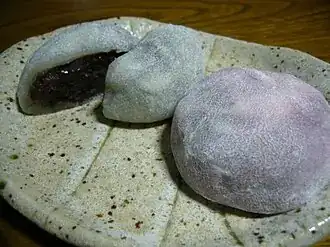
Daifuku (Sweet Filled Mochi)
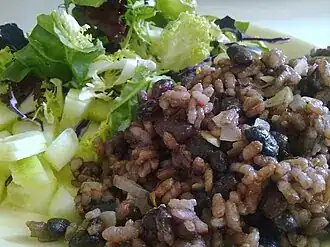
Gallo Pinto (Costa Rican Rice and Beans)
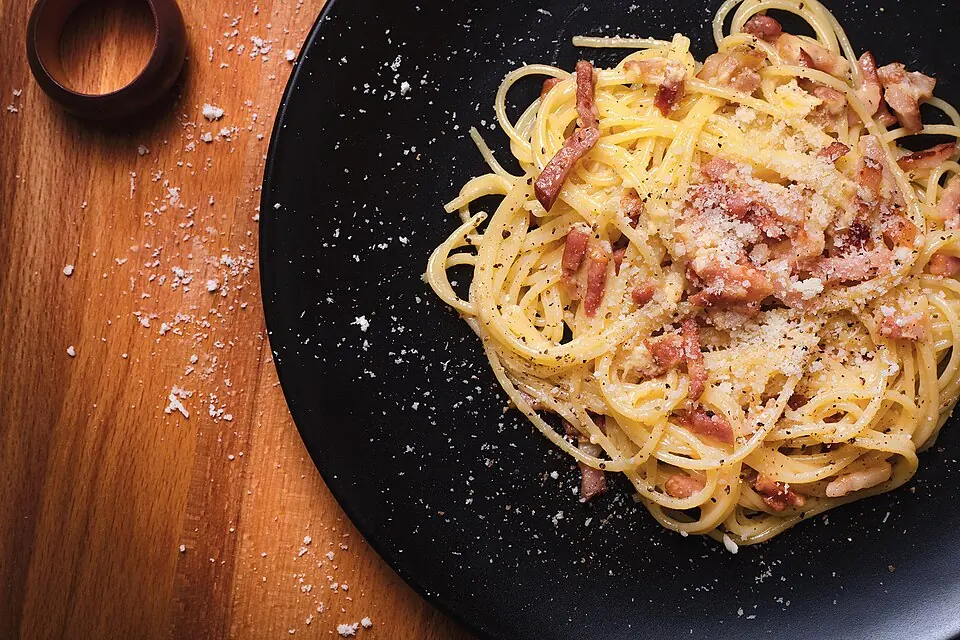
Carbonara: The Story Behind a Rich Roman Pasta Dish