This longer reference provides the background behind the topic. Read it alongside the recipe collection when you want to connect an ingredient or food idea with a dish to prepare.
In this story
OverviewTerminologyAmoy theoryMalay theoryEuropean-Arabic theoryMushroom ketchupTomato ketchupOverview
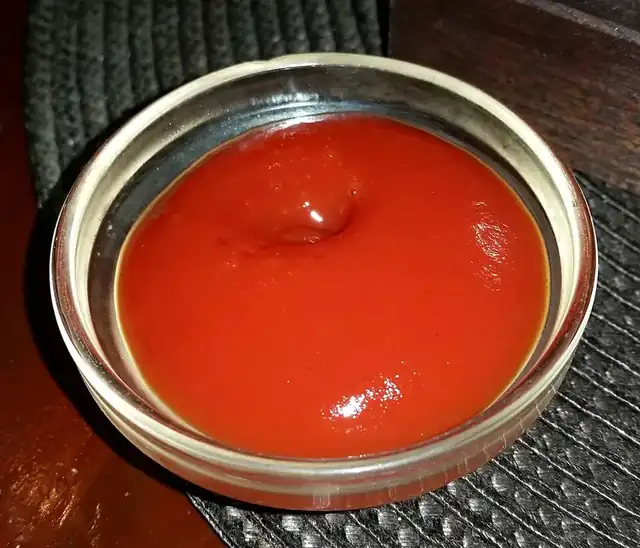
Ketchup or catsup is a table condiment with a sweet and sour flavor.
Ketchup now typically refers to tomato ketchup, although early recipes for different varieties contained mushrooms, oysters, mussels, egg whites, grapes, or walnuts, among other ingredients.
Tomato ketchup is made from tomatoes, sugar, and vinegar, with seasonings and spices. The spices and flavors vary but commonly include onions, allspice, coriander, cloves, cumin, garlic, mustard and sometimes include celery, cinnamon, or ginger. Tomato ketchup is sometimes used as a condiment for dishes that are usually served hot, and are fried or greasy.
Tomato ketchup is sometimes used in other sauces and dressings, such as Thousand Island dressing and Marie Rose sauce, or as a general cooking ingredient. Its flavor may be replicated as an additive flavoring for snacks, such as potato chips.
Terminology
The term used for the sauce varies. Ketchup is the dominant term in North America and the UK, though catsup is commonly used in some southern US states and Mexico. The term "tomato sauce" is also used in the UK for something similar.
Amoy theory
A folk etymology is that the word came from the Amoy (Xiamen) region of China into English, as a borrowed word 茄汁 (Cantonese, meaning "tomato sauce"; the character 茄 means 'eggplant'; tomato in Chinese is 番茄, so the phrase translates to foreign eggplant sauce).
Another theory is that the word derives from one of two words from Hokkien of the Fujian region of coastal southern China: kôe-chiap (in the Amoy / Xiamen dialect and Quanzhou dialect) or kê-chiap (in the Zhangzhou dialect). Both pronunciations of the same word (膎汁, kôe-chiap / kê-chiap) come from the Quanzhou dialect, Amoy dialect, and Zhangzhou dialect of Hokkien, respectively, where it meant the brine of pickled fish or shellfish (膎, 'pickled food' (usually seafood) + 汁, 'juice'). There are citations of koe-chiap in the Chinese-English Dictionary of the Vernacular or Spoken Language of Amoy (1873) by Carstairs Douglas, defined as "brine of pickled fish or shell-fish".
Malay theory
Ketchup may have entered the English language from the Malay word kicap (sometimes spelled kecap or ketjap). Originally meaning "soy sauce", the word itself derives from Chinese.
In Indonesian cuisine, which is similar to Malay, the term kecap refers to fermented savory sauces. Two main types are well known in their cuisine: kecap asin, which translates to "salty kecap" in Indonesian (a salty soy sauce) and kecap manis or "sweet kecap" in Indonesian. Kecap manis is a sweet soy sauce that is a mixture of soy sauce with brown sugar, molasses, garlic, ginger, anise, coriander and a bay leaf reduced over medium heat until rather syrupy. A third type, kecap ikan, meaning "fish kecap" is fish sauce similar to the Thai nam pla or the Philippine patis. It is not, however, soy-based.
European-Arabic theory
American anthropologist E. N. Anderson relies on Elizabeth David to claim that ketchup is a cognate of the French escavèche, meaning "food in sauce". The word also exists in Spanish and Portuguese forms as escabeche, "a sauce for pickling", which culinary historian Karen Hess traced back to Arabic kabees, or "pickling with vinegar". The term was anglicized to caveach, a word first attested in the late 17th century, at the same time as ketchup.
Mushroom ketchup
In the United Kingdom, from the 1600s ketchup was prepared with mushrooms as a primary ingredient, rather than tomatoes. In the United States, mushroom ketchup dates back to at least 1770, and was prepared by British colonists in the Thirteen Colonies.
Tomato ketchup
James Mease published the first known tomato ketchup recipe in 1812. An early recipe for "tomato catsup" from 1817 includes anchovies and cochineal (a species of insect used for carmine dye).
In 1824, a ketchup recipe using tomatoes appeared in The Virginia Housewife (an influential 19th-century cookbook written by Mary Randolph, Thomas Jefferson's cousin). Tomato ketchup was sold locally by farmers. Jonas Yerkes is credited as the first American to sell it in a bottle. By 1837, he had produced and distributed the condiment nationally. By the mid-1850s, anchovies no longer featured as an ingredient.
Shortly thereafter, other companies followed suit. By 1897, the Sears catalog reported "there are hundreds of brands of Catsup on the market, a few of them good."
American cooks also began to sweeten ketchup in the 19th century. The Webster's Dictionary of 1913 defined "catsup" as: "table sauce made from mushrooms, tomatoes, walnuts, etc. [Also written as ketchup]." As the century progressed, tomato ketchup began to gain popularity in the United States. Tomato ketchup was popular long before fresh tomatoes were. People were less hesitant to eat tomatoes as part of a highly processed product that had been cooked and infused with vinegar and spices.
With industrial ketchup production and a need for better preservation, there was a great increase of sugar in ketchup, leading to the typically sweet and sour formula of today. In Australia, it was not until the late 19th century that sugar was added to tomato sauce, initially in small quantities, but today it contains just as much as American ketchup and only differed in the proportions of tomatoes, salt and vinegar in early recipes. While ketchup and tomato sauce are both sold in Australia, American ketchup is sweeter and thicker, whereas Australian tomato sauce is more sour and runny.
Modern ketchup emerged in the early years of the 20th century, out of a debate over the use of sodium benzoate as a preservative in condiments. Harvey W. Wiley, the "father" of the US Food and Drug Administration, challenged the safety of benzoate which was banned in the 1906 Pure Food and Drug Act. In response, entrepreneurs including Henry J. Heinz, pursued an alternative recipe that eliminated the need for that preservative. Katherine Bitting, a bacteriologist working for the U.S. Department of Agriculture, carried out research in 1909 that proved increasing the sugar and vinegar content of the product would prevent spoilage without use of artificial preservatives. She was assisted by Arvil Bitting, her husband and an official at that agency.
More to savor

Chicken Vindaloo
Spaghetti alla Carbonara
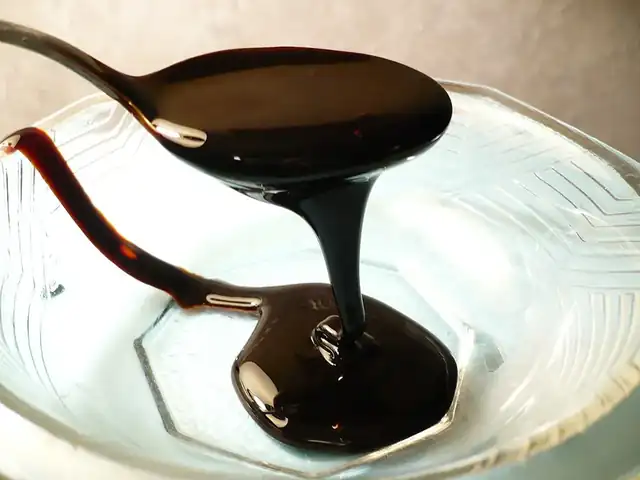
A Closer Look at Molasses: From Ingredient to Meal