The dish is a starting point for exploring a wider food story. The guide below looks more closely at its background and different forms. When you want to cook, visit the recipe collection for ingredient quantities and step-by-step methods.
Overview
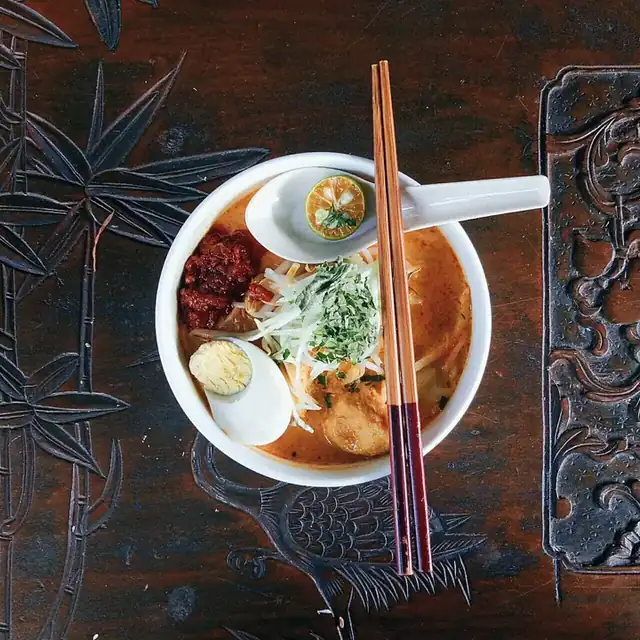
Laksa (Chinese: 叻沙) is a spicy noodle dish popular in Southeast Asia. Laksa consists of various types of noodles, most commonly thick rice noodles, with toppings such as chicken, prawns or fish. Most variations of laksa are prepared with a rich and spicy coconut curry soup or a broth seasoned with a souring ingredient like tamarind or asam gelugur.
Originating from Peranakan Chinese cuisine, laksa recipes are commonly served in Singapore, Indonesia, and Malaysia.
Ingredients
A wide variety of laksa exists in Southeast Asia, with regional and vendor-specific differences. Laksa can be broadly categorized by its two main ingredients: noodles and soup. Most preparations of laksa are garnished with herbs. Two of the most widely used herbs are mint and Vietnamese coriander, known in Malay as daun kesum or by its colloquial name daun laksa "laksa leaf". Another popular garnish used for many laksa recipes is the unopened flower bud of the torch ginger, usually sliced or shredded.
Noodles
Thick rice noodles, also known as "laksa noodles" are most commonly used, although thin rice vermicelli (米粉 "bee hoon") are also common. Some laksa variants might use fresh rice noodles handmade from scratch, other types of noodles; Johor laksa for example uses wheat-based spaghetti, while Kelantanese laksam is served with wide strips of rice noodle rolls similar in texture to shahe fen.
Soup
The type of Laksa is generally based upon the soup base employed in its recipe; either rich and savoury coconut milk, fresh and sour asam (tamarind, tamarind slice), or a combination of those two.
Laksa with a rich and strongly spiced coconut gravy is typically described in Malaysia and Singapore as Laksa Lemak or Nyonya Laksa (Laksa Nyonya). Lemak is a Malay culinary description that specifically refers to the presence of coconut milk which adds a distinctive richness to a dish, whereas Nyonya alludes to the dish's Peranakan origins and the role of women in Peranakan cuisine. "Laksa" is also an alternate name used for curry mee, a similar coconut soup noodle dish widely popular within the region which is sometimes known as curry laksa. The most common toppings for the various versions of coconut soup laksa include eggs, deep-fried tofu, beansprouts, and herbs, with a spoonful of sambal chilli paste on the side as a relish.
The Malay word asam refers to any ingredient that makes a dish taste sour (e.g. tamarind (Asam Jawa) or tamarind slice (Asam Gelugor), which comes from a different tree despite its name). The main ingredients for tamarind-based laksa typically include shredded fish, normally mackerel (ikan kembung), and finely sliced vegetables including cucumber, onions, red chillies, pineapple, mint leaves, laksa leaves, and shredded torch ginger flower. Preparations for tamarind-based laksa usually produce tangy, spicy, sour flavours. This type of Laksa is normally served with either thick rice noodles ("laksa") or thin rice noodles ("mee hoon") and topped off with otak udang or hae ko (Penang Hokkien: 蝦膏; hêe-ko), a thick sweet shrimp paste.
Singapore
Katong Laksa (Laksa Katong), from the Singaporean residential neighbourhood of Katong, is a variant of Singapore-style Laksa Lemak or Singapore Laksa (Laksa Singapura). The noodles in Katong Laksa are normally cut into smaller pieces so that the entire dish can be eaten with a spoon alone, without chopsticks or a fork. Another hallmark feature of this laksa is the gravy thickened not just with coconut milk but ground dried shrimp, which gives the soup its characteristic "sandy" texture.
Siglap Laksa (Laksa Siglap) from the neighbourhood of Kampung Siglap resembles Johor laksa but it is eaten with laksa noodles instead of spaghetti. The laksa is accompanied by cucumber, bean sprouts, laksa leaves and a dollop of sambal.
Indonesia
Baduy Laksa (Laksa Baduy) possibly is one of the oldest and the most traditional laksa variant in Indonesia. Unlike commonly known laksa recipes as a spicy noodle soup dish, laksa baduy's form is more akin to lontong and lepet rice cake. Laksa baduy is a type of traditional food in a form of wide noodles similar to kwetiau made from rice flour. The rice flour dough is boiled in water spiced with papagan combrang (kecombrang or torch ginger), then made into noodles. Baduy laksa is wrapped in congkok leaf (Molineria capitulata leaf) or in upih (betel nut stems). Laksa baduy is treated as a traditional dish prerequisite for ngalaksa ceremony conducted by Baduy people, thus not widely available nor commonly sold.
Banjar Laksa (Laksa Banjar) is a laksa variant from Indonesian city of Banjarmasin that has snakehead (ikan haruan) as one of its ingredients. Similar to Palembang Lakso, instead of rice noodle or vermicelli, Banjar Laksa uses steamed noodle-like balls, made from rice flour paste, served in a thick yellowish soup made from coconut milk, ground spices, and snakehead fish broth. Sprinkles of fried shallots (bawang goreng) and hard-boiled duck egg might also be added.
Betawi Laksa (Laksa Betawi) is a laksa variant from Jakarta, Indonesia, is similar to Bogor Laksa. However, Betawi Laksa is accompanied with basil leaves, chives, rice vermicelli, and perkedel. The thick yellowish coconut milk based soup contains ground (dried shrimp) to give it unique taste.
Malaysia
Johor Laksa (Laksa Johor) from Johor state in southern Malaysia resembles Penang Laksa but differs greatly because it is eaten with spaghetti and the broth is made of grilled wolf herring (parang), concentrated coconut milk, onion and spices. The uniqueness of Johor Laksa is its use of spaghetti and the concentration of its gravy. Johor Laksa is usually served during the festive season and special occasions. People in Johor formerly used their hands to eat this dish, believing it to be tastier.
Penang Laksa (Laksa Pulau Pinang), also known as Asam Laksa, a specialty of the Malaysian island of Penang. The soup is made with mackerel and its unique feature is the asam or tamarind which gives a sour, appetising taste. The fish is poached and then flaked. Other ingredients which give Penang Laksa its distinctive flavour include mint, pineapple slices and otak udang.
More to savor
Tonkotsu Ramen
Pan-Fried Shanghai Noodles
Gazpacho: The Spanish Soup That Keeps Its Cool