This longer reference provides the background behind the topic. Read it alongside the recipe collection when you want to connect an ingredient or food idea with a dish to prepare.
Overview
Macadamia is a genus of four species of trees in the flowering plant family Proteaceae. They are indigenous to Australia—specifically, northeastern New South Wales and central and southeastern Queensland. Two species of the genus are commercially important for their fruit, the macadamia nut (or simply macadamia). Global production in 2025 was 344000 t. Other names include Queensland nut, bush nut, maroochi nut or bauple nut. It was an important source of bushfood for the Aboriginal peoples.
The nut was first commercially produced on a wide scale in Hawaii, where Australian seeds were introduced in the 1880s, and which for more than a century was the world's largest producer. South Africa has been the world's largest producer of the macadamia since the 2010s.
The macadamia is the only widely grown food plant that is native to Australia.
Description
Macadamia is a genus of evergreen trees that grows 2 – 12 m tall.
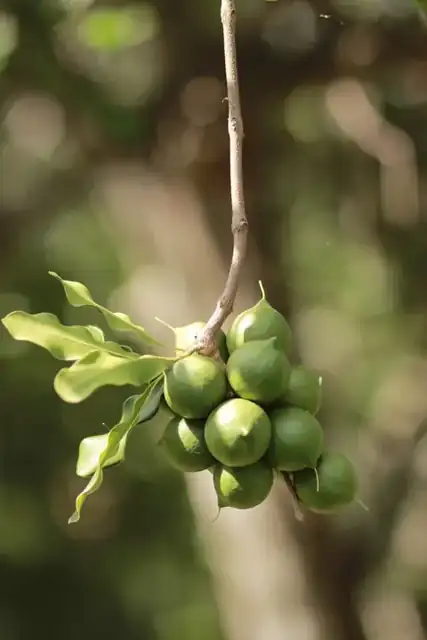
The leaves are arranged in whorls of three to six, lanceolate to obovate or elliptic in shape, 60 – 300 mm long and 30 – 130 mm broad, with an entire or spiny-serrated margin. The flowers are produced in a long, slender, and simple raceme 50 – 300 mm long, the individual flowers 10 – 15 mm long, white to pink or purple, with four tepals. The fruit is a hard, woody, globose follicle with a pointed apex containing one or two seeds. The nutshell ("coat") is particularly tough and requires around 2000 N to crack. The shell material is five times harder than hazelnut shells and has mechanical properties similar to aluminum. It has a Vickers hardness of 35.
Species
Nuts from M. jansenii and M. ternifolia contain cyanogenic glycosides. The other two species are cultivated for the commercial production of macadamia nuts for human consumption.
Previously, more species with disjunct distributions were named as members of this genus Macadamia. Genetics and morphological studies published in 2008 show they have separated from the genus Macadamia, correlating less closely than thought from earlier morphological studies. The species previously named in the genus Macadamia may still be referred to overall by the descriptive, non-scientific name of macadamia.
Formerly included in the genus
Lasjia , formerly Macadamia until 2008
Lasjia claudiensis ; synonym, base name: Macadamia claudiensis
Lasjia erecta ; synonym, base name: Macadamia erecta A tree endemic to the island of Sulawesi, Indonesia. First described by science in 1995.
Lasjia grandis ; synonym, base name: Macadamia grandis
Lasjia hildebrandii ; synonym, base name: Macadamia hildebrandii Another species endemic to Sulawesi.
Lasjia whelanii ; synonyms: base name: Helicia whelanii , Macadamia whelanii
Catalepidia Peter H. Weston, formerly Macadamia until 1995
Catalepidia heyana ; synonyms: base name: Helicia heyana , Macadamia heyana
Virotia , formerly Macadamia until the first species renaming began in 1975 and comprehensive in 2008
Virotia angustifolia ; synonym, base name: Macadamia angustifolia
Virotia francii ; synonym, base name: Roupala francii
Virotia leptophylla (1975 type species); synonym, base name: Kermadecia leptophylla
Virotia neurophylla ; synonyms: base name: Kermadecia neurophylla , Macadamia neurophylla
Virotia rousselii ; synonym, base name: Roupala rousselii
Virotia vieillardi ; synonym, base name: Roupala vieillardii
Beaumont
A Macadamia integrifolia / M. tetraphylla hybrid commercial variety is widely planted in Australia and New Zealand; Dr. J. H. Beaumont discovered it. It is high in oil but is not sweet. New leaves are reddish, and flowers are bright pink, borne on long racemes. It is one of the quickest varieties to come into bearing once planted in the garden, usually carrying a useful crop by the fourth year and improving from then on. It crops prodigiously when well pollinated. The impressive, grape-like clusters are sometimes so heavy they break the branchlets to which they are attached. Commercial orchards have reached 18 kg per tree by eight years old.
On the downside, the macadamias do not drop from the tree when ripe, and the leaves are a bit prickly when one reaches into the tree's interior during harvest. Its shell is easier to open than that of most commercial varieties.
Maroochy
A pure M. tetraphylla variety from Australia, this strain is cultivated for its productive crop yield, flavour, and suitability for pollinating 'Beaumont.'
Nelmac II
A South African M. integrifolia / M. tetraphylla hybrid cultivar, it has a sweet seed, which means it must be cooked carefully so that the sugars do not caramelise. The sweet seed is usually not fully processed, as it generally does not taste as good, but many people enjoy eating it uncooked. It has an open micropyle (hole in the shell), which may let in fungal spores. The crack-out percentage (ratio of nut meat to the whole nut by weight) is high. Ten-year-old trees average 22 kg per tree. It is a popular variety because of its pollination of 'Beaumont,' and the yields are almost comparable.
Renown
A M. integrifolia / M. tetraphylla hybrid, this is a rather spreading tree. On the plus side, it is high-yielding commercially; 17 kg from a 9-year-old tree has been recorded, and the nuts drop to the ground. However, they are thick-shelled, with not much flavour.
Production
In 2024, South Africa was the leading producer of macadamia nuts, with 87,000 tonnes, up from 77,000 tonnes in 2023 and 54,000 tonnes out of global production of 211,000 tonnes in 2018. Macadamia is commercially produced in many countries of East Africa, Southeast Asia, South America, Australia, and North America having Mediterranean, temperate or tropical climates.
More to savor

Chicken Vindaloo

Com Chien (Vietnamese Fried Rice)
Zucchini at the Table: The Food Behind the Name