This longer reference provides the background behind the topic. Read it alongside the recipe collection when you want to connect an ingredient or food idea with a dish to prepare.
Overview
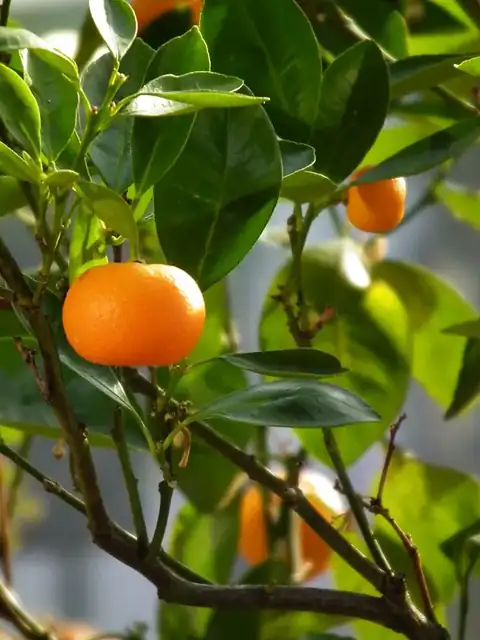
A mandarin orange (Citrus reticulata), often simply called mandarin, is a small, rounded citrus tree fruit. Treated as a distinct species of orange, it is usually eaten plain or in fruit salads. The mandarin is small and oblate, unlike the roughly spherical sweet orange (which is a mandarin-pomelo hybrid). The taste is sweeter and stronger than the common orange. A ripe mandarin orange is firm to slightly soft, heavy for its size, and pebbly-skinned. The peel is thin and loose, with little white mesocarp, so they are usually easier to peel and to split into segments. Hybrids have these traits to lesser degrees. The mandarin orange is tender and is damaged easily by cold. It can be grown in tropical and subtropical areas.
According to genetic studies, the wild mandarin was one of the original citrus species; through breeding or natural hybridization, it is the ancestor of many hybrid citrus cultivars. With the citron and pomelo, it is the ancestor of the most commercially important hybrids. Though the ancestral mandarin orange was bitter, most commercial mandarin strains derive from hybridization with the pomelo, which gives them sweet fruit.
Tree
Citrus reticulata is a moderate-sized tree some 25 ft in height. The tree trunk and major branches have thorns. The leaves are shiny, green, and rather small. The petioles are short, almost wingless or slightly winged. The flowers are borne singly or in small groups in the leaf-axils. Citrus are usually self-fertile (needing only a bee to move pollen within the same flower) or parthenocarpic (not needing pollination and therefore seedless, such as the satsuma). A mature mandarin tree can yield up to 175 lbs of fruit.
Fruit
Mandarin orange fruits are small 40 - 80 mm. Their color is orange, yellow-orange, or red-orange. The skin is thin and peels off easily. Their easiness to peel is an important advantage of mandarin oranges over other citrus fruits. Just like with other citrus fruits, mandarin is separated easily from the segments. The fruits may be seedless or contain a small number of seeds. Though the ancestral mandarin orange was bitter, most commercial mandarin strains derive from hybridization with pomelo, which gives them sweet fruit. They can be eaten as whole or squeezed to make juice. A ripe mandarin orange is firm to slightly soft, heavy for its size, and pebbly-skinned. The peel is thin and loose, with little white mesocarp, so they are easy to peel and to split into segments.
Genomics
In 2026, the Ponkan mandarin genome was reannotated as part of a haplotype-aware annotation study of three major Citrus crops. The updated annotation had a BUSCO completeness score of approximately 99.5%, and identified 25,162 protein-coding genes, 42,833 mRNAs, and 18,751 alternative-splicing events.
Domestication
Mandarins appear to have been domesticated at least twice, in the north and south Nanling Mountains, derived from separate wild subspecies. Wild mandarins are still found there, including Daoxian mandarines (sometimes given the species name Citrus daoxianensis) as well as some members of the group traditionally called 'Mangshan wild mandarins', a generic grouping for the wild mandarin-like fruit of the Mangshan area that includes both true mandarins (mangshanyeju, the southern subspecies) and the genetically distinct and only distantly-related Mangshanyegan. The wild mandarins were found free of the introgressed pomelo (C. maxima) DNA found in domestic mandarins. Still, they did appear to have small amounts (~1.8%) of introgression from the ichang papeda, which grows wild in the same region.
The Nanling Mountains are home to northern and southern genetic clusters of domestic mandarins that have similar levels of sugars in the fruit compared to their wild relatives but appreciably (in some almost 90-fold) lower levels of citric acid. The clusters display different patterns of pomelo introgression, have different deduced historical population histories, and are most closely related to distinct wild mandarins, suggesting two independent domestications in the north and south. All tested domesticated cultivars belong to one of these two genetic clusters, with varieties such as Nanfengmiju, Kishu, and Satsuma from the northern domestication event producing larger, redder fruit, while varieties such as Willowleaf, Dancy, Sunki, Cleopatra, King, and Ponkan belong to the smaller, yellower-fruited southern cluster.
Production
In 2024, world production of mandarin oranges (combined with tangerines and clementines in reporting to FAOSTAT) was approximately 50 million tonnes, led by China with 51% of the total. Turkey produced two million tonnes in 2024, with Spain and Egypt as other significant producers.
Culinary
Mandarins have a stronger and sweeter taste than sweet oranges. They are peeled and eaten fresh or used in salads, desserts and main dishes. Fresh mandarins are used in the production of the liqueur Mandarine Napoléon.
The peel is used fresh, whole or as zest, or dried as chenpi. It can be used as a spice for cooking, baking, drinks, or candy. Essential oil from the fresh peel may be used as a flavoring for candy, in gelatins, ice cream, chewing gum, and baked goods. It is used as a flavoring in some liqueurs.
Fruit rind oil
The oils expressed from the peel/rind of mandarin are used as flavor and fragrance materials. Compositional differences arise from both cultivar and stage of fruit ripeness (green - unripe; yellow - partially ripe; and "red" - fully ripe). In general, the aroma of the peel oils are described as "citrus, floral, bitter orange, orange, terpenic, aldehydic, orange rind, neroli".
More to savor

Chicken Vindaloo
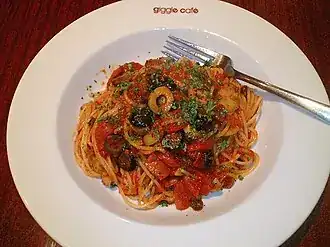
Spaghetti alla Puttanesca
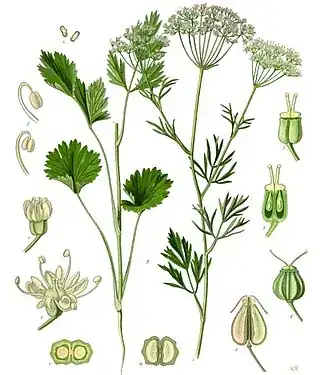
A Closer Look at Anise: From Ingredient to Meal