The dish is a starting point for exploring a wider food story. The guide below looks more closely at its background and different forms. When you want to cook, visit the recipe collection for ingredient quantities and step-by-step methods.
Overview
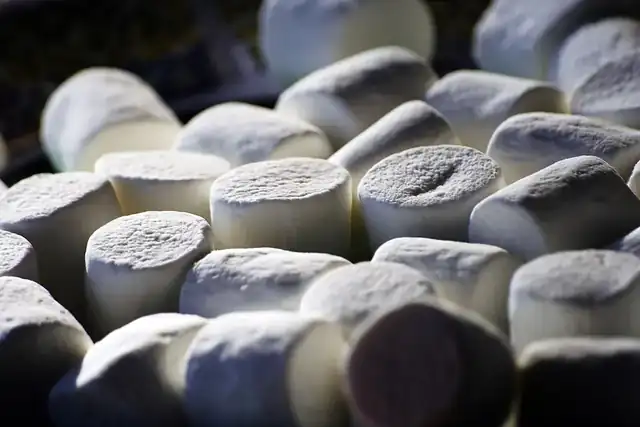
Marshmallow is a confection made from sugar, water and gelatin whipped to a solid-but-soft consistency. It is used as a filling in baking or molded into shapes and coated with corn starch. This sugar confection is inspired by a medicinal confection made from Althaea officinalis, the marsh-mallow plant.
Ingredients
Marshmallows consist of four ingredients: sugar, water, air, and a whipping agent/aerator (usually a protein). The types of sugar and whipping agent vary depending on the desired characteristics. Each ingredient plays a specific role in the final product.
The marshmallow is a foam, consisting of an aqueous continuous phase and a gaseous dispersed phase; in other words, a liquid with gas bubbles spread throughout. Marshmallows are an "aerated" confection because the material is made up of 50% air. The goal of an aerated confection like a marshmallow is to incorporate gas into a sugar mixture and stabilize the aerated product before the gas can escape.
Protein
In marshmallows, proteins are the main surface-active agents responsible for the formation and stabilization of the dispersed air. Due to their structure, surface-active molecules gather at the surface area of a portion of (water-based) liquid. A portion of each protein molecule is hydrophilic, with a polar charge, and another portion is hydrophobic and non-polar. The non-polar section has little or no affinity for water, and so this section orients as far away from the water as possible. However, the polar section is attracted to the water and has little or no affinity for the air. Therefore, the molecule orients with the polar section in the water, with the non-polar section in the air. Two primary proteins that are commonly used as aerators in marshmallows are albumen (egg whites) and gelatin.
Albumen (egg whites)
Albumen is a mixture of proteins found in egg whites and is utilized for its capacity to create foams. In a commercialized setting, dried albumen is used as opposed to fresh egg whites. In addition to convenience, the advantages of using dried albumen are an increase in food safety and the reduction of water content in the marshmallow. Fresh egg whites carry a higher risk of Salmonella, and are approximately 90 percent water. This is undesirable for the shelf life and firmness of the product. For artisan-type marshmallows, prepared by a candy maker, fresh egg whites are usually used. Albumen is rarely used on its own when incorporated into modern marshmallows, and instead is used in conjunction with gelatin.
Gelatin
Gelatin is the aerator most often used in the production of marshmallows. It is made up of collagen, a structural protein derived from animal skin, connective tissue, and bones. Not only can it stabilize foams, like albumen, but when combined with water, it forms a thermally-reversible gel. This means that gelatin can melt, then reset due to its temperature sensitivity. The melting point of gelatin gel is around 95 F, which is just below normal body temperature (around 97 F). This is what contributes to the "melt-in-your-mouth" sensation when a marshmallow is consumed—it actually starts to melt when it touches the tongue.
During preparation, the temperature needs to be just above the melting point of the gelatin, so that as soon as it is formed, it cools quickly, and the gelatin sets, retaining the desired shape. If the marshmallow rope mixture exiting the extruder during processing is too warm, the marshmallow starts to flow before the gelatin sets. Instead of a round marshmallow, it takes on an oval form. Excessive heat can also degrade or break down the gelatin itself. Therefore, when marshmallows are being produced at home or by artisan candy makers, the gelatin is added after the syrup has been heated and cooled down.
In commercial operations, the gelatin is cooked with the sugar syrup, rather than being added later after the syrup has cooled. In this case, kinetics play an important role, with both time and temperature factoring in. If the gelatin was added at the beginning of a batch that was then cooked to 112–116 °C in 20–30 minutes, a significant amount of gelatin would break down. The marshmallow would have reduced springiness from that loss of gelatin. But since the time the syrup spends at elevated temperature in modern cookers is so short, there is little to no degradation of the gelatin.
In terms of texture and mouth-feel, gelatin makes marshmallows chewy by forming a tangled 3-D network of polymer chains. Once gelatin is dissolved in warm water (dubbed the "blooming stage"), it forms a dispersion, which results in a cross-linking of its helix-shaped chains. The linkages in the gelatin protein network trap air in the marshmallow mixture and immobilize the water molecules in the network. The result is the well-known spongy structure of marshmallows. This is why the omission of gelatin from a marshmallow recipe results in marshmallow creme, since there is no gelatin network to trap the water and air bubbles.
Fruit syrups
While not widely used for traditional or commercial recipes, fruit syrups have been proposed as an alternative sugar for marshmallows.
Flavors
Unless a variation of the standard marshmallow is being made, vanilla is always used as the flavoring. The vanilla can either be added in extract form or by infusing the vanilla beans in the sugar syrup during cooking. The latter is the best technique to get an even distribution of flavor throughout the marshmallow.
More to savor
Crêpes I

English Breakfast
Honey at the Table: The Food Behind the Name