The dish is a starting point for exploring a wider food story. The guide below looks more closely at its background and different forms. When you want to cook, visit the recipe collection for ingredient quantities and step-by-step methods.
In this story
OverviewGeneral descriptionMid-Autumn FestivalMing RevolutionFillingsRegional variations in ChinaFillingsOverview
A mooncake is a Chinese baked item traditionally eaten during the Mid-Autumn Festival (中秋節). The festival is primarily about the harvest, while a legend connects it to moon watching, and mooncakes are regarded as a delicacy. Mooncakes are offered between friends or on family gatherings while celebrating the festival. The Mid-Autumn Festival is widely regarded as one of the four most important Chinese festivals.
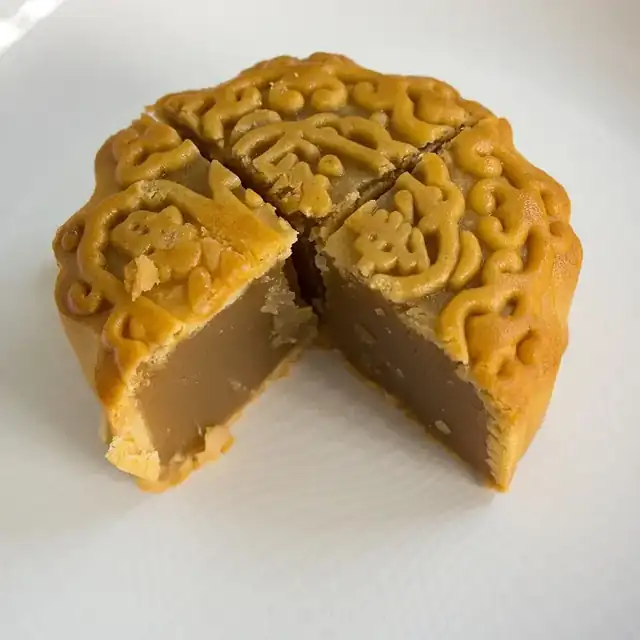
There are a number of varieties of mooncakes consumed within China and outside of China in overseas Chinese communities. The Cantonese mooncake is the most famous variety. A traditional Cantonese mooncake is a round pastry, measuring about 10 cm in diameter and 3 – 4 cm thick, with a rich, thick filling usually made from lotus seed paste (other typical fillings include red bean paste or mixed nuts) surrounded by a thin, 2–3 mm (approximately 1/8 of an inch) crust and may contain yolks from salted duck eggs.
Mooncakes are usually eaten in small wedges, accompanied by tea. Today, it is customary for business people and families to present them to their clients or relatives as presents, encouraging the market for high-end mooncakes.
General description
Most mooncakes consist of a thick, tender pastry skin enveloping a sweet, dense filling, which may contain one or several whole salted egg yolks in the center to symbolize the full moon. Depending on the custom, mooncakes may also be steamed, baked, or fried.
Traditional mooncakes have an imprint on top consisting of the Chinese characters for "longevity" or "harmony", as well as the name of the bakery and the filling inside. Imprints of the Moon, the Chinese goddess of the Moon (Chang'e), flowers, vines, or a rabbit (symbol of the Moon) may surround the characters for additional decoration.
Mid-Autumn Festival
The festival is intricately linked to legends of Chang’e, the Moon Goddess of Immortality. According to the Liji, an ancient Chinese book recording customs and ceremonies, the Chinese Emperor should offer sacrifices to the Sun in spring and the Moon in autumn. The 15th day of the 8th Chinese month is the day called "Mid-Autumn". The night on the 15th of the 8th Chinese month is also called "Night of the Moon".
Because of its central role in the Mid-Autumn festival, mooncakes remained popular even in recent years. For a number of people, they form a central part of the Mid-Autumn festival experience such that it is now commonly known as 'Mooncake Festival'.
Ming Revolution
There is a folk tale about the overthrow of the Yuan dynasty facilitated by messages smuggled in moon cakes.
Mooncakes were used by revolutionaries in their effort to overthrow the Mongol-led Yuan dynasty, eventually resulting in the establishment of the Ming dynasty. The idea is said to have been conceived by Zhu Yuanzhang and his advisor Liu Bowen, who circulated a rumor that a deadly plague was spreading and that the only way to prevent it was to eat special mooncakes, which would instantly revive and give special powers to the user. This prompted the quick distribution of mooncakes. The mooncakes contained a secret message: on the fifteenth day of the eighth lunar month, kill the rulers.
Another method of hiding a message was to print it on the surfaces of mooncakes (which came in packages of four), as a simple puzzle or mosaic. To read the message, each of the four mooncakes was cut into four parts. The resulting 16 pieces were pieced together to reveal the message. The pieces of mooncakes were then eaten to destroy the message.
Fillings
Many types of fillings can be found in traditional mooncakes:
Lotus seed paste (蓮蓉, lían róng): Considered by some to be the original and most luxurious mooncake filling, lotus paste filling is found in multiple types of mooncakes.White lotus paste commands an even higher premium. Due to the high price of lotus paste, white kidney bean paste is sometimes used as a filler.
Sweet bean paste (豆沙, dòu shā): A number of pastes are common fillings found in Chinese desserts. Although red bean paste, made from azuki beans, is the most common worldwide, there are regional and original preferences for bean paste made from mung beans, as well as black beans.
Regional variations in China
There are a number of regional variants of the mooncake. Types of traditional mooncake include:
Beijing-style mooncake: This style has two variations. One, called di qiang, was influenced by the Suzhou-style mooncake. It has a light, foamy dough as opposed to a flaky one. The other variation, called "fan mao", has a flaky, white dough. The two most popular fillings are the mountain hawthorn and wisteria blossom flavors.
Cantonese-style mooncake: Originating from Guangdong and Guangxi provinces, the Cantonese mooncake has multiple variations and is the most famous regional style of the mooncake. The ingredients used for the fillings are various: lotus seed paste, melon seed paste, nuts, ham, chicken, duck, roast pork, mushrooms, egg yolks, etc. More elaborate versions contain four egg yolks, representing the four phases of the moon. Recent contemporary forms (albeit non-traditional) sold in Hong Kong are even made from chocolate, ice cream or jelly.
Fillings
Fillings in contemporary style mooncakes have diversified to include just about anything which can be made into a paste. Mooncakes containing taro paste and pineapple, which were considered novelty items at their time of invention, have become commonplace in recent years. In addition, filling composed of ingredients such as coffee, chocolate, nuts (e.g., walnuts, mixed nuts, etc.), fruits (e.g., prunes, pineapples, melons, lychees, etc.), vegetables (e.g., sweet potatoes, etc.), and even ham have been added to give a modern twist to the traditional recipes.
Some other examples include
Traditional Chinese delicacies such as ginseng and edible bird's nest were soon followed by abalone and shark fin. Foreign food companies have also tried to cash in. Häagen-Dazs were one of the first to create an ice-cream mooncake, with a choice of either the "traditional," snow-skin, or Belgian/Swiss white, milk, and dark chocolate crusts. Other ice cream and restaurant chains soon followed up with their own versions. Other Western ingredients, including champagne ganache, malt whisky, volcanic-salt caramel and even black truffles, caviar and foie gras have made it into mooncakes.
More to savor
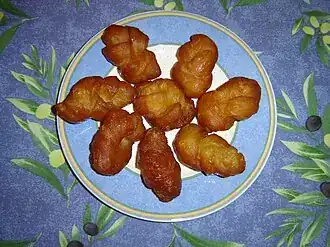
Koeksisters (Fried Braided Pastry in Syrup)
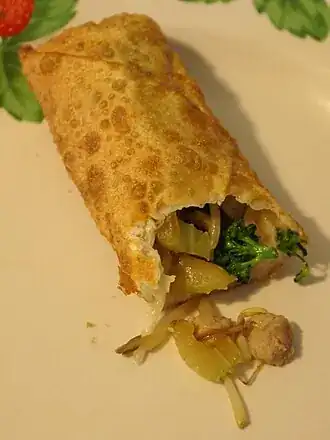
Egg Roll
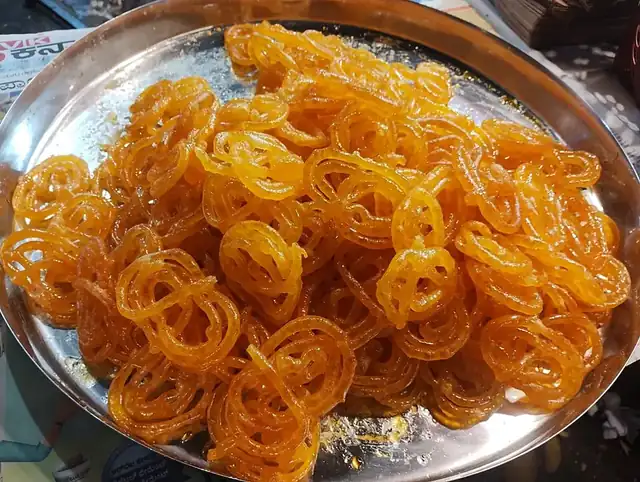
Jalebi: The Twisted Story of a Syrupy Sweet