The dish is a starting point for exploring a wider food story. The guide below looks more closely at its background and different forms. When you want to cook, visit the recipe collection for ingredient quantities and step-by-step methods.
In this story
OverviewHistoryChinese douchiCommercialization in the Taisho periodAppearance and consumptionProductionRelated productsOverview
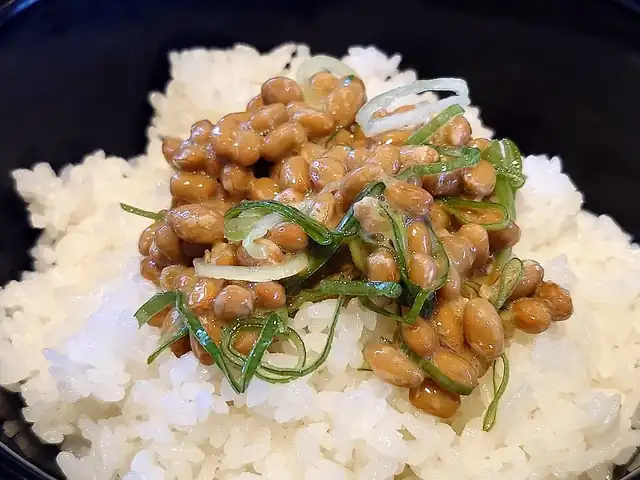
Natto is a traditional Japanese food made from whole soybeans that have been fermented with Bacillus subtilis var. natto. It is often served as a breakfast food with rice. It is served with karashi mustard, soy or tare sauce, and sometimes spring onion. Within Japan, natto is most popular in the eastern regions, including Kantō, Tōhoku, and Hokkaido.
Natto is often considered an acquired taste because of its powerful smell, strong flavor, and sticky, slimy texture. A 2009 survey revealed that 70% of the 3,827 respondents found the taste pleasant, and others who may not find the taste pleasant still eat the food out of habit.
History
Sources differ about the earliest origin of natto. One theory is that natto was codeveloped in multiple locations in the distant past, since it is simple to make with ingredients and tools commonly available in Japan since ancient times.
Chinese douchi
Before natto, there was a similar dish of fermented black soybeans food in China called shì, chǐ , or douchi . These are salted, fermented and aged whole soybean seasonings or condiments invented in China and spread throughout East Asia. They are usually made from fermented soybeans and with an ample amount of salt; however, the ingredients and production methods differ in Japan. Chinese use both black and yellow soybeans to produce douchi. The amount of salt used also differentiates douchi and natto in taste and appearance.
The cultivation methods of soybeans and rice were imported from China to Japan during the Yayoi period, and later on, the circulation of salt began to flourish in Japan. This provided an opportunity for the production of douchi to become popular in Japan. Because salt was expensive at the time, it has been suggested that natto was invented by accident during the production of douchi.
A wooden slip was excavated in Heijō-kyō, which had the Chinese character 豉 (chǐ; soybean) written on it. The excavation of the slip is considered an evidence to support the hypothesis that the invention of natto was based on the Chinese douchi imported to Japan.
The Chinese character 豉 entered Japan in the 8th century. It was pronounced "kuki" until the 11th century, when natto became a new name for fermented soybeans.
Commercialization in the Taisho period
A change in the production of natto occurred in the Taishō period (1912–1926), when researchers discovered a way to produce a natto starter culture containing Bacillus subtilis without the need for straw, thereby simplifying the commercial production of natto and enabling more consistent results.
Appearance and consumption
Natto has a distinctive odor, somewhat akin to a pungent aged cheese. Stirring natto produces many sticky strings. The dish is eaten cold with rice, mixed with the included soy sauce or karashi mustard if eaten from a commercially packaged natto. Other ingredients such as long onion or kimchi are often added.
Natto is frequently eaten as nattō gohan (natto on rice). Natto is occasionally used in other foods, such as natto sushi (nattōmaki), natto toast, in miso soup, tamagoyaki, salad, as an ingredient in okonomiyaki, chahan, or even with spaghetti. Sometimes soybeans are crushed before fermenting.
Many find the taste unpleasant and smelly while others relish it as a delicacy. Natto is more popular in some areas of Japan than in others. Natto is known to be popular in the eastern Kantō region, but less popular in Kansai.
For those who dislike the smell and texture of natto, "dried natto" and "fried natto" were developed around 1990. The smell and stickiness are reduced, making it easier to eat for those who do not like conventional natto. Another type of fermented soybeans called mamenoka (豆乃香) has also been developed by developing versions of natto bacillus varieties that result in less sticky natto.
Production
Natto is made from soybeans, typically natto soybeans. Smaller beans are preferred, as the fermentation process will be able to reach the center of the bean more easily. The beans are washed and soaked in water for 12 to 20 hours to hydrate them, and increase their size. Next, the soybeans are steamed for six hours, although a pressure cooker may be used to reduce the time. The cooked beans are mixed with the bacterium Bacillus subtilis, known as nattō-kin in Japanese. From this point on, care must be taken to keep the ingredients away from impurities and other bacteria. The mixture is fermented at 40 °C for up to 24 hours. Afterward, the natto is cooled, then aged in a refrigerator for up to one week to allow the development of stringiness.
In natto-making facilities, these processing steps have to be done while avoiding incidents in which soybeans are touched by workers. Even though workers use B. subtilis natto as the starting culture, which can suppress some undesired bacterial growth, workers pay extra-close attention not to introduce skin flora onto soybeans.
Mass-produced natto is sold in small polystyrene containers. A typical package contains two, three, or occasionally four containers, each 40 to 50 g. One container typically complements a small bowl of rice.
Natto odor comes from diacetyl and pyrazines, but if it is allowed to ferment too long, then ammonia is released. The fermenting of natto develops glutamic acid, which is why it has an umami flavour.
Related products
Many countries around Asia also produce similar traditional soybean foods fermented with Bacillus bacteria, such as shuidouchi (水豆豉) of China, cheonggukjang (청국장) of Korea, thua nao (ถั่วเน่า) of Thailand, kinema of Nepal and the Himalayan regions of West Bengal and Sikkim, tungrymbai of Meghalaya, hawaijaar of Manipur, bekang um of Mizoram, akhuni of Nagaland, and piak of Arunachal Pradesh, India.
More to savor
Daifuku (Sweet Filled Mochi)
Hallaca (Venezuelan Stuffed Corn Dough)
Edamame: The Green Soybean Dish Made for Snacking