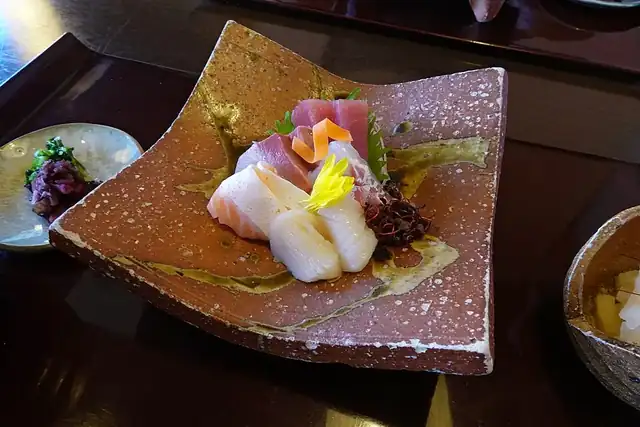
The dish is a starting point for exploring a wider food story. The guide below looks more closely at its background and different forms. When you want to cook, visit the recipe collection for ingredient quantities and step-by-step methods.
In this story
OverviewServingPreparationVarietiesIngredients other than raw fish meatSafetyEnvironmental concernsOverview
Sashimi is a Japanese delicacy that consists of fresh raw fish or other raw meat that is sliced into thin pieces, and is often eaten with soy sauce.
Serving
Sashimi is often served early in a formal Japanese meal, but it can also be served as a sashimi set meal, presented with rice (ご飯) and miso soup (味噌汁) in separate bowls. Japanese chefs consider sashimi the finest dish in Japanese formal dining, and recommend eating it before other strong flavors affect the palate.
The sliced seafood that composes the main ingredient is typically draped over a garnish. The typical garnish is Asian white radish, daikon, shredded into long thin strands, or single leaves of the herb shiso (perilla). Garnishes for sashimi are generally called tsuma, and may also include slices of other raw vegetables, such as cucumbers and carrots, as well as seaweed, and the flowers and leaves and stems of other plants.
Sashimi is popularly served with a dipping sauce (soy sauce) and condiments such as wasabi paste, grated fresh ginger, gari or pickled ginger, grated fresh garlic, or ponzu for meat sashimi, and such garnishes as shiso and shredded daikon radish.
Wasabi paste is sometimes mixed directly into soy sauce as a dipping sauce, which is generally not done when eating sushi (which itself normally includes wasabi). A reputed motivation for serving wasabi with sashimi and also gari, besides its flavor, is killing harmful bacteria and parasites that could be present in raw seafood.
Preparation
To highlight the delicate flavor and texture, the chef cuts fish into different thicknesses depending on the fish's variety, age, and season. The hira-zukuri cut (literally 'flat slice'), is the standard cut for most sashimi. Typically this style of cut is the size of a domino and 3/8 in thick. Tuna, salmon, and kingfish are most commonly cut in this style. The usu-zukuri cut (literally 'thin slice') is an extremely thin, diagonally cut slice that is mostly used to cut firm fish, such as bream, whiting, and flounder. The dimensions of this cut are usually 2 in long and 1/16 in wide. The kaku-zukuri cut (literally 'square slice') is the style in which sashimi is cut into small cubes that are 3/4 in on each side.
The ito-zukuri cut (literally 'thread slice') is the style in which the fish is cut into fine strips, less than 1/16 in in diameter. The fish typically cut with the ito-zukuri style include garfish and squid; squid dish prepared in ito-zukuri is also called ika sōmen and is dipped in dashi or men-tsuyu, in the same way as sōmen (white flour noodles).
Varieties
Popular main ingredients for sashimi include:
Salmon
Squid
Shrimp
Tuna
Mackerel
Horse mackerel
Octopus
Fatty tuna
Yellowtail
Scallop
Sea urchin
flatfish fin(えんがわ, Engawa)
Ingredients other than raw fish meat
Food that is cut into small pieces and eaten with wasabi and soy sauce may be called sashimi in Japan, including the following ingredients. Like bamboo shoots, the food is eaten raw to appreciate its freshness, and producers and farmers offer sashimi at their properties in top season. Some vegetables are eaten as thin-sliced strips and called sashimi since they resemble fish meat, like avocado as salmon and konnyaku as pufferfish.
Less common, but not unusual, sashimi ingredients are vegetarian items, such as yuba (bean curd skin), and raw red meats, such as beef or horse (known as basashi). Chicken "sashimi" (known as toriwasa) is considered by some people to be a delicacy. Chicken sashimi is sometimes slightly braised or seared on the outside.
Vegetable
Avocado: served as "avocado sashimi", it is considered to have a texture that is similar to raw or slightly salted fatty salmon. It is eaten with wasabi soy sauce.
Bamboo shoots: Bamboo grove farmers serve takenoko in the course menu, and sashimi is almost always sold during the high season of harvest.
Japanese radish: among wide varieties of vegetables that are eaten fresh, it is said that the flavor stands out when tasted within a couple of hours after harvesting, and is called sashimi vegetables instead of very fresh salad.
Safety
As a raw food, consuming sashimi can result in foodborne illness when bacteria or parasites are present. For example, anisakiasis is a disease that is caused by the accidental ingestion of larval nematodes in the family Anisakidae, primarily Anisakis simplex, but also Pseudoterranova decipiens. In addition, incorrectly prepared fugu fish may contain tetrodotoxin, a potent neurotoxin.
Another type of foodborne illness that could occur after consuming tainted sashimi is diphyllobothriasis. This disease is an intestinal infection from consuming the tapeworm Diphyllobothrium latum. Common fish such as trout, salmon, pike, and sea bass harbor this parasitic larva in their muscles. Since the innovation of the chilled transport system, paired with the increased consumption of salmon and trout, an increasing number of cases have been recorded annually in northern Japan due to the spread of this disease.
Traditionally, fish that spend at least part of their lives in brackish or fresh water were considered unsuitable for sashimi because of the possibility of parasites. For example, salmon, an anadromous fish, is not traditionally eaten straight out of the river. A study in Seattle, Washington showed that all wild salmon had roundworm larvae that are capable of infecting people, while farm-raised salmon did not have any roundworm larvae. However, a study commissioned by the Pew Foundation found that total organic contaminants were consistently and significantly more concentrated in the farmed salmon as a group than in wild salmon.
Freezing is often used to kill parasites. According to a European Union Regulation No. 843/2004, freezing fish at −20 °C (−4 °F) for 24 hours kills parasites. As of 2024, the Fish and Fishery Products Hazards and Controls manual published by the U.S. Food and Drug Administration (FDA) recommends freezing at −35 °C (−31 °F) for 15 hours, or at −20 °C (−4 °F) for 7 days.
Environmental concerns
With the constant amount of fishing, bluefin tuna populations have been steadily declining. A proposed solution has been farming bluefin tuna in fisheries. Historically, this has posed a problem in that the captive fish are not raised from spawn. Rather, they are raised from small wild fish that are netted and transported to the farms, mostly in the Mediterranean. However, Japanese scientists have found a way to breed and raise the fish entirely in captivity successfully.
More to savor

Toast
Pork Gyoza
Natto: The Japanese Soybean Dish with a Distinctive Bite