The dish is a starting point for exploring a wider food story. The guide below looks more closely at its background and different forms. When you want to cook, visit the recipe collection for ingredient quantities and step-by-step methods.
Overview
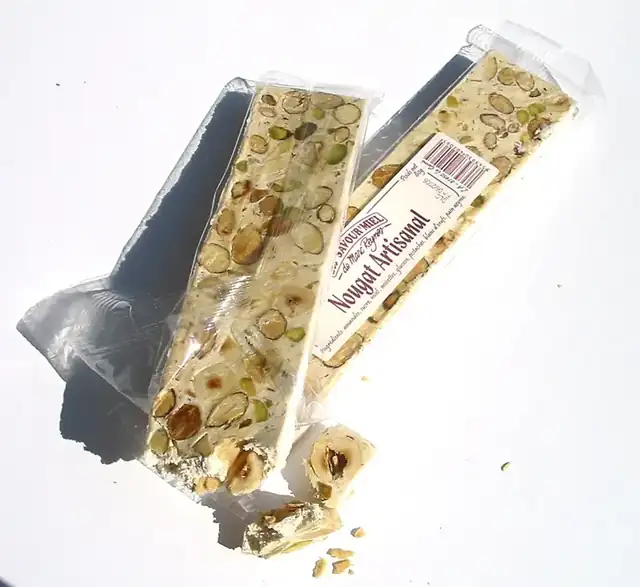
Nougat refers to a variety of soft, chewy or crunchy confections made from sugar, honey or syrup combined with nuts, egg white, cocoa, milk powder, candied fruits, and/or other ingredients. The main colour is usually white or brown.
Nougat is typically eaten either on its own or in candy bars or chocolates. In some places it is an everyday item of confectionary, in others it is associated with particular religious festivals.
The usual version in Western and Southern Europe is made from a mousse of whipped egg white sweetened with sugar or honey. Various nuts and/or pieces of candied fruit are added to flavor and texture the resulting paste, which is allowed to harden and then cut into pieces for serving. Forms of this confection are first attested in Middle Eastern cookbooks during the Middle Ages, but it was greatly popularized as the French Montélimar nougat in the 19th century. Similar confections are staples of regional Iranian cuisine.
Names
English '' was borrowed in the early 19th century from French , whose pronunciation is approximated in English as . The spelling pronunciations (cf. nugget'') and have also become common in British and American English respectively, the latter being the standard American form.
The French name was borrowed in turn from Old Occitan nogat ( or ), meaning "nutty" or "thing with nuts". Cognate words in medieval Catalan and Castilian referred to nutty sauces before being adapted to reference the confection.
English also occasionally uses local names for specific varieties of nougat, such as turrón in Spain and torrone in Italy and Brazil. These names derive from Latin torrere ("to roast"). Venetian nougat, known as mandorlato in Cremona, mandulat in Croatia, in Greece, and mandolate in Brazil, similarly takes its name from vulgar development of Latin ("almond"). Maltese and Sicilian (cubbàita & cupeta) names for nougat derive from Arabic (قُبَّيْط). Iranian forms—particularly those from the Isfahan region—are known as gaz (گز) from its incorporation of psyllid honeydew, traditionally misunderstood as astragalus sap.
History
Principally owing to the simplicity of the basic recipe and a similarity between the Latin terms and , dialectical Italian cupeto and copeta, and the Sicilian terms cubbàita and cupeta, it is sometimes claimed that nougat appears in Roman authors such as Varro, Livy, Martial, Cicero, Aulus Gellius, and Plautus, although the Roman terms as used in those authors were generic words for both sweet and salty delicacies. It is, however, probable that somewhat similar confections were known to the Greeks and Romans.
Cato describes a Carthaginian dish made from eggs, honey, flour, and cheese; the Samnites are sometimes credited with an egg, honey, and hazelnut confection; and terse "recipes" in the Apiciususually taken as walnut, hazelnut, and pine nut custardsmay have been kinds of nougat incorporating milk, spices, and oil as one recipe specifically directs cooks to "spread it out on a pan and when cool cut it into handy pieces like small cookies".
Forms of nougat including whipped egg white, sweeteners, and flavorings are more certainly attested in recipes from a 10th-century book written in Baghdad, then the capital of the Abbasid Caliphate. It was known as ALA (ناطف), derived from the Arabic triliteral root ALA (ن ط ف) with the base sense of "dribbling", "trickling", and referencing the paste's viscous mass. The recipes describe the nougat as varieties made in Baghdad (now in Iraq) and Harran (now in southeastern Turkey). Medieval references to ALA have been found at locations within the triangle between Urfa, Aleppo, and Baghdad and in the writings of the 10th-century traveler Ibn Hawqal, who stated he ate ALA in Manbij (now in Syria) and Bukhara (now in Uzbekistan).
White nougat
The usual form of nougat in Western and Southern Europe is made from a mousse of whipped egg white sweetened with sugar or honey. Various nuts including almonds, pistachios, macadamias, hazelnuts, and walnuts and/or pieces of candied fruit are added to the resulting paste, which is allowed to harden and then cut into pieces for serving. It is usually made at home or manufactured at artisan scale by nougat makers, known in French as nougatiers. Some manufacturers wrap nougats in edible wafer paper to ease handling; this can affect the taste depending on its thickness.
The most prominent form of nougat in French cuisine is Montélimar nougat, traditionally made with whipped egg white, sugar, lavender honey, roasted almonds & pistachios, vanilla, and unleavened bread. It received protected status in 2024.
Spanish nougat (turrón) is traditionally made with whipped egg whites, honey, and roasted almonds, with two styles particularly distinguished. Soft (blando) or Jijona nougat (turrón de Jijona) is over 60% almonds by mass but kept mushy or crumbly by the addition of oil to the recipe. Lacking such oil, hard (duro) or Alicante nougat (turrón de Alicante) is extremely firm, particularly when prepared in very thick blocks. Jijona nougat has also received PGI protected status.
Whipped nougat
In the United States, nougat more often refers to a softer brown paste made in industrial settings. It usually consists of corn syrup or sucrose aerated with a whipping agent like hydrolyzed soy protein or gelatine; other components such as vegetable fats, milk powder, and preservatives may be added to impart or enhance desired characteristics. Such nougat is used as a filling in commercial candy bars, frequently in combination with milk chocolate, caramel, and peanuts. Varieties of this nougat are found in Baby Ruth, Double Decker, Fast Break, Milky Way, Moro, Nuts, Snickers, Twin Bing, and Zero bars. Occasionally, American confections feature its form of nougat as their primary component. Especially aerated "fluffy nougat" is the main ingredient in 3 Musketeers candy bars.
Chocolate-derived confections
In Central and Northern Europe, the term "nougat" has been confusingly applied to confections (or fillings) made primarily of chocolate and ground nuts, likely derived from Italian gianduja, a blend of chocolate and hazelnut paste. German nougat, in particular, consists of chocolate and ground hazelnuts. Viennese nougat is a similar confection made with ground almonds. Introduced to Finland by Fazer in 1904, it has become a staple Finnish Christmas treat.
In the context of Central and Northern Europe, traditional egg-white nougat is therefore distinguished as "French nougat".
More to savor
Daifuku (Sweet Filled Mochi)
Ají de Gallina (Peruvian Chili Chicken)
Pudding: Why One Word Can Mean So Many Different Dishes