This longer reference provides the background behind the topic. Read it alongside the recipe collection when you want to connect an ingredient or food idea with a dish to prepare.
In this story
OverviewSpecies and geographic spreadElevation and pinecone productionPhysical characteristicsCulinary usesTaste disturbancesFood fraudOverview
Pine nuts, also called piñón , pinoli , or pignoli, are the edible seeds of pines (family Pinaceae, genus Pinus). According to the Food and Agriculture Organization, only 29 species provide edible nuts, while 20 are traded locally or internationally owing to their seed size being large enough to be worth harvesting; in other pines, the seeds are also edible but are too small to be of notable value as human food. The biggest exporters of pine nuts are China, Russia, North Korea, and Pakistan.
As pines are gymnosperms, not angiosperms (flowering plants), pine nuts are not "true nuts"; they are not botanical fruits, the seed not being enclosed in an ovary which develops into the fruit, but simply bare seeds—"gymnosperm" meaning literally "naked seed" (from γυμνός and σπέρμα). The similarity of pine nuts to some angiosperm fruits is an example of convergent evolution.
Species and geographic spread
In Asia, two species, in particular, are widely harvested: Korean pine (Pinus koraiensis) in northeast Asia (the most important species in international trade) and chilgoza pine (P. gerardiana) in the western Himalaya. Four other species, Siberian pine (P. sibirica), Siberian dwarf pine (P. pumila), Chinese white pine (P. armandii) and lacebark pine (P. bungeana), are also used to a lesser extent. Russia is the largest producer of P. sibirica nuts in the world, followed by either Mongolia or Afghanistan. They each produce over 10,000 MT annually, most of it exported to China.
Pine nuts produced in Europe mostly come from the stone pine (P. pinea), which has been cultivated for its nuts for over 5,000 years. Pine nuts have been harvested from wild trees for far longer. The Swiss pine (P. cembra) is also used, to a very small extent.
Elevation and pinecone production
Some growers claim that the elevation of the pinyon pine is an important determinant of the quantity of pine cone production and, therefore, will largely determine the number of pine nuts the tree will yield. The US Department of Agriculture notes that variation in cone production between trees growing on identical sites is often observed.
American pinyon pine cone production is most commonly found at an elevation between 6000 and 8500 ft, and ideally at 7000 ft. This is due to higher temperatures at elevations lower than 6000 ft during the spring, which dry up humidity and moisture content (particularly snow packs) that provide for the tree throughout the spring and summer, causing little nourishment for pine cone maturity.
Although several other environmental factors determine the conditions of the ecosystem (such as clouds and rain), the trees tend to abort cones without sufficient water. High humidity encourages cone development. There are certain topographical areas found in lower elevations, such as shaded canyons, where the humidity remains constant throughout the spring and summer, allowing pine cones to fully mature and produce seed.
Physical characteristics
When first extracted from the pine cone, they are covered with a hard shell (seed coat), thin in some species and thick in others. The nutrition is stored in the embryo (sporophyte) in the center. Although a nut in the culinary sense, in the botanical sense, pine nuts are seeds; being a gymnosperm, they lack a carpel (fruit) outside.
The shell must be removed before the pine nut can be eaten. Unshelled pine nuts have a long shelf life if kept dry and refrigerated (-5 to 2 C); shelled nuts (and unshelled nuts in warm conditions) deteriorate rapidly, becoming rancid within a few weeks or even days in warm, humid conditions. Pine nuts are commercially available in the shelled form, but due to poor storage, they can have poor flavor and may already be rancid at the time of purchase. Consequently, pine nuts are often frozen to preserve their flavor.
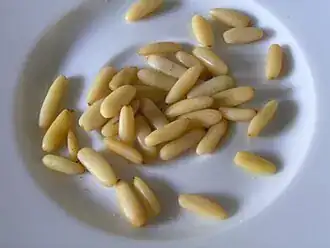
European pine nuts may be distinguished from Asian ones by their greater length than girth; Asian pine nuts are stubbier, shaped somewhat like long kernels of corn. The American piñon nuts are known for their large size and ease of shelling. In the United States, Pinus edulis, the hard shell of New Mexico and Colorado, became a sought-after species due to the trading post system and the Navajo people who used the nuts as a means of commerce. The Italian pine nut (P. pinea) was brought to the United States by immigrants and became a favored treat along the East Coast in the early 1930s, when bumper crops of American pine nuts were readily available at low prices.
Culinary uses
Pine nuts have been eaten in Europe and Asia since the Paleolithic period. They are frequently added to meat, fish, salads, and vegetable dishes or baked into bread.
In Italian, they are called pinoli (in the US, they are often called pignoli, but in Italy, pignolo is actually a word far more commonly used to describe a fussy, overly fastidious or extremely meticulous person) and are an essential component of Italian pesto sauce; the upsurge in the popularity of this sauce since the 1990s has increased the visibility of the nut in America, primarily on the West Coast. Torta della nonna (literally "granny's cake") is a generic Italian dish name that in most families indicates an old family recipe for any cake but often is used for a tart or a pie filled with custard, topped with pine nuts and optionally dusted with icing sugar.
Taste disturbances
Some raw pine nuts can cause pine mouth syndrome, a taste disturbance lasting from a few days to a few weeks after consumption. A bitter, metallic, unpleasant taste is reported. There are no known lasting effects, with the United States Food and Drug Administration reporting that there are "no apparent adverse clinical side effects". Raw nuts from Pinus armandii, mainly in China, may be the cause of the problem. Metallic taste disturbance is typically reported 1–3 days after ingestion, being worse on day two and typically lasting up to two weeks. Cases are self-limited and resolve without treatment.
Food fraud
In the United States, from 2008 to 2012, some people reported a bitter metallic taste ("pine mouth") that sometimes lasted for weeks after they ate pine nuts. After an international investigation, the FDA found that some manufacturers substituted a non-food species of pine nuts in place of more expensive edible pine nut species as a form of food fraud.
More to savor

Chicken Vindaloo

Butternut Squash Soup
Getting to Know Peach: A Food Lover’s Guide