This longer reference provides the background behind the topic. Read it alongside the recipe collection when you want to connect an ingredient or food idea with a dish to prepare.
In this story
OverviewDescriptionTransgenicityNamesProductionComparison to other food staplesCulinaryOverview
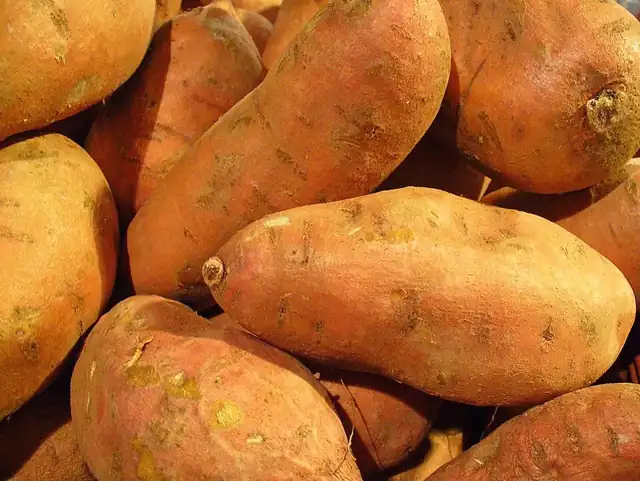
The sweet potato or sweetpotato (Ipomoea batatas) is a dicotyledonous plant in the morning glory family, Convolvulaceae. Its sizeable, starchy, sweet-tasting, tuberous roots are used as a root vegetable, which is a staple food in parts of the world. Cultivars of the sweet potato have been bred to bear tubers with flesh and skin of various colors. Moreover, the young shoots and leaves are eaten as greens with nutritional composition comparable to spinach. The sweet potato and the potato are only distantly related, both being in the order Solanales. Although darker sweet potatoes are often known as yams in parts of North America, they are even more distant from actual yams, which are monocots in the order Dioscoreales.
The sweet potato is native to the warm tropical regions of South America in modern Ecuador. Of the approximately 50 genera and more than 1,000 species of Convolvulaceae, I. batatas is the only crop plant of major importance—some others are used locally (e.g., I. aquatica 'kangkong' as a green vegetable), but many are poisonous. The genus Ipomoea that contains the sweet potato also includes several garden flowers called morning glories, but that term is not usually extended to I. batatas. Some cultivars of I. batatas are grown as ornamental plants under the name tuberous morning glory and sometimes used in a horticultural context.
Description
The plant is a herbaceous perennial vine, bearing alternate, triangle-shaped or palmately lobed leaves and medium-sized, sympetalous flowers. The stems usually crawl on the ground and form adventitious roots at the nodes. The leaves are screwed along the stems. The leaf stalk is 5 to 20 in long. The leaf blades are very variable, 5 to 13 cm long, the shape is heart-, kidney-, to egg-shaped, rounded or triangular, and spear-shaped, the edge can be entire, toothed, or often three- to seven-lobed, cut or divided. Most of the leaf surfaces are bare, rarely hairy, and the tip is rounded to pointed. The leaves are mostly green in color, but the accumulation of anthocyanins, especially along the leaf veins, can make them purple. Depending on the variety, the total length of a stem can be between 0.5 and 4 m.
Some cultivars also form shoots up to 16 m in length. However, these do not form underground storage organs.
The hermaphrodite, five-fold, and short-stalked flowers are single or few in stalked, zymous inflorescences that arise from the leaf axils and stand upright. It produces flowers when the day is short. The small sepals are elongated and taper to a point and spiky and (rarely only 7) 10 to 15 mm long, usually finely haired or ciliate. The inner three are a little longer. The 4 to 7 cm long, overgrown and funnel-shaped, folded crown, with a shorter hem, can be lavender to purple-lavender in color, the throat is usually darker in color, but white crowns can also appear. The enclosed stamens are of unequal length with glandular filaments. The two-chambered ovary is upper constant with a relatively short stylus. Seeds are only produced from cross-pollination.
Transgenicity
The genome of cultivated sweet potatoes contains sequences of DNA from Agrobacterium (sensu lato; specifically, one related to Rhizobium rhizogenes), with genes actively expressed by the plants. The T-DNA transgenes were not observed in closely related wild relatives of the sweet potato. Studies indicated that the sweet potato genome evolved over millennia, with eventual domestication of the crop taking advantage of natural genetic modifications. These observations make sweet potatoes the first known example of a naturally transgenic food crop.
Names
Although the soft, orange sweet potato is often called a "yam" in parts of North America, the sweet potato is distinct from the botanical yam (Dioscorea), which has a cosmopolitan distribution, and belongs to the monocot family Dioscoreaceae. A different crop plant, the oca (Oxalis tuberosa, a species of wood sorrel), is called a "yam" in many parts of the world.
Although the sweet potato is not closely related botanically to the common potato, they have a shared etymology. The first Europeans to taste sweet potatoes were members of Christopher Columbus's expedition in 1492. Later explorers found many cultivars under an assortment of local names, but the name which stayed was the indigenous Taíno name of batata. The Spanish combined this with the Quechua word for potato, papa, to create the word patata for the common potato.
Production
In 2020, global production of sweet potatoes was 89 million tonnes, led by China with 55% of the world total (table). Secondary producers were Malawi, Tanzania, and Nigeria. It is the fifth-most-important food crop in developing countries. Studies are being done to develop a salt tolerant variety to combat the effects of climate change.
Comparison to other food staples
The table below presents the relative performance of sweet potato (in column)'''' to other staple foods on a dry weight basis to account for their different water contents. While sweet potato provides less edible energy and protein per unit weight than cereals, it has higher nutrient density than cereals.
According to a study by the United Nations Food and Agriculture Organization, sweet potatoes are the most efficient staple food to grow in terms of farmland, yielding roughly 28000 kcal/acre daily.
Culinary
The starchy, tuberous roots of the sweet potato are by far the most important product of the plant. In some tropical areas, the tubers are a staple food crop and are often cooked before consumption, as this increases nutritive value and digestibility, although the American colonists in the Southeast ate raw sweet potatoes as a staple food.
The vines' tips and young leaves are edible as a green vegetable with a characteristic flavor. Older growths may be used as animal fodder.
== Africa ==Amukeke (sun-dried slices of root) and inginyo (sun-dried crushed root) are a staple food for people in northeastern Uganda. Amukeke is mainly served for breakfast, eaten with peanut sauce. Inginyo is mixed with cassava flour and tamarind to make atapa. People eat atapa with smoked fish cooked in peanut sauce or with dried cowpea leaves cooked in peanut sauce. Emukaru (earth-baked root) is eaten as a snack anytime and is mostly served with tea or with peanut sauce. Similar uses are also found in South Sudan.
More to savor

Chicken Vindaloo
Malpua (South Asian Sweet Pancake)
Getting to Know Taro: A Food Lover’s Guide