This longer reference provides the background behind the topic. Read it alongside the recipe collection when you want to connect an ingredient or food idea with a dish to prepare.
Overview
A plum is a fruit of some species in Prunus subg. Prunus. Dried plums are usually called prunes.
Plums are likely to have been one of the first fruits domesticated by humans, with origins in Eastern Europe, the Caucasus Mountains and China. They were brought to Britain from Asia, and their cultivation has been documented in Andalusia, southern Spain. Plums are a diverse group of species, with trees reaching a height of 5 - 6 m when pruned. The fruit is a drupe, with a firm and juicy flesh. Plums can be eaten fresh, dried to make prunes, used in jams, or fermented into wine and distilled into brandy. Plum seeds (also called kernels) contain the cyanide-like poison, amygdalin, a cyanogenic glycoside.
In 2023, China produced 55% of the world total of plums. Japanese or Chinese plums dominate the fresh fruit market, while European plums are also common in some regions.
History
Plums are likely to have been one of the first fruits domesticated by humans. Three of the most abundantly cultivated species are not found in the wild, only around human settlements: Prunus domestica has been traced to East European and Caucasian mountains, while Prunus salicina and Prunus simonii originated in China. Plum remains have been found in Neolithic age archaeological sites along with olives, grapes and figs. According to Ken Albala, plums originated in Iran. They were brought to Britain from Asia.
An article on plum tree cultivation in Andalusia (southern Spain) appears in Ibn al-'Awwam's 12th-century agricultural work, Book on Agriculture.
Plum cultivation is recorded in medieval monasteries in England. A garden with 'ploumes' and 'bulaces' is referred to by Chaucer.
The cultivation of plums increased during the 17th and 18th centuries. During this period greengages were given their English name and the Mirabelle plum became firmly established. Advances in the development of new varieties in England were made by Thomas Rivers. Two examples of River's work are the varieties Early Rivers and Czar. Both are still esteemed. The fame of the Victoria plum, first sold in 1844, has been put down to good marketing rather than any inherent quality.
Etymology and names
The name plum comes from Old English plūme "plum, plum tree", an evolution of plūmā, which was a common West Germanic loanword from Latin prūnum, which borrowed it from Ancient Greek προῦμνον : , itself believed to be a loanword from an unknown language of Asia Minor. In the late 18th century, the word plum was used to indicate "something sweet or agreeable", probably in reference to tasty fruit pieces in desserts, as in the word sugar plum.
Description
Plums are a diverse group of species. The commercially important plum trees are medium-sized, usually pruned to 5 – 6 m height. The tree is of medium hardiness. Without pruning, the trees can reach 12 m in height and spread across 10 m. They blossom in different months in different parts of the world; for example, in about January in Taiwan and early April in the United Kingdom.
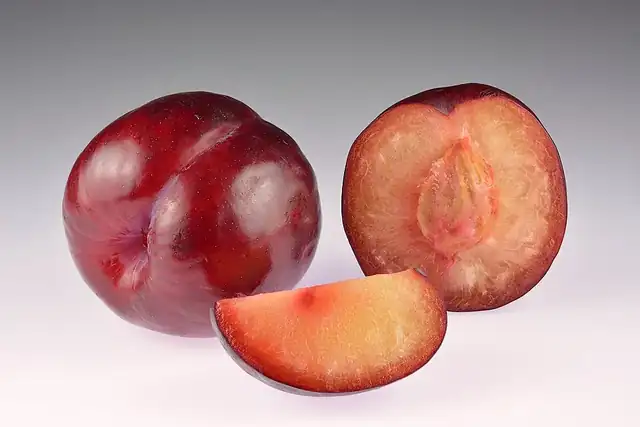
Fruits are usually of medium size, between 2 - 7 cm in diameter, globose to oval. The flesh is firm and juicy. The fruit's peel is smooth, with a natural waxy surface that adheres to the flesh. The plum is a drupe, meaning its fleshy fruit surrounds a single hard fruitstone which encloses the fruit's seed.
Cultivation and uses
Japanese or Chinese plums are large and juicy with a long shelf life and therefore dominate the fresh fruit market. They are usually clingstone and not suitable for making prunes. They are cultivars of Prunus salicina or its hybrids. The cultivars developed in the US are mostly hybrids of P. salicina with P. simonii and P. cerasifera. Although these cultivars are often called Japanese plums, two of the three parents (P. salicina and P. simonii) originated from China and one (P. cerasifera) from Eurasia.
In some parts of Europe, European plum (Prunus domestica) is also common in fresh fruit market. It has both dessert (eating) or culinary (cooking) cultivars, which include:
Damson (purple or black skin, green flesh, clingstone, astringent)
Prune plum (usually oval, freestone, sweet, fresh eaten or used to make prunes)
Greengage (firm, green flesh and skin even when ripe)
Mirabelle (dark yellow, predominantly grown in northeast France)
Victoria (yellow flesh with a red or mottled skin)
Yellowgage or golden plum (similar to greengage, but yellow)
In West Asia, myrobalan plum or cherry plum (Prunus cerasifera) is also widely cultivated. In Russia, apart from these three commonly cultivated species, there are also many cultivars resulting from hybridization between Japanese plum and myrobalan plum, known as Russian plum (Prunus × rossica).
Production
In 2023, world production of plums (data combined with sloes) was 12.5 million tonnes, led by China with 55% of the total, and Romania and Chile as the next largest producers (table).
Species
The numerous species of Prunus subg. Prunus are classified into many sections, but not all of them are called plums. Plums include species of sect. Prunus and sect. Prunocerasus, as well as P. mume of sect. Armeniaca. Only two plum species, the hexaploid European plum (Prunus domestica) and the diploid Japanese plum (Prunus salicina and hybrids), are of worldwide commercial significance. The origin of P. domestica is uncertain but may have involved P. cerasifera and possibly P. spinosa as ancestors. Other species of plum variously originated in Europe, Asia and America.
Sect. Prunus (Old World plums) – leaves in bud rolled inwards; flowers 1–3 together; fruit smooth, often wax-bloomed
Sect. Prunocerasus (New World plums) – leaves in bud folded inwards; flowers 3–5 together; fruit smooth, often wax-bloomed
Sect. Armeniaca (apricots) – leaves in bud rolled inwards; flowers very short-stalked; fruit velvety; treated as a distinct subgenus by some authors
In certain parts of the world, some fruits are called plums and are quite different from fruits known as plums in Europe or the Americas. For example, marian plums are popular in Thailand, Malaysia and Indonesia, otherwise also known as gandaria, plum mango, ma-praang, ma-yong, ramania, kundang, rembunia or setar. Another example is the loquat, also known as Japanese plum and Japanese medlar, as well as nispero, bibassier and wollmispel elsewhere. In South Asia and Southeast Asia, Jambul, a fruit from tropical tree in family Myrtaceae, is similarly sometimes referred to 'damson plums', and it is different from damson plums found in Europe and Americas. Jambul is also called as Java plum, Malabar plum, Jaman, Jamun, Jamblang, Jiwat, Salam, Duhat, Koeli, Jambuláo or Koriang.
More to savor

Chicken Vindaloo
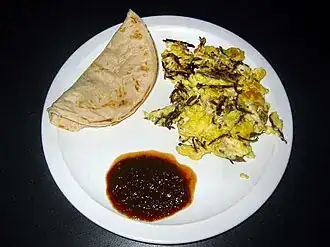
Machacado con Huevo (Eggs with Shredded Beef)
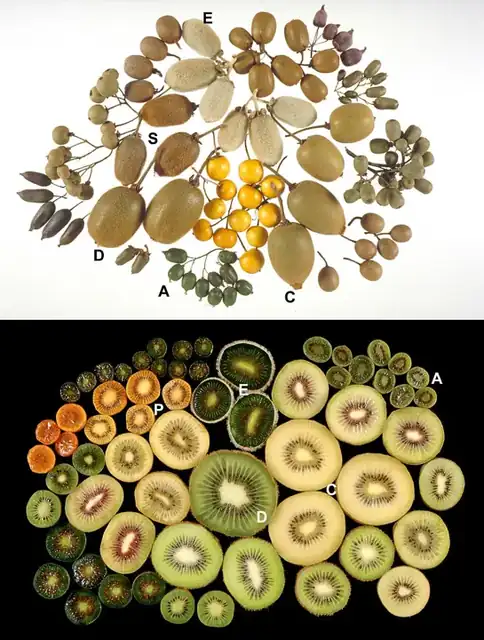
Beyond the Shopping List: The Story of Kiwifruit