Use the regional background below as a starting point for exploring the food, rather than expecting one dish to represent every household. Food traditions differ within a country and continue to change through travel, migration, and everyday cooking.
In this story
OverviewMealsFish and seafoodMeat and poultryMeatVegetables and starchesInfluences on world cuisineOverview
Portuguese cuisine (Cozinha portuguesa) consists of the traditions and practices of cooking in Portugal. The oldest known book on Portuguese cuisine, entitled Livro de Cozinha da Infanta D. Maria de Portugal, from the 16th century, describes many popular dishes of meat, fish, poultry and others.
Culinária Portuguesa, by António-Maria De Oliveira Bello, better known as Olleboma, was published in 1936.
Despite being relatively restricted to an Atlantic, Celtic sustenance, the Portuguese cuisine also has strong French and Mediterranean influences.
Meals
A Portuguese breakfast often consists of fresh bread, with butter, ham, cheese or jam, accompanied by coffee, milk, tea or hot chocolate. A small espresso coffee (sometimes called a bica after the spout of the coffee machine, or Cimbalino after the Italian coffee machine La Cimbali) is a very popular beverage had during breakfast or after lunch, which is enjoyed at home or at the many cafés in towns and cities throughout Portugal. Sweet pastries are also very popular, as well as breakfast cereal, mixed with milk or yogurt and fruit. The pastel de nata, one of the most salient symbols of the Portuguese cuisine, is a common feature of the Portuguese breakfast. They are frequently eaten with a shot of espresso, both at breakfast or as an afternoon treat.
Lunch, often lasting over an hour, is served between noon and 2 o'clock, typically around 1 o'clock and dinner is generally served around 8 o'clock. There are three main courses, with lunch and dinner usually including a soup. A common Portuguese soup is caldo verde, which consists of a base of cooked, then pureed, potato, onion and garlic, to which shredded collard greens are then added. Slices of chouriço (a smoked or spicy Portuguese sausage) are often added as well, but may be omitted, thereby making the soup fully vegan.
Fish and seafood
Portugal is a seafaring nation with a well-developed fishing industry and this is reflected in the amount of fish and seafood eaten. The country has Europe's highest fish consumption per capita, and is among the top four in the world for this indicator. Fish is served grilled, boiled (including poached and simmered), fried or deep-fried, stewed known as caldeirada (often in clay pot cooking), roasted, or even steamed.
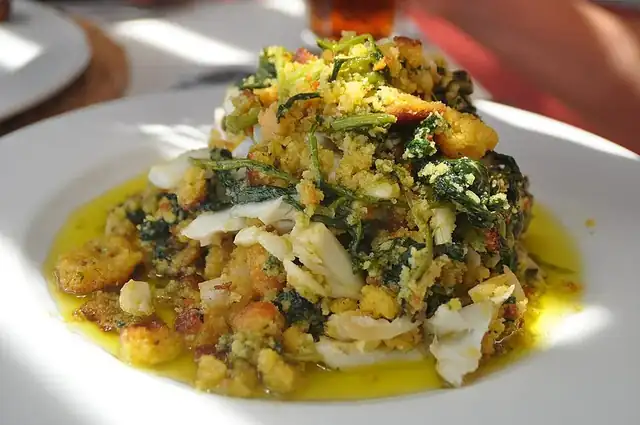
Foremost amongst these is bacalhau (cod), which is the type of fish most consumed in Portugal. It is said that there are more than 365 ways to cook cod, meaning at least one dish for each day of the year. Cod is almost always used dried and salted, because the Portuguese fishing tradition in the North Atlantic developed before the invention of refrigeration—therefore it needs to be soaked in water or sometimes milk before cooking. The simpler fish dishes are often flavoured with virgin olive oil and white wine vinegar.
Meat and poultry
Eating meat and poultry on a daily basis was historically a privilege of the upper classes. Pork and beef are the most common meats in the country. Meat was a staple at the nobleman's table during the Middle Ages. A Portuguese Renaissance chronicler, Garcia de Resende, describes how an entrée at a royal banquet was composed of a whole roasted ox garnished with a circle of chickens. A common Portuguese dish, mainly eaten in winter, is cozido à portuguesa, which somewhat parallels the French pot-au-feu or the New England boiled dinner. Its composition depends on the cook's imagination and budget. An extensive lavish cozido may include beef, pork, salt pork, several types of charcutaria (such as cured chouriço, morcela e chouriço de sangue, linguiça, farinheira, etc.), pig's feet, cured ham, potatoes, carrots, turnips, cabbage and rice.
This would originally have been a favourite food of the affluent farmer, which later reached the tables of the urban bourgeoisie and typical restaurants.
Meat
Tripas à moda do Porto (tripe with white beans) is said to have originated in the 14th century, when the Castilians laid siege to Lisbon and blockaded the Tagus entrance. The Portuguese chronicler Fernão Lopes dramatically recounts how starvation spread all over the city. Food prices rose astronomically, and small boys would go to the former wheat market place in search of a few grains on the ground, which they would eagerly put in their mouths when found. Old and sick people, as well as prostitutes, or in short anybody who would not be able to aid in the city's defence, were sent out to the Castilian camp, only to be returned to Lisbon by the invaders.
It was at this point that the citizens of Porto decided to organize a supply fleet that managed to slip through the river blockade. Apparently, since all available meat was sent to the capital for a while, Porto residents were limited to tripe and other organs. Others claim that it was only in 1415 that Porto deprived itself of meat to supply the expedition that conquered the city of Ceuta. Whatever the truth may be, since at least the 17th century, people from Porto have been known as tripeiros or tripe eaters. Another Portuguese dish with tripe is dobrada.
Nowadays, the Porto region is equally known for the toasted sandwich known as a francesinha (meaning "Frenchie").
Vegetables and starches
Vegetables that are popular in Portuguese cookery include numerous cabbage and collard varieties, sprouts (traditionally collected from turnips and different cabbage shoots) tomatoes, onions and peas. There are many starchy dishes, such as feijoada, a rich black bean stew with beef and pork, and açorda, a Portuguese bread soup. Numerous ’’cozido’’ stews are prepared from kale, white beans, red beans, Catarino and Bragançano, fava beans, black eyed beans. Several pumpkins like menina and porqueira varietals, are used in soups and soufflés.
One of numerous vegetable and starch rich soups and broths is caurdo or caldo à Lavrador, a soup made of cabbage, red beans, potatoes, prosciutto chunks and wheat flour.
Influences on world cuisine
Portugal's maritime explorers and traders after the Age of Discovery influenced the cuisines in both directions. Portuguese influences reside in the Chinese territory of Macau (Macanese cuisine) and territories which were part of the Portuguese India, such as Goa or Kerala, where vindalho (a spicy curry), shows the pairing of vinegar, chilli pepper and garlic.
The Persian orange, grown widely in southern Europe since the 11th century, was bitter. Sweet oranges were brought from India to Europe in the 15th century by Portuguese traders. Some Southeast Indo-European languages name the orange after Portugal, which was formerly its main source of imports.
More to savor

Chicken Vindaloo
Asaro
At the Polish Table: The Food Behind a Shared Meal