This longer reference provides the background behind the topic. Read it alongside the recipe collection when you want to connect an ingredient or food idea with a dish to prepare.
In this story
OverviewDescriptionPhylogenyVarietiesProductionEffects of climate change on productionCulinaryOverview
The potato is a starchy tuberous vegetable native to the Americas that is consumed as a staple food in many parts of the world. Potatoes are underground stem tubers of the plant Solanum tuberosum, a perennial in the nightshade family Solanaceae.
Wild potato species can be found from the southern United States to southern Chile. Genetic studies show that the cultivated potato has a single origin, in the area of present-day southern Peru and extreme northwestern Bolivia. Potatoes were domesticated there about 7,000–10,000 years ago from a species in the S. brevicaule complex. Many varieties of the potato are cultivated in the Andes region of South America, where the species is indigenous.
The Spanish introduced potatoes to Europe in the second half of the 16th century from the Americas. They are a staple food in many parts of the world and an integral part of much of the world's food supply. Following centuries of selective breeding, there are now over 5,000 different varieties of potatoes. The potato remains an essential crop in Europe, especially Northern and Eastern Europe, where per capita production is still the highest in the world, while the most rapid expansion in production during the 21st century was in southern and eastern Asia, with China and India leading the world production as of 2023.
Description
Potato plants are herbaceous perennials that grow up to 1 m high. The stems are hairy. The leaves have roughly four pairs of leaflets. The flowers range from white or pink to blue or purple; they are yellow at the centre, and are insect-pollinated.
The plant develops tubers to store nutrients. These are not roots but stems that form from thickened rhizomes at the tips of long thin stolons. On the surface of the tubers there are "eyes," which act as sinks to protect the vegetative buds from which the stems originate. The "eyes" are arranged in helical form. In addition, the tubers have small holes that allow breathing, called lenticels. The lenticels are circular and their number varies depending on the size of the tuber and environmental conditions. Tubers form in response to decreasing day length, although this tendency has been minimized in commercial varieties.
After flowering, potato plants produce small green fruits that resemble green cherry tomatoes, each containing about 300 very small seeds.
Phylogeny
Like the tomato, potatoes belong to the genus Solanum, which is a member of the nightshade family, the Solanaceae. That is a diverse family of flowering plants, often poisonous, that includes the mandrake (Mandragora), deadly nightshade (Atropa), and tobacco (Nicotiana), as shown in the outline phylogenetic tree (many branches omitted). The most commonly cultivated potato is S. tuberosum; there are several other species.
The major species grown worldwide is S. tuberosum (a tetraploid with 48 chromosomes), and modern varieties of this species are the most widely cultivated. There are also four diploid species (with 24 chromosomes): S. stenotomum, S. phureja, S. goniocalyx, and S. ajanhuiri. There are two triploid species (with 36 chromosomes): S. chaucha and S. juzepczukii. There is one pentaploid cultivated species (with 60 chromosomes): S. curtilobum.
Varieties
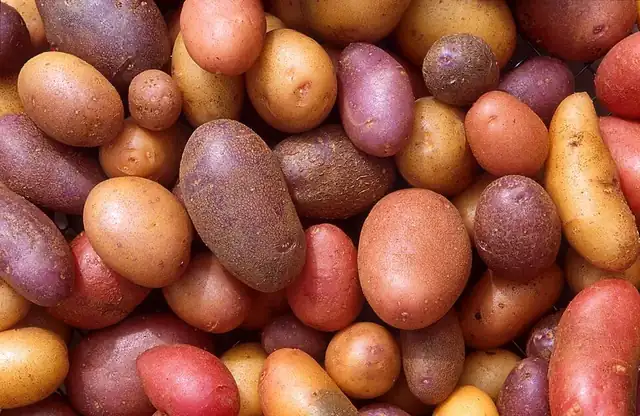
There are some 5,000 potato varieties worldwide, 3,000 of them in the Andes alone — mainly in Peru, Bolivia, Ecuador, Chile, and Colombia. Over 100 cultivars might be found in a single valley, and a dozen or more might be maintained by a single agricultural household.
The European Cultivated Potato Database is an online collaborative database of potato variety descriptions updated and maintained by the Scottish Agricultural Science Agency within the framework of the European Cooperative Programme for Crop Genetic Resources Networks—which is run by the International Plant Genetic Resources Institute.
Around 80 varieties are commercially available in the UK.
Production
In 2024, world production of potatoes was 390 million tonnes, led by China with 24% of the total, and India as a major secondary producer (table). The total area of potatoes harvested in the world in 2024 was 17.1 e6ha.
Effects of climate change on production
Climate change is predicted to have significant effects on global potato production. Like many crops, potatoes are likely to be affected by changes in atmospheric carbon dioxide, temperature and precipitation, as well as interactions between these factors. As well as affecting potatoes directly, climate change will also affect the distributions and populations of many potato diseases and pests. While the potato is less important than maize, rice, wheat and soybeans, which are collectively responsible for around two-thirds of all calories consumed by humans (both directly and indirectly as animal feed), it still is one of the world's most important food crops.
Altogether, one 2003 estimate suggests that future (2040–2069) worldwide potato yield would be 18–32% lower than it was at the time, driven by declines in hotter areas like Sub-Saharan Africa, unless farmers and potato cultivars can adapt to the new environment.
Culinary
Potato dishes vary around the world. Peruvian cuisine naturally contains the potato as a primary ingredient in many dishes, as around 3,000 varieties of the tuber are grown there. Chuño is a freeze-dried potato product traditionally made by Quechua and Aymara communities of Peru and Bolivia. In the UK, potatoes form part of the traditional dish fish and chips. Roast potatoes are commonly served as part of a Sunday roast dinner and mashed potatoes form a major component of several other traditional dishes, such as shepherd's pie, bubble and squeak, and bangers and mash. New potatoes may be cooked with mint and are often served with butter. In Germany, Northern Europe (Finland, Latvia and especially Scandinavian countries), Eastern Europe (Russia, Belarus and Ukraine) and Poland, newly harvested, early ripening varieties are considered a special delicacy.
Boiled whole and served un-peeled with dill, these "new potatoes" are traditionally consumed with Baltic herring. Puddings made from grated potatoes (kugel, kugelis, and potato babka) are popular items of Ashkenazi, Lithuanian, and Belarusian cuisine. Cepelinai, the national dish of Lithuania, are dumplings made from boiled grated potatoes, usually stuffed with minced meat. In Italy, in the Friuli region, potatoes serve to make a type of pasta called gnocchi. Potato is used in northern China where rice is not easily grown, a popular dish being 青椒土豆丝 (qīng jiāo tǔ dòu sī), made with green pepper, vinegar and thin slices of potato. In the winter, roadside sellers in northern China sell roasted potatoes.
More to savor

Chicken Vindaloo
Tattie Scones

Pecan in the Kitchen: Exploring an Everyday Ingredient