A drink can be an everyday routine, something shared with company, or a way to explore a food tradition. The background below looks more closely at the preparation and story behind the cup or glass.
In this story
OverviewMaocha or rough teaFlavourSix Great Tea MountainsTea factoriesTea packagingPreparationOverview
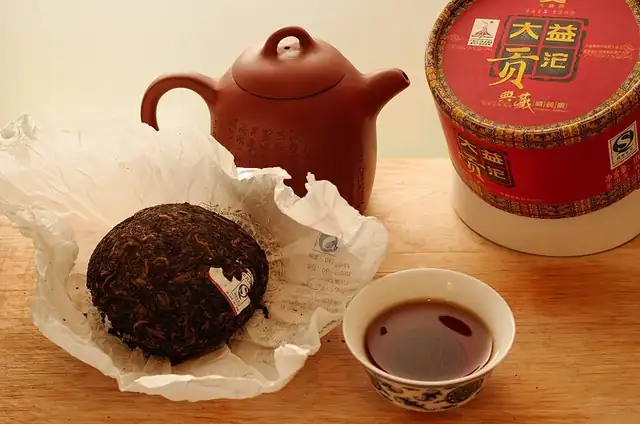
Pu'er or pu-erh is a variety of fermented tea traditionally produced in Yunnan Province, China. Pu-erh tea is made from the leaves of the Yunnan tea plant Camellia sinensis var. assamica, which is a specific variety of tea plant that is native to Yunnan. It differs from Yunnan tea (dianhong) in that pu'er tea goes through a complex fermentation process. In the context of traditional Chinese tea production terminology, fermentation refers to microbial fermentation (called 'wet piling'), and is typically applied after the tea leaves have been sufficiently dried and rolled. As the tea undergoes controlled microbial fermentation, it also continues to oxidize, which is also controlled, until the desired flavors are reached.
This process produces tea known as , though the term is commonly translated to English as "dark tea" to distinguish it from the English-language "black tea" , which it is not.
Maocha or rough tea
The intent of the stage ( or ; literally, "light green rough tea" or "rough tea" respectively) is to dry the leaves and keep them from spoiling. It involves minimal processing and there is no fermentation involved.
The first step in making raw or ripened pu'er is picking appropriate tender leaves. Plucked leaves are handled gingerly to prevent bruising and unwanted oxidation. It is optional to wilt/wither the leaves after picking and it depends on the tea processor, as drying occurs at various stages of processing. If so, the leaves would be spread out in the sun, weather permitting, or a ventilated space to wilt and remove some of the water content. On overcast or rainy days, the leaves will be wilted by light heating, a slight difference in processing that will affect the quality of the resulting maocha and pu'er.
Flavour
Ripe pu'er is often described by its multiple layers of aroma: or fermented flavour, or storage flavour, or fish flavour and moldy flavour. The storage locations (Yunnan, Canton or Hong Kong) and storing conditions (wet versus dry storage) will result in distinct flavours. The aromas can be annotated as camphora (樟香), ginseng (参香), jujube (枣香), costus (木香), minty (荷香) or very aged (陈香). Raw pu'er is often distinguished by its floral (花香) grassy (草香), fresh (清香), herbal (药香), fruity (水果), or honey (蜜香) aroma.
Some pu'er are flavour-infused. Sticky rice pu'er is infused with leaves of Strobilanthes tonkinensis, native to Mengla, which gives it a young rice flavour. Bamboo-roasted pu'er is encased in bamboo tubes and undergoes a smoking process. Tangerine pu'er is made with small green tangerines stuffed with tea. Flower-infused pu'er is made in the form of tea balls (龙珠) or tea cakes.
Six Great Tea Mountains
The best known pu'er areas are the Six Great Tea Mountains , a group of mountains in the north of Mengla County, Xishuangbanna, Yunnan, renowned for their climates and environments, which not only provide excellent growing conditions for pu'er, but also produce unique taste profiles (akin to terroir in wine) in the produced pu'er tea. Over the course of history, the designated mountains for the tea mountains have either been changed or listed differently.
In the Qing dynasty government records for Pu'er (普洱府志), the oldest historically designated mountains were said to be named after six commemorative items left in the mountains by Zhuge Liang, and using the Chinese characters of the native languages (Hani and Tai) of the region. These mountains are all located northeast of the Lancang River (Mekong) in relatively close proximity to one another. The mountains' names, in the Standard Chinese character pronunciation are:
Tea factories
Factories are generally responsible for the production of pu'er teas. While some individuals oversee small-scale production of high-quality tea, the majority of tea on the market is compressed by factories or tea groups. Until recently factories were all state-owned and under the supervision of the China National Native Produce & Animal Byproducts Import & Export Corporation (CNNP), Yunnan Tea Branch. Kunming Tea Factory, Menghai Tea Factory, Pu'er Tea Factory and Xiaguan Tea Factory are the most notable of these state-owned factories. While CNNP still operates today, few factories are state-owned, and CNNP contracts out much production to privately owned factories.
Different tea factories have earned good reputations. Menghai Tea Factory and Xiaguan Tea Factory, which date from the 1940s, have enjoyed good reputations, but in the twenty-first century face competition from many of the newly emerging private factories. For example, Haiwan Tea Factory, founded by former Menghai Factory owner Zhou Bing Liang in 1999, has a good reputation, as do Changtai Tea Group, Mengku Tea Company, and other new tea makers formed in the 1990s. However, due to production inconsistencies and variations in manufacturing techniques, the reputation of a tea company or factory can vary depending on the year or the specific cakes produced during a year.
Tea packaging
Pu'er tea is specially packaged for trade, identification, and storage. These attributes are used by tea drinkers and collectors to determine the authenticity of the pu'er tea.
Preparation
Preparation of pu'er involves first separating a portion of the compressed tea for brewing. This can be done by flaking off pieces of the cake or by steaming the entire cake until it is soft from heat and hydration. A pu'erh knife, which is similar to an oyster knife or a rigid letter opener, is used to pry large horizontal flakes of tea off the cake to minimize leaf breakage. Smaller cakes such as tuocha or mushroom pu'erh are often steamed until they can be rubbed apart and then dried. In both cases, a vertical sampling of the cake should be obtained since the quality of the leaves in a cake usually varies between the surface and the center.
Pu'erh is commonly brewed in the Gongfu style using Yixing teaware or a gaiwan, a Chinese brewing vessel consisting of bowl, lid, and saucer. Optimum water temperatures are generally regarded to be in the range of 85–99 °C depending on the quality and processing of the pu'erh. The leaves are traditionally given one or more "rinses" before the first infusion, involving exposing them to hot water for 2–5 seconds and subsequently discarding the extract produced. This is done to saturate the leaf with water and allow it to decompress, as well as remove any small leaf particles that could adversely affect the outcome of the first infusion. The first infusion is steeped for 12 to 30 seconds, followed by later infusions repeatedly increasing by 2–10 seconds.
More to savor
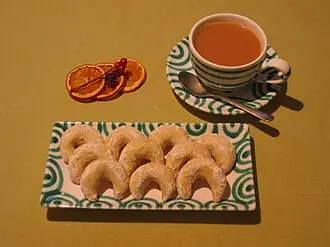
Vanillekipferl (Almond Crescent Cookies)

A Nice Cup of Tea

Kombucha: The Fermented Tea with a Tangy Food Story