This longer reference provides the background behind the topic. Read it alongside the recipe collection when you want to connect an ingredient or food idea with a dish to prepare.
Overview
The raspberry is the edible fruit of several plant species in the genus Rubus of the rose family, most of which are in the subgenus Idaeobatus. The name also applies to these plants themselves. Raspberries are perennial with woody stems.
World production of raspberries in 2023 was 940,979 tonnes, led by Russia with 23% of the total. Raspberries are cultivated across northern Europe and North America and are consumed in various ways, including as whole fruit and in preserves, cakes, pastries, ice cream, and liqueurs.
Description
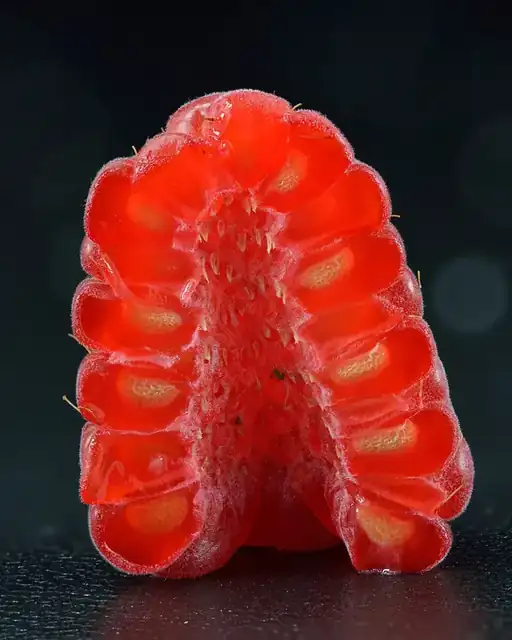
A raspberry is an aggregate fruit, developing from the numerous distinct carpels of a single flower. Each carpel then grows into individual drupelets, which, taken together, form the body of a single raspberry fruit. As with blackberries, each drupelet contains a seed. What distinguishes the raspberry from its blackberry relatives is whether or not the torus (receptacle or stem) "picks with" (i.e., stays with) the fruit. When picking a blackberry fruit, the torus stays with the fruit. With a raspberry, the torus remains on the plant, leaving a hollow core in the raspberry fruit.
An individual raspberry weighs 3 – 5 g and is made up of around 100 drupelets. A raspberry bush can yield several hundred berries a year.
Raspberries thrive in well-drained soil with a pH between 6 and 7 with ample organic matter to assist in retaining water. Raspberries need ample sun and water for optimal development. While moisture is essential, wet and heavy soils or excess irrigation can bring on Phytophthora root rot, which is one of the most serious pest problems faced by the red raspberry. As a cultivated plant in moist, temperate regions, it is easy to grow and tends to spread unless pruned. Escaped raspberries frequently appear as garden weeds, spread by seeds found in bird droppings.
Raspberries are grown for the fresh fruit market and for commercial processing into individually quick frozen (IQF) fruit, purée, juice, or dried fruit used in a variety of grocery products such as raspberry pie.
Species
Examples of raspberry species in Rubus subgenus Idaeobatus include:
Rubus crataegifolius (Asian raspberry)
Rubus gunnianus (Tasmanian alpine raspberry)
Rubus idaeus (red raspberry or European red raspberry)
Rubus leucodermis (whitebark raspberry or western raspberry, blue raspberry, black raspberry)
Rubus occidentalis (black raspberry)
Rubus parvifolius (Australian native raspberry)
Rubus phoenicolasius (wine raspberry or wineberry)
Rubus rosifolius (Mauritius raspberry)
Rubus strigosus (American red raspberry) (syn. R. idaeus var. strigosus)
Rubus ellipticus (yellow Himalayan raspberry)
Rubus fraxinifolius (mountain raspberry, in southeast Asia and the Pacific Ocean)
Several species of Rubus, also called raspberries, are classified in other subgenera, including:
Rubus deliciosus (boulder raspberry, subgenus Anoplobatus)
Rubus odoratus (flowering raspberry, subgenus Anoplobatus)
Rubus nivalis (snow raspberry, subgenus Chamaebatus)
Rubus arcticus (Arctic raspberry, subgenus Cyclactis)
Rubus sieboldii (Molucca raspberry, subgenus Malachobatus)
Major cultivars
Raspberries are an important commercial fruit crop, widely grown in all temperate regions of the world. Many of the most important modern commercial red raspberry cultivars derive from hybrids between Rubus idaeus and Rubus strigosus.
Both the red and the black raspberry species have albino-like pale-yellow natural or horticultural variants, resulting from presence of recessive genes that impede production of anthocyanin pigments.
Red raspberries have also been crossed with various species in other subgenera of the genus Rubus, resulting in a number of hybrids, the first of which was the loganberry. Later notable hybrids include the olallieberry, boysenberry, marionberry, and tayberry; all are multi-generational hybrids.
Selected cultivars
Numerous raspberry cultivars have been selected. Two basic types are available for commercial and domestic use:
1) the summer-bearing type produces no fruit on their first-year canes, but an abundance of fruit on second-year canes (floricanes) within a relatively short period in midsummer. Early summer fruiting cultivars include Glen Moy*, Malling Jewel*, and Prelude. Mid-summer fruiting cultivars include Glen Ample*. Late summer fruiting cultivars include Glen Magna*, Leo*, Malling Admiral*, Tulameen*, and Jeanne d'Orleans.
2) double or "everbearing" plants bear some fruit on first-year canes (primocanes) in the late summer and fall, and a main summer crop on second-year canes. Primocane, autumn fruiting cultivars include: Autumn Bliss*, Joan J, and Polka*.
In addition, there are some dwarf raspberry cultivars, such as .
Cultivars marked * have gained the Royal Horticultural Society's Award of Garden Merit.
Insects
Raspberries, due to the high sugar content of their fruit, are the main food resource of the Japanese beetle. The voracious feeding habits of these beetles not only pose a direct threat to raspberry plants but also increase the risk of transmitting various plant diseases. This dual impact can significantly undermine agricultural productivity, making pest control a high priority for growers.
Raspberry beetle in Europe and the raspberry fruitworm in North America lay larvae that feed on raspberries. Other insects that prey on raspberry plants are some butterfly and moth species, as well as European and American large raspberry aphids.
Production
In 2023, world production of raspberries was 940,979 tonnes, led by Russia with 23% of the total (table). Other major producers were Mexico, Serbia, and Poland.
More to savor

Chicken Vindaloo

Spaghetti alla Carbonara
A Closer Look at Mushroom: From Ingredient to Meal