This longer reference provides the background behind the topic. Read it alongside the recipe collection when you want to connect an ingredient or food idea with a dish to prepare.
Overview
A mushroom is the fleshy, spore-bearing fruiting body of a fungus, typically produced above ground on soil or another food source. A toadstool generally refers to a poisonous mushroom.
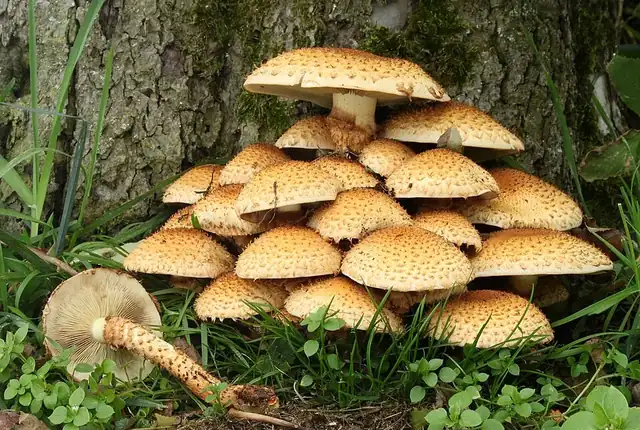
The standard for the name "mushroom" is the cultivated white button mushroom, Agaricus bisporus; hence, the word "mushroom" is most often applied to those fungi (Basidiomycota, Agaricomycetes) that have a stem (stipe), a cap (pileus), and gills (lamellae, sing. lamella) on the underside of the cap. "Mushroom" also describes a variety of other gilled fungi, with or without stems; therefore the term is used to describe the fleshy fruiting bodies of some Ascomycota. The gills produce microscopic spores which help the fungus spread across the ground or its occupant surface.
Forms deviating from the standard morphology usually have more specific names, such as "bolete", "truffle", "puffball", "stinkhorn", and "morel", and gilled mushrooms themselves are often called "agarics" in reference to their similarity to Agaricus or their order Agaricales.
Identification
Identifying what is and is not a mushroom requires a basic understanding of their macroscopic structure. Most are basidiomycetes and gilled. Their spores, called basidiospores, are produced on the gills and fall in a fine rain of powder from under the caps as a result. At the microscopic level, the basidiospores are shot off basidia and then fall between the gills in the dead air space. As a result, for most mushrooms, if the cap is cut off and placed gill-side-down overnight, a powdery impression reflecting the shape of the gills (or pores, or spines, etc.) is formed (when the fruit body is sporulating). The color of the powdery print, called a spore print, is useful in both classifying and identifying mushrooms.
Spore print colors include white (most common), brown, black, purple-brown, pink, yellow, and creamy, but almost never blue, green, or red.
Classification
Typical mushrooms are the fruit bodies of members of the order Agaricales, whose type genus is Agaricus and type species is the field mushroom, Agaricus campestris. However in modern molecularly defined classifications, not all members of the order Agaricales produce mushroom fruit bodies, and many other gilled fungi, collectively called mushrooms, occur in other orders of the class Agaricomycetes. For example, chanterelles are in the Cantharellales, false chanterelles such as Gomphus are in the Gomphales, milk-cap mushrooms (Lactarius, Lactifluus) and russulas (Russula), as well as Lentinellus, are in the Russulales, while the tough, leathery genera Lentinus and Panus are among the Polyporales, but Neolentinus is in the Gloeophyllales, and the little pin-mushroom genus, Rickenella, along with similar genera, are in the Hymenochaetales.
Within the main body of mushrooms, in the Agaricales, are common fungi like the common fairy-ring mushroom, shiitake, enoki, oyster mushrooms, fly agarics and other Amanitas, magic mushrooms like species of Psilocybe, paddy straw mushrooms, shaggy manes, etc.
Morphology
A mushroom develops from a nodule, or pinhead, less than two millimeters in diameter, called a primordium, which is typically found on or near the surface of the substrate. It is formed within the mycelium, the mass of threadlike hyphae that make up the fungus. The primordium enlarges into a roundish structure of interwoven hyphae roughly resembling an egg, called a "button". The button has a cottony roll of mycelium, the universal veil, that surrounds the developing fruit body. As the egg expands, the universal veil ruptures and may remain as a cup, or volva, at the base of the stalk, or as warts or volval patches on the cap. Many mushrooms lack a universal veil; therefore, they do not have either a volva or volval patches.
Often, a second layer of tissue, the partial veil, covers the blade-like gills that bear spores. As the cap expands the veil breaks, and remnants of the partial veil may remain as a ring, or annulus, around the middle of the stalk or as fragments hanging from the margin of the cap. The ring may be skirt-like as in some species of Amanita, collar-like as in many species of Lepiota, or merely the faint remnants of a cortina (a partial veil composed of filaments resembling a spiderweb), which is typical of the genus Cortinarius. Mushrooms lacking partial veils do not form an annulus.
Microscopic features
A hymenium is a layer of microscopic spore-bearing cells that covers the surface of gills. In the nongilled mushrooms, the hymenium lines the inner surfaces of the tubes of boletes and polypores, or covers the teeth of spine fungi and the branches of corals. In the Ascomycota, spores develop within microscopic elongated, sac-like cells called asci, which typically contain eight spores in each ascus. The Discomycetes, which contain the cup, sponge, brain, and some club-like fungi, develop an exposed layer of asci, as on the inner surfaces of cup fungi or within the pits of morels. The Pyrenomycetes, tiny dark-colored fungi that live on a wide range of substrates including soil, dung, leaf litter, and decaying wood, as well as other fungi, produce minute, flask-shaped structures called perithecia, within which the asci develop.
Growth
Many species of mushrooms seemingly appear overnight, growing or expanding rapidly. This phenomenon is the source of several common expressions in the English language including "to mushroom" or "mushrooming" (expanding rapidly in size or scope) and "to pop up like a mushroom" (to appear unexpectedly and quickly). In reality, all species of mushrooms take several days to form primordial mushroom fruit bodies, though they do expand rapidly by the absorption of fluids.
Vitamin D
The vitamin D content of a mushroom depends on postharvest handling, in particular the unintended exposure to sunlight. The US Department of Agriculture provided evidence that UV-exposed mushrooms contain substantial amounts of vitamin D. When exposed to ultraviolet (UV) light, even after harvesting, ergosterol in mushrooms is converted to vitamin D2, a process now used intentionally to supply fresh vitamin D mushrooms for the functional food grocery market. In a comprehensive safety assessment of producing vitamin D in fresh mushrooms, researchers showed that artificial UV light technologies were equally effective for vitamin D production as in mushrooms exposed to natural sunlight, and that UV light has a long record of safe use for production of vitamin D in food.
More to savor

Chicken Vindaloo

Koko da Kosai (Fermented Corn Porridge and Bean Fritters)
A Closer Look at Fenugreek: From Ingredient to Meal