Use the regional background below as a starting point for exploring the food, rather than expecting one dish to represent every household. Food traditions differ within a country and continue to change through travel, migration, and everyday cooking.
In this story
OverviewEthnic and regional variations and influencesSoupsCold soupsHot soupsSaladsMeatOverview
Russian cuisine is a collection of the different dishes and cooking traditions of the Russian people as well as a list of culinary products popular in Russia, with most names being known since pre-Soviet times, coming from all kinds of social circles.
Ethnic and regional variations and influences
The national Russian cuisine has evolved in a multicultural and multiethnic state, with strong mutual influence from the cuisines of other ethnic groups that live within the nation's borders or had been a part of the Russian state historically.
Despite such deep mutual influence, many national cuisines within the borders of the Russian Federation maintain their uniqueness, such as Bashkir cuisine, Tatar cuisine, Sakha cuisine, or Yamal cuisine.
The Russian cuisine itself is also geographically diverse, its variations dependent on raw materials and cooking methods available locally. In the north of Russia, it incorporates local berries such as cloudberry or crowberry, fish such as cod, game meat such as elk, or even edible moss known as yagel. Conversely, in Siberia it includes the local fish varieties, particularly those of the coregonus genus such as arctic cisco or muksun, and borrows the local cooking methods, to result in raw fish eaten frozen or combined with spices. Further east, local specialties are added such as eagle fern, kolomikta fruit, scallops and Kamchatka crabs.
Soups
Soups have always played an important role in Russian cuisine. The traditional staple of soups such as shchi (щи), borscht (борщ), ukha (уха́), rassolnik (рассо́льник), solyanka (соля́нка), botvinya (ботви́нья), okroshka (окро́шка), and tyurya (тю́ря) was enlarged in the 18th to 20th centuries by both European and Central Asian staples like clear soups, puréed soups, stews, and many others.
Russian soups can be divided into at least seven large groups:
Chilled soups based on kvass, such as tyurya, okroshka, and botvinya.
Light soups and stews based on water and vegetables, such as svekolnik.
Noodle soups with meat, mushrooms, or milk.
Soups based on cabbage, most prominently shchi.
Cold soups
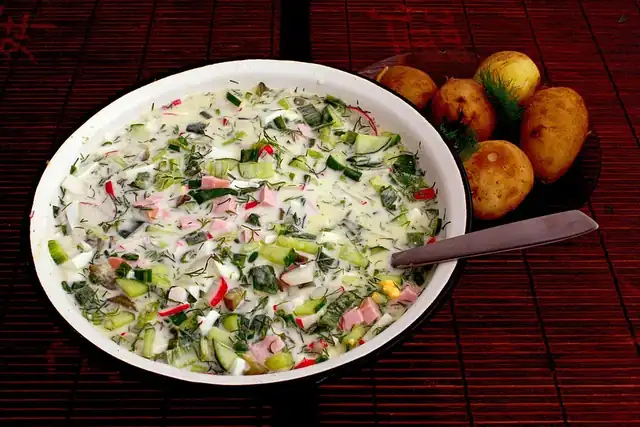
Okroshka is a cold soup based on kvass or (less frequently) various kinds of sour milk; kefir is often preferred nowadays. Okroshka is also a salad. The main ingredients are two types of vegetables that can be mixed with cold boiled meat or fish in a 1:1 proportion. Thus vegetable, meat, poultry, and fish varieties of okroshka are made.
There are typically two types of vegetables in okroshka. The first must have a neutral taste, such as boiled potatoes, turnips, rutabagas, carrots, or fresh cucumbers. The second must be spicy and aromatic, like radishes or green onion as well as other herbs—greens of dill, parsley, chervil, celery, or tarragon. Different meat and poultry can be used in the same soup. The most common ingredient is beef alone or with poultry. A mild bologna-like sausage is sometimes used. If it is made with fish, the best choice would be tench, European perch, pike-perch, cod, or other neutral-tasting fish. In the coastal areas smoked and/or salted salmon is preferred instead, often in combination with other meats.
The kvass most commonly used in cooking is white okroshka kvass, which is much more sour than drinking kvass. Spices used include mustard, black pepper and pickled cucumber (specifically, the liquid from the pickles), solely or in combination. For the final touch, boiled eggs and smetana (similar to crème fraîche) are added. Often, the mustard, chopped hard-boiled yolks, pepper and pickle brine are combined into a spicy sauce that is added to the soup to taste.
For sour milk-based okroshka, well-shaken natural sour milk (often with the addition of seed oil) is used with the addition of pure water and ground garlic. Sometimes manufactured kefir is used instead of natural sour milk for time-saving reasons, though some say it detracts from the original taste of okroshka.
Tyurya is very similar to okroshka, the main difference being that instead of vegetables, bread, sometimes with addition of onion and vegetable oil, is soaked in kvass, similar to Silesian wodzionka or Portuguese açorda. It was commonly consumed during rough times (such as the Russian Revolution, World War I, and World War II) and by poor peasants. Also, due to its simplicity, it was very common as a meal during religious fasting.
Hot soups
Shchi (cabbage soup) had been the predominant first course in Russian cuisine for over a thousand years. Shchi knew no social class boundaries, and even if the rich had richer ingredients and the poor made it solely of cabbage and onions, all these "poor" and "rich" variations were cooked in the same tradition. The unique taste of this cabbage soup was from the fact that after cooking it was left to draw (stew) in a Russian stove. The "spirit of shchi" was inseparable from a Russian izba (log hut). Many Russian proverbs are connected to this soup, such as Shchi da kasha — pishcha nasha (Щи да каша — пища наша, "Shchi and porridge are our staples"). It can be eaten regularly, and at any time of the year.
The richer variant of shchi includes several ingredients, but the first and last components are necessary:
Cabbage.
Meat (very rarely fish or mushrooms).
Carrots, basil or parsley roots.
Salads
Olivier salad (also known as Russian salad) is a mayonnaise-based potato salad distinguished by its diced texture and the contrasting flavors of pickles, hard-boiled eggs, boiled carrots, boiled potatoes, meat, and peas. This dish is one of the main features of New Year buffets.
Sel'edka pod shuboy (or shuba, from шуба), also known as "dressed herring", is chopped salted herring under a "coat" of shredded cooked beet, sometimes with a layer of egg or other vegetables.
Vinegret (from French vinaigrette) is a salad made of boiled beets, potatoes, carrots, pickles, onions, sauerkraut, and sometimes peas or white beans. It is dressed with sunflower or olive oil.
Meat
In traditional Russian cuisine three basic variations of meat dishes can be highlighted:
a large boiled piece of meat cooked in a soup or porridge, and then used as the second course or served cold (particularly in jellied stock such as kholodets, below)
offal dishes (liver, tripe, etc.), baked in pots together with cereals;
whole fowl dishes or parts of fowl (legs or breasts), or a large piece of meat (rump) baked on a baking tray in an oven, so-called "zharkoye" (from the word "zhar"(жар) meaning "heat")
Affluent households also mention sausage-making, spit-roasted meats, stews and many other meat dishes.
More to savor
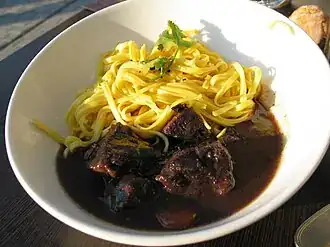
Boeuf Bourguignon

Egyptian Meatballs (Kofta)
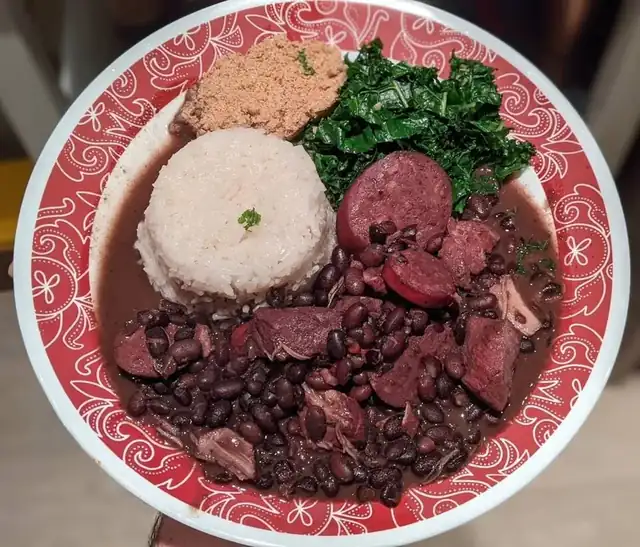
A Taste of Brazil: Many Influences, Many Ways to Eat