Use the regional background below as a starting point for exploring the food, rather than expecting one dish to represent every household. Food traditions differ within a country and continue to change through travel, migration, and everyday cooking.
In this story
OverviewRegional cuisinesCenter-West Brazil's cuisineSoutheast Brazil's cuisineSouthern Brazil's cuisineNortheast Brazil's cuisineOther popular and traditional dessertsOverview
Brazilian cuisine is the set of cooking practices and traditions of Brazil, and is characterized by African, European, Amerindian and Asian (Levantine, Japanese, and most recently, Chinese) influences. It varies greatly by region, reflecting the country's mix of native and immigrant populations, and its continental size as well. This has created a national cuisine marked by the preservation of regional differences.
Ingredients first used by native peoples in Brazil include cashews, cassava, pineapple, guaraná, açaí, cumaru, and tucupi. From there, the many waves of immigrants brought some of their typical dishes, replacing missing ingredients with local equivalents. For instance, the European immigrants (primarily from Portugal, Italy, Spain, Germany, Netherlands, Poland, and Ukraine), were accustomed to a wheat-based diet, and introduced wine, leafy vegetables, and dairy products into Brazilian cuisine. When potatoes were not available, they discovered how to use the native sweet manioc as a replacement. Enslaved Africans also had a role in developing Brazilian cuisine, especially in the coastal states. The foreign influence extended to later migratory waves; Japanese immigrants brought most of the food items that Brazilians associate with Asian cuisine today, and introduced large-scale aviaries well into the 20th century.
The most visible regional cuisines belong to the states of Minas Gerais and Bahia. Minas Gerais cuisine has European influence in delicacies and dairy products such as feijão tropeiro, pão de queijo and Minas cheese, and Bahian cuisine due to the presence of African delicacies such as Acarajé, Abará and vatapá.
Root vegetables such as manioc (locally known as mandioca, aipim or macaxeira, among other names), yams, and fruit like açaí, cupuaçu, mango, papaya, guava, orange, passion fruit, pineapple, and hog plum are among the local ingredients used in cooking.
Regional cuisines
There is not an exact single "national Brazilian cuisine", but there is an assortment of various regional traditions and typical dishes. This diversity is linked to the origins of the people inhabiting each area.
For instance, the cuisine of Bahia is heavily influenced by a mix of African, Indigenous, and Portuguese cuisines. Chili (including chili sauces) and palm oil are very common. In the northern states, however, due to the abundance of forest and freshwater rivers, fish, fruits and cassava (including flours made of cassava) are staple foods. In the deep south, as in Rio Grande do Sul, the influence shifts more towards gaúcho traditions shared with its neighbors Argentina and Uruguay, with many meat-based products, due to this region's livestock-based economy; the churrasco, a kind of barbecue, is a local tradition.
Center-West Brazil's cuisine
In the state of Goiás, the pequi fruit is used in typical foods, such as arroz com pequi (rice cooked with pequi), and in snacks, such as a filling for pastel. The dish Galinhada, which is a mixture of chicken and rice, is popular in the state.
The states of Mato Grosso and Mato Grosso do Sul received influence from neighboring countries in their cuisine, as well as the Pantanal area and its various rivers and extensive wetlands that cross these two states with a high abundance of fish.
Southeast Brazil's cuisine
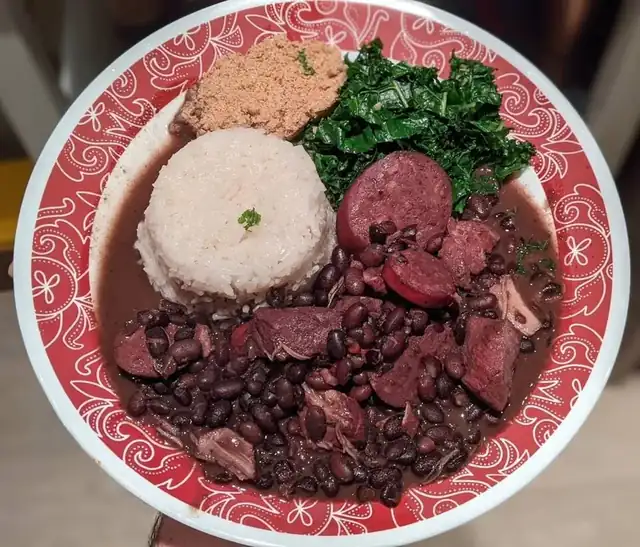
In the states of Rio de Janeiro, São Paulo, Espírito Santo, and Minas Gerais, feijoada is popular, especially as a Wednesday or Saturday lunch. Also consumed frequently is picadinho (literally, diced meat) and rice and beans. In Rio de Janeiro, besides the feijoada, a popular plate is any variation of grilled beef fillet, rice and beans, farofa, fried garlic and fried potatoes (batatas portuguesas), commonly called filé à Osvaldo Aranha. Seafood is very popular in coastal areas, as is roasted chicken (galeto). The strong Portuguese heritage also endowed the city with a taste for bolinhos de bacalhau (fried cod fritters), one of the most common street foods there.
In São Paulo, a typical dish is virado à paulista, made with rice, virado de feijão (similar to a tutu), sauteed kale, fried plantains or bananas and pork chops. São Paulo is also the home of pastel, a food consisting of thin pastry envelopes wrapped around assorted fillings, then deep-fried in vegetable oil. It is a common belief that they originated when Chinese and Japanese immigrants adapted the recipe of fried spring rolls to sell as snacks at weekly street markets. São Paulo is also known for parmegianna.
The countryside of São Paulo also has its own individual cuisine. Among notable examples is the farofa de Iça [pt] (farofa made out of the abdomen of the Saúva), the snack bolinho caipira [pt], Taiada [pt] (a candy made of sugarcane) and Torta Holandesa, a dessert invented in Campinas. The state has an itinerant cultural festival known as Revelando São Paulo, which travels the state showing the different cuisines of every region.
Southern Brazil's cuisine
In Southern Brazil, due to the long tradition in livestock production and the heavy German immigration, red meat is the basis of the local cuisine.
Besides many of the pasta, sausage and dessert dishes common to continental Europe, churrasco is the term for a barbecue (similar to the Argentine or Uruguayan asado) which originated in southern Brazil. It contains a variety of meats which may be cooked on a purpose-built churrasqueira, a barbecue grill, often with supports for spits or skewers. Portable churrasqueiras are similar to those used to prepare the Argentine and Uruguayan asado, with a grill support, but many Brazilian churrasqueiras do not have grills, only the skewers above the embers. The meat may alternatively be cooked on large metal or wood skewers resting on a support or stuck into the ground and roasted with the embers of charcoal (wood may also be used, especially in the State of Rio Grande do Sul).
Northeast Brazil's cuisine
Northeastern Brazilian cuisine is heavily influenced by African cuisine from the coastal areas of the states of Pernambuco to Bahia, as well as the eating habits of indigenous populations who have lived in the region.
Vatapá is an Afro-Brazilian dish made from bread, shrimp, coconut milk, finely ground peanuts and palm oil, mashed into a creamy paste. The word "vatapá" is derived from the Yoruba words Ẹ̀bà Tápà.
Bobó de camarão is a dish made with cassava and shrimp (camarão).
Other popular and traditional desserts
Brigadeiro (a Brazilian chocolate candy, considered the most typical dessert in the country, a type of truffle made of condensed milk, butter and cocoa powder)
Paçoca (similar to Spanish polvorones, but made with peanuts instead of almonds and without the addition of fats)
Quindim (egg custard with coconut)
Cocada (coconut sweet)
Beijinho (coconut "truffles" with clove)
More to savor

Chicken Vindaloo

Austrian Napkin Dumpling (Serviettenknödel)
A Taste of Nepal: Food Across Regions and Communities