This longer reference provides the background behind the topic. Read it alongside the recipe collection when you want to connect an ingredient or food idea with a dish to prepare.
Overview
Rye (Secale cereale) is a grass grown extensively as a grain, a cover crop and a forage crop. It is grown principally in an area from Eastern and Northern Europe into Russia. It is much more tolerant of cold weather and poor soil than other cereals, making it useful in those regions; its vigorous growth suppresses weeds and provides abundant forage for animals early in the year. It is a member of the wheat tribe (Triticeae) which includes the cereals wheat and barley. It is likely that rye arrived in Europe as a secondary crop, meaning that it was a minor admixture in wheat as a result of Vavilovian mimicry, and was only later cultivated in its own right.
Rye grain is used for bread, beer, rye whiskey, and animal fodder. In Scandinavia, rye was a staple food in the Middle Ages, and rye crispbread remains a popular food in the region. Europe produces around half of the world's rye; relatively little is traded between countries. A wheat-rye hybrid, triticale, combines the qualities of the two parent crops and is produced in large quantities worldwide. In European folklore, the Roggenwolf ("rye wolf") is a carnivorous corn demon or Feldgeist.
Description
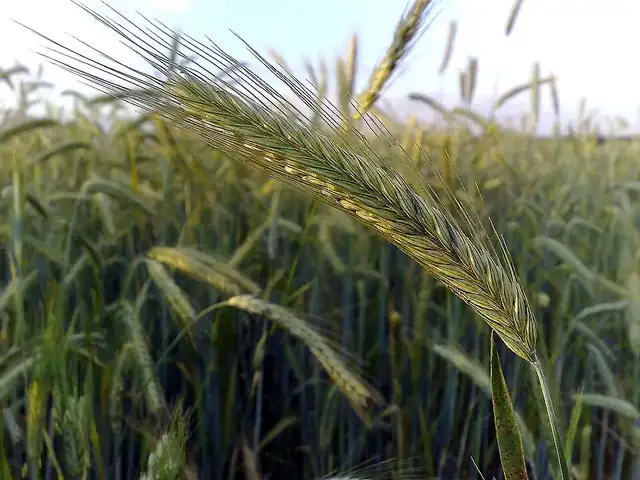
Rye is a tall grass grown for its seeds; it can be an annual or a biennial. Depending on environmental conditions and variety it reaches 1 to 3 m in height. Its leaves are blue-green, long, and pointed. The seeds are carried in a curved head or spike some 7 to 15 cm long. The head is composed of many spikelets, each of which holds two small flowers; the spikelets alternate left and right up the head.
Agroecology
Winter rye is any breed of rye planted in the autumn to provide ground cover for the winter. It grows during warmer days of the winter when sunlight temporarily warms the plant above freezing, even while there is general snow cover. It can be used as a cover crop to prevent the growth of winter-hardy weeds.
Rye grows better than any other cereal in heavy clay and light sandy soil, and infertile or drought-affected soils. It can tolerate pH between 4.5 and 8.0, but soils having pH 5.0 to 7.0 are best suited for rye cultivation. Rye grows best in fertile, well-drained loam or clay-loam soils. As for temperature, the crop can thrive in subzero environments, assisted by the production of antifreeze polypeptides (different from those produced by some fish and insects) by the leaves of winter rye.
Rye is a common, unwanted invader of winter wheat fields. If allowed to grow and mature, it may cause substantially reduced prices (docking) for harvested wheat.
Production
In 2023, world production of rye was 12.7 million tonnes, led by Germany with 25% of the total, and Poland and Russia as major secondary producers.
Culinary
Rye grain is refined into a flour high in gliadin but low in glutenin and rich in soluble fiber. Alkylresorcinols are phenolic lipids present in high amounts in the bran layer (e.g. pericarp, testa and aleurone layers) of wheat and rye (0.1–0.3% of dry weight). Rye bread, including pumpernickel, is made using rye flour and is a widely eaten food in Northern and Eastern Europe. In Scandinavia, rye is widely used to make crispbread (Knäckebröd); in the Middle Ages it was a staple food in the region, and it remains popular in the 21st century.
Rye grain is used to make alcoholic drinks, such as rye whiskey and rye beer. The traditional cloudy and sweet-sour low-alcohol beverage kvass is fermented from rye bread or rye flour and malt.
Production of hybrids
Plant breeders, starting in the 19th century in Germany and Scotland, but mainly from the 1950s, worked to develop a hybrid cereal with the best qualities of wheat and rye, now called triticale. Modern triticales are hexaploid with six sets of chromosomes; they are used to produce millions of tons of cereal annually.
Varieties of rye hold much genetic diversity, which can be used to improve other crops such as wheat. For example, the pollination abilities of wheat can be improved by the addition of the rye chromosome 4R; this increases the size of the wheat anther and the amount of pollen. The chromosome is the source of many crop disease resistance genes. Varieties such as Petkus, Insave, Amigo, and Imperial have donated 1R-originating resistance to wheat. AC Hazlet rye is a medium-sized winter rye with resistance to both lodging and shattering. Rye was the gene donor of Sr31 – a stem rust resistance gene – introgressed into wheat.
The characteristics of S. cereale have been combined with another perennial rye, S. montanum, to produce S. cereanum, which has the beneficial characteristics of each. The hybrid rye can be grown in harsh environments and on poor soil. It provides improved forage with digestible fiber and protein.
Other uses
Rye is a useful forage crop in cool climates; it grows vigorously and provides plentiful fodder for grazing animals, or green manure to improve the soil. It forms a good cover crop in winter with its rapid growth and deep roots.
Rye straw is used as livestock bedding, despite the risk of ergot poisoning. It is used on a small scale to make crafts such as corn dollies. More recently it has found uses as a raw material for bioconversion to products such as the sweetener xylitol.
Rye flour is boiled with red iron oxide pigments and some additives to make traditional Falun red paint, widely used as a house paint in Sweden and other Scandinavian countries.
More to savor

Chicken Vindaloo

Steak and Ale Pie
A Closer Look at Seaweed: From Ingredient to Meal