This longer reference provides the background behind the topic. Read it alongside the recipe collection when you want to connect an ingredient or food idea with a dish to prepare.
Overview
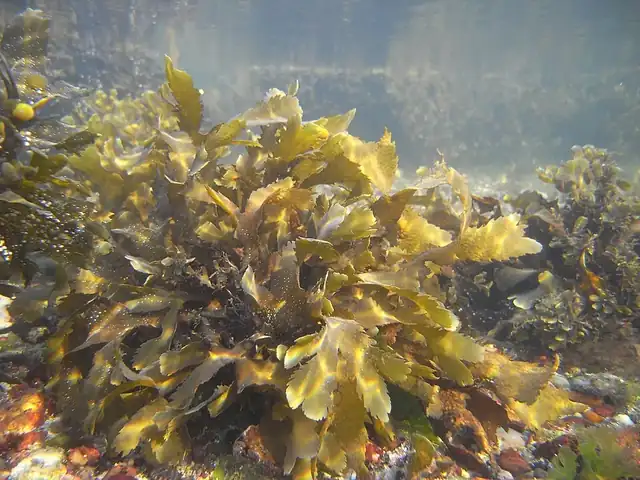
Seaweed, or macroalgae, refers to thousands of species of macroscopic, multicellular, marine algae. The term includes some types of Rhodophyta (red), Phaeophyta (brown) and Chlorophyta (green) macroalgae. Seaweed species such as kelps provide essential nursery habitat for fisheries and other marine species and thus protect food sources; other species, such as planktonic algae, play a vital role in capturing carbon and producing at least 50% of Earth's oxygen.
Natural seaweed ecosystems are sometimes under threat from human activity. For example, mechanical dredging of kelp destroys the resource and dependent fisheries. Other forces also threaten some seaweed ecosystems; for example, a wasting disease in predators of purple urchins has led to an urchin population surge which has destroyed large kelp forest regions off the coast of California.
Humans have a long history of cultivating seaweeds for their uses. In recent years, seaweed farming has become a global agricultural practice, providing food, source material for various chemical uses (such as carrageenan), cattle feeds and fertilizers. Due to their importance in marine ecologies and for absorbing carbon dioxide, recent attention has been on cultivating seaweeds as a potential climate change mitigation strategy for biosequestration of carbon dioxide, alongside other benefits like nutrient pollution reduction, increased habitat for coastal aquatic species, and reducing local ocean acidification. The IPCC Special Report on the Ocean and Cryosphere in a Changing Climate recommends "further research attention" for the purpose of mitigation.
Genera
The following table lists a few examples of genera of seaweed.
Anatomy
Seaweed's appearance resembles non-woody terrestrial plants. Its anatomy includes:
Thallus: algal body
Lamina or blade: flattened structure that is somewhat leaf-like
Sorus: spore cluster
pneumatocyst, air bladder: a flotation-assisting organ on the blade
Kelp, float: a flotation-assisting organ between the lamina and stipe
Stipe: stem-like structure, may be absent
Holdfast: basal structure providing attachment to a substrate
Haptera: finger-like extension of the holdfast that anchors to a benthic substrate
The stipe and blade are collectively known as the frond.
Ecology
Two environmental requirements dominate seaweed ecology. These are seawater (or at least brackish water) and light sufficient to support photosynthesis. Another common requirement is an attachment point, and therefore seaweed most commonly inhabits the littoral zone (nearshore waters) and within that zone, on rocky shores more than on sand or shingle. In addition, there are few genera (e.g., Sargassum and Gracilaria) which do not live attached to the sea floor, but float freely.
Seaweed occupies various ecological niches. At the surface, they are only wetted by the tops of sea spray, while some species may attach to a substrate several meters deep. In some areas, littoral seaweed colonies can extend miles out to sea. The deepest living seaweed are some species of red algae. Others have adapted to live in tidal rock pools. In this habitat, seaweed must withstand rapidly changing temperature and salinity and occasional drying.
Macroalgae and macroalgal detritus have also been shown to be an important food source for benthic organisms, because macroalgae shed old fronds.
These macroalgal fronds tend to be utilized by benthos in the intertidal zone close to the shore.
Alternatively, pneumatocysts (gas filled "bubbles") can keep the macroalgae thallus afloat; fronds are transported by wind and currents from the coast into the deep ocean. It has been shown that benthic organisms also at several 100 m tend to utilize these macroalgae remnants.
As macroalgae takes up carbon dioxide and releases oxygen in the photosynthesis, macroalgae fronds can also contribute to carbon sequestration in the ocean, when the macroalgal fronds drift offshore into the deep ocean basins and sink to the sea floor without being remineralized by organisms. The importance of this process for blue carbon storage is currently a topic of discussion among scientists.
Biogeographic expansion
Nowadays a number of vectors—e.g., transport on ship hulls, exchanges among shellfish farmers, global warming, opening of trans-oceanic canals—all combine to enhance the transfer of exotic seaweeds to new environments. Since the piercing of the Suez Canal, the situation is particularly acute in the Mediterranean Sea, a 'marine biodiversity hotspot' that now registers over 120 newly introduced seaweed species -the largest number in the world.
Production
As of 2019, 35,818,961 tonnes were produced, of which 97.38% were produced in Asian countries.
Food
Seaweed is consumed across the world, particularly in East Asia, e.g., Japan, China, Korea,and Southeast Asia, e.g. Brunei, Singapore, Thailand, Burma, Cambodia, Vietnam, Indonesia, the Philippines, and Malaysia, as well as in South Africa, Belize, Peru, Chile, the Canadian Maritimes, Scandinavia, South West England, Ireland, Wales, Polynesia (known as limu or rimu), California, and Scotland.
Gim (김, Korea), nori (海苔, Japan) and zicai (紫菜, China) are sheets of dried Porphyra used in soups, sushi or onigiri (rice balls). Gamet in the Philippines, from dried Pyropia, is also used as a flavoring ingredient for soups, salads and omelettes. Chondrus crispus ('Irish moss' or carrageenan moss) is used in food additives, along with Kappaphycus and Gigartinoid seaweed. Porphyra is used in Wales to make laverbread (sometimes with oat flour). In northern Belize, seaweed is mixed with milk, nutmeg, cinnamon and vanilla to make "dulce" ("sweet").
Alginate, agar and carrageenan are gelatinous seaweed products collectively known as hydrocolloids or phycocolloids. Hydrocolloids are food additives. The food industry exploits their gelling, water-retention, emulsifying and other physical properties. Agar is used in foods such as confectionery, meat and poultry products, desserts and beverages and moulded foods. Carrageenan is used in salad dressings and sauces, dietetic foods, and as a preservative in meat and fish, dairy items and baked goods.
Seaweeds are used as animal feeds. They have long been grazed by sheep, horses and cattle in Northern Europe, even though their nutritional benefits are questionable. Their protein content is low and their heavy metal content is high, especially for arsenic and iodine, which are respectively toxic and nutritious.
They are valued for fish production. Adding seaweed to livestock feed can substantially reduce methane emissions from cattle, but only from their feedlot emissions. As of 2021, feedlot emissions account for 11% of overall emissions from cattle.
More to savor

Chicken Vindaloo

Spaghetti alla Puttanesca
A Closer Look at Mayonnaise: From Ingredient to Meal