A cooking method is easier to appreciate when you connect it with the food on the plate. The background below explains the subject in more detail; for a complete method and ingredient quantities, explore the recipe collection.
In this story
OverviewCold smokingWarm smokingHot smokingLiquid smokeSmoke roastingList of smoked foods and beveragesOverview
Smoking is the process of flavoring, browning, cooking, or preserving food, particularly meat, fish and tea, by exposing it to smoke from burning or smoldering material, most often wood.
In Europe, alder is the traditional smoking wood, but oak is now more commonly used, while beech is used to a lesser extent than both oak and alder. In North America, hickory, mesquite, oak, pecan, alder, maple, and fruit tree woods, such as apple, cherry, and plum, are commonly used for smoking. Other biomass besides wood can also be employed, sometimes with the addition of flavoring ingredients. Chinese tea-smoking uses a mixture of uncooked rice, sugar, and tea, heated at the base of a wok.
Some North American ham and bacon makers smoke their products over burning corncobs. Peat is burned to dry and smoke the barley malt used to make Scotch whisky and some beers. In New Zealand, sawdust from the native mānuka (tea tree) is commonly used for hot-smoking fish. In Iceland, dried sheep dung is used to cold-smoke fish, lamb, mutton, and whale.
Historically, farms in the West included a smokehouse, a small building where meats could be smoked and stored. This was generally well separated from other buildings both because of fire danger and smoke emanations. The smoking of food may possibly introduce polycyclic aromatic hydrocarbons, which may lead to an increased risk of some types of cancer; however, this association is debated.
Food can be smoked by cold smoking, warm smoking or hot smoking. However, these methods of imparting smoke only affect the food surface, and are unable to preserve food, thus, smoking is paired with other microbial hurdles, such as chilling and packaging, to extend food shelf-life. Smoke-like flavor can be added by flavorings such as liquid smoke.
Cold smoking
Cold smoking differs from hot smoking in that it does not cook anything; when cold smoking is finished, the food is still raw. Smokehouse temperatures for cold smoking are typically between 20 and 30 C. In this temperature range, foods take on a smoked flavor, but remain relatively moist. Since cold smoking does not cook foods, meats should be fully cured before cold smoking. Cold smoking can be used as a flavor enhancer for items such as cheese or nuts, along with meats such as chicken breasts, beef, pork chops, salmon, scallops, and steak. The item is often hung in a dry environment first to develop a pellicle; it can then be cold smoked up to several days to ensure it absorbs the smoke flavor. Some cold smoked foods are baked, grilled, steamed, roasted, or sautéed before eating.
Cold smoking meats should not be attempted at home, according to the US National Center for Home Food Preservation: "Most food scientists cannot recommend cold-smoking methods because of the inherent risks."
Cold smoking meats should only be attempted by personnel certified in HACCP [...] to ensure that it is safely prepared.
Warm smoking
Warm smoking exposes foods to temperatures of 25 – 40 C.
Hot smoking
Hot smoking cooks foods and simultaneously flavors them with smoke in a controlled environment such as a smoker oven or smokehouse. It requires consistent control of both the temperature of the food and the amount of smoke being applied to it. Some smokers have a heat source built into them, while others use the heat from a stove-top or oven. Like cold smoking, the item may be hung first to develop a pellicle; it is then smoked from 1 hour to as long as 24 hours. Although foods that have been hot smoked are often reheated or further cooked, they are typically safe to eat without further cooking. The temperature range for hot smoking is usually between 52 and 80 C. Foods smoked in this temperature range are usually fully cooked, but still moist and flavorful.
At smoker temperatures hotter than 185 °F, foods can shrink excessively, buckle, or even split. Smoking at high temperatures also reduces yield, as both moisture and fat are cooked away.
Liquid smoke
Liquid smoke, a product derived from smoke compounds in water, is applied to foods through spraying or dipping.
Smoke roasting
Smoke-roasting refers to any process that has the attributes of both roasting and smoking. This smoking method is sometimes referred to as barbecuing or pit-roasting. It may be done in a smoke-roaster, a closed wood-fired oven, or a barbecue pit, any smoker that can reach above 121 C, or in a conventional oven by placing a pan filled with hardwood chips on the floor of the oven so that the chips can smolder and produce a smoke-bath. In North America, this smoking method is commonly referred to as "barbecuing", "pit baking", or "pit roasting".
List of smoked foods and beverages
Some of the more common smoked foods and beverages include:
Beverages
Lapsang souchong tea leaves are smoked and dried over pine or cedar fires
Malt beverages
The malt used to make whisky
Rauchbier (smoked beer)
Grodziskie (smoked beer)
Maté, in the traditional preparation yerba mate leaves are smoked
Fruit and vegetables
Capsicums: chipotles (smoked, ripe jalapeños), paprika
Prunes (dried plums) can be smoked while drying
Wumei are smoked plum fruits
Iburi-gakko are a smoked daikon pickle from Akita Prefecture, Japan
Meat, fish, and cheese
Beef
Pastrami (pickled, spiced and smoked beef brisket)
Pork
Bacon
Ham
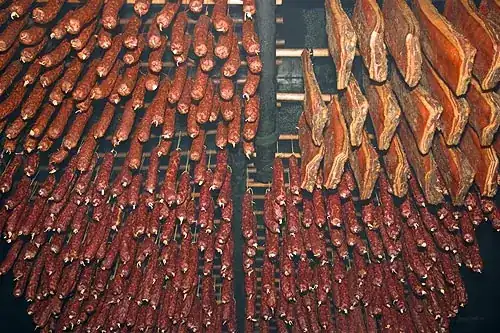
Bakkwa
Turkey
Chicken
Sausage
Salami
Jerky
Fish
Eel popular in eastern/northern Europe
Traditional Grimsby smoked fish (cod and haddock)
Haddock and Arbroath smokies (haddock)
Buckling, kippers and bloater (herring)
Salmon
Mackerel
Bivalves including oysters and mussels.
Egg (eggs and fish eggs)
Cheese
Adyghe Qwaye (Circassian)
Gouda
Gruyère
Oscypek
Other proteins
Nuts
Tofu
Spices
Paprika
Salt
More to savor
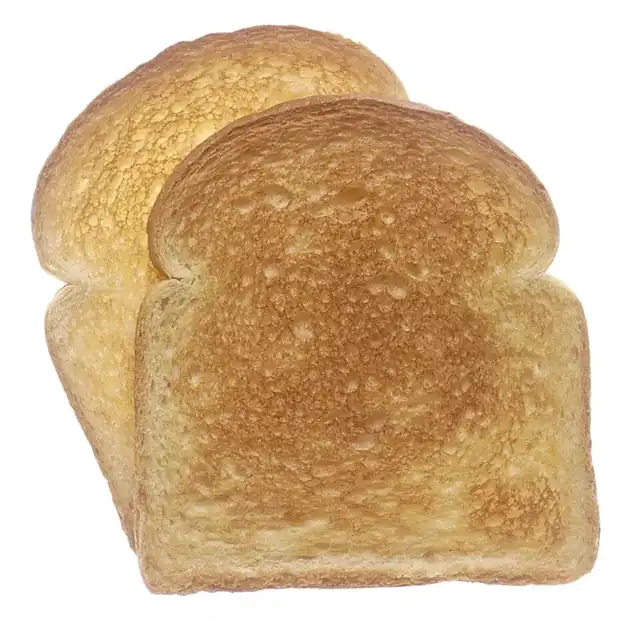
Toast
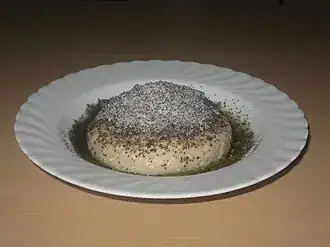
Germknödel (Plum and Poppy Seed Dumpling)
Why Food Browns: The Flavor Story Behind the Maillard Reaction