The dish is a starting point for exploring a wider food story. The guide below looks more closely at its background and different forms. When you want to cook, visit the recipe collection for ingredient quantities and step-by-step methods.
In this story
OverviewRaising the duckCooking the duckClosed-oven styleOpen-oven styleServingReheatingOverview
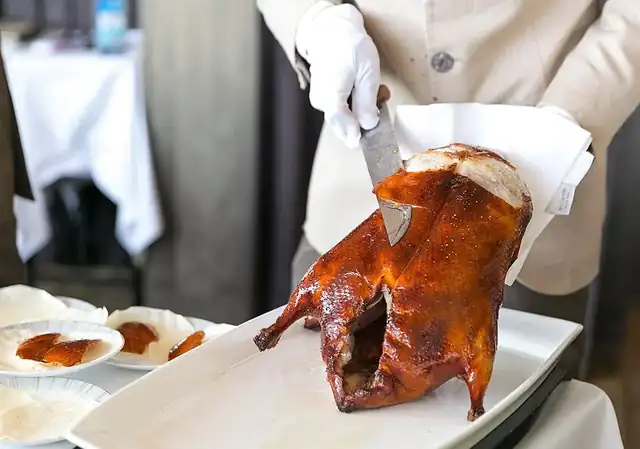
Peking duck is a dish from Beijing that has been prepared since the Imperial era. The meat is characterized by its thin, crispy skin, with authentic versions of the dish serving mostly the skin and little meat, sliced in front of the diners by the cook. Ducks bred especially for the dish are slaughtered after 65 days and seasoned before being roasted in a closed or hung oven. The meat is often eaten with spring onion, cucumber, and sweet bean sauce, with pancakes rolled around the fillings. Aromatic duck is a similar dish to Peking duck and is popular in the United Kingdom and Ireland.
Raising the duck
The breed of ducks used to prepare Peking duck originated in Nanjing. They were large, had black feathers, and lived in the canals that linked the city to major waterways.
With the relocation of the Chinese capital to Beijing, supply barge traffic increased in that area. Often these barges spilled water into side-canals, providing a habitat for the ducks. By the time of adoption of five-spice powder, a new breed of duck had been domesticated by Chinese farmers.
Newly hatched ducks are raised in a free-range environment for the first 45 days of their lives, and force-fed 4 times a day for the next 15–20 days, resulting in ducks that weigh 5 - 7 kg. (Another source states that ducks should be at least 3.25 kg, have more than 5.5 mm of subcutaneous fat, a well-developed chest, and at least 5.0% of intramuscular fat.) The force-feeding of the ducks led to an alternate name for the animal, "Peking stuffed duck" .
Force-feeding is necessitated by the slow growth rate of ducks as well as the traditional requirements for fat content. It leads to relatively fast growth at the cost of high rates of dead and otherwise unusable ducks (each amounting to about 20%) as well as poor feed conversion. After all, it is unrealistic to expect a duck to swallow 600 g of food daily without issue, given that a duck normally eats 200 g of food per day when left alone. Newer broiler-type Peking duck breeds mature without the need of force-feeding, which reduces animal suffering and frees up human labor: each laborer could raise 500 force-fed ducks or 5,000 non-force-feed ducks.
Cooking the duck
Fattened ducks are killed, plucked, eviscerated and rinsed thoroughly with water. Air is pumped under the skin through the neck cavity to separate the skin from the fat. The duck is then blanched in boiling hot water for two to three minutes before it is hung up to dry. This tightens the skin. While it is hung, the duck is glazed with a layer of syrup with honey, and the duck's inside is rinsed once more with water. A second layer of glaze/marinade of soy sauce, five-spice powder, and more maltose is then applied inside and out, and the duck is left to stand for 24 hours in a cool, dry place (or a refrigerator). It is then roasted in an oven until the skin turns shiny brown.
Besides two traditional methods to prepare Peking duck, recipes have been compiled by chefs all around the world to produce the dish at home.
Closed-oven style
Peking duck is traditionally roasted in a closed oven ( mènlú). Bianyifang, a restaurant in Beijing, China, is famous for keeping this tradition. The closed oven is built of brick and fitted with metal griddles . The oven is preheated by burning Gaoliang sorghum straw at the base. The duck is placed in the oven immediately after the fire burns out, allowing the meat to be slowly cooked through the convection of heat within the oven. Controlling the fuel and the temperature is the main skill. In closed-oven style, duck meat is combined well with the fat under the skin, and therefore is juicy and tender.
Open-oven style
The open oven was developed in the imperial kitchens during the Qing dynasty and adopted by the Quanjude restaurant chain. It is designed to roast up to 20 ducks at the same time with an open fire fueled by hardwood from peach or pear trees. The ducks are hung on hooks above the fire and roasted at a temperature of 270 C for 30–40 minutes. While the ducks are roasting, the chef may use a pole to dangle each duck closer to the fire for 30-second intervals. In open-oven style, the fat is usually melted during the cooking process, so the skin is crispy.
Serving
Peking duck is traditionally carved in front of the guests and served in three stages. First, slices of duck skin are served with sugar and sweet bean sauce as a dip. Duck skin is best enjoyed hot and crisp to the bite. The meat is then served with steamed pancakes and an assortment of vegetable dishes, typically julienned cucumber and spring onion. Traditionally, diners dip slices of duck into the condiments and wrap into the pancake with cucumber and any other ingredients. The wrap is then eaten by hand or with chopsticks. The carved duck (鸭架) – the remainder of the roast duck, with choice cuts removed – can be cooked in three ways. The traditional way is in a broth with ingredients such as Chinese cabbage and soft tofu.
The carved duck can also be chopped and stir-fried in sweet bean sauce, or rapidly sautéed and served with salt and pepper (椒鹽). Otherwise, the carved duck is packed to be taken home by the customers.
Reheating
Whole Peking ducks can be ordered as takeaway. The ducks can be reheated at home with an oven or stovetop. When an oven is used, the duck is heated at a temperature of 150 C for 20 minutes, and then at 160 C for another 10 minutes. The stove method involves submerging the duck in boiling water before placing it on a griddle 70 cm above the cooking fire. The water is replaced every 3–4 minutes until the duck is piping hot. To reheat the Peking duck with oil, the duck is sliced into thin pieces and placed in a strainer held over a wok of hot oil. The duck is then rinsed several times with the oil.
More to savor
Sylheti Rice Pudding

Austrian Napkin Dumpling (Serviettenknödel)
Jiaozi: The Chinese Dumplings with a Story in the Fold