The dish is a starting point for exploring a wider food story. The guide below looks more closely at its background and different forms. When you want to cook, visit the recipe collection for ingredient quantities and step-by-step methods.
In this story
OverviewMixing and shaping the breadType I sourdoughType II sourdoughType III sourdoughTypes of breadRegional preferencesOverview
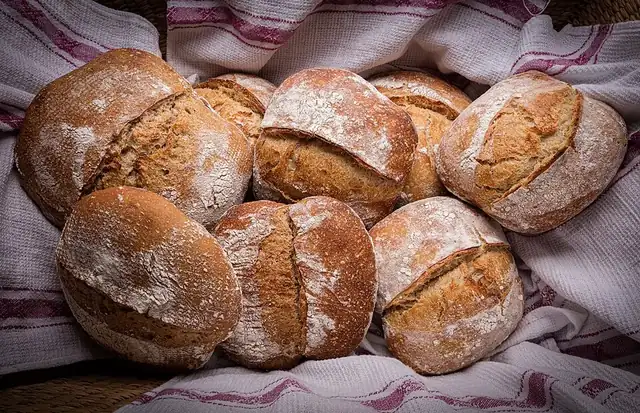
Sourdough is a leavening agent containing naturally occurring yeast and lactobacillus bacteria. The term is used to describe bread baked with sourdough, while the sourdough itself is referred to as a starter. In addition to leavening the bread, the fermentation process produces lactic acid, which gives the bread its distinctive sour taste and improves its keeping qualities.
Mixing and shaping the bread
The starter is typically fed 4 to 12 hours prior to being added to dough. Feeding means mixing flour and water into the starter. This creates an active leaven, which should grow in size and is ready to use when it is bubbly and floats in water.
A portion of the leaven is mixed with flour and water to make a final dough of the desired consistency. The starter weight is usually 13–25% of the total flour weight, though formulas may vary. Using a smaller ratio of cold unfed starter (called sourdough discard) in the range of 5% to 10% can also create good sourdough loaves; the fermentation time will be longer and can result in improved flavor.
A number of 'no knead' methods are available for sourdough bread.
Type I sourdough
Traditional sourdoughs used as sole leavening agent are referred to as Type I sourdough; examples include sourdoughs used for San Francisco Sourdough Bread, Panettone, and rye bread. Type I sourdoughs are generally firm doughs, have a pH range of 3.8 to 4.5, and are fermented in a temperature range of 20 to 30 C. Fructilactobacillus sanfranciscensis was named for its discovery in San Francisco sourdough starters, though it is not endemic to San Francisco. F. sanfranciscensis and Limosilactobacillus pontis often highlight a lactic-acid bacterial flora that includes Limosilactobacillus fermentum, Fructilactobacillus fructivorans, Levilactobacillus brevis, and Companilactobacillus paralimentarius. The yeasts Saccharomyces exiguus, Kasachstania humilis, or Candida holmii usually populate sourdough cultures symbiotically with Fructilactobacillus sanfranciscensis. The yeast S. exiguus is related to the yeasts C. milleri and C. holmii. Torulopsis holmii, Torula holmii, and S. rosei are synonyms used prior to 1978.
C. milleri and C. holmii are physiologically similar, but DNA testing established them as distinct. Other yeasts reported found include C. humilis, C. krusei, Pichia anomala, C. peliculosa, P. membranifaciens, and C. valida. There have been changes in the taxonomy of yeasts in recent decades. F. sanfranciscensis requires maltose, while C. milleri is maltase negative and thus cannot consume maltose. C. milleri can grow under conditions of low pH and relatively high acetate levels, a factor contributing to sourdough flora's stability.
Type II sourdough
In Type II sourdoughs, baker's yeast or Saccharomyces cerevisiae is added to leaven the dough; L. pontis and Limosilactobacillus panis in association with Lactobacillus species are dominant members of Type II sourdoughs. They have a pH less than 3.5, and are fermented within a temperature range of 30 to 50 C for several days without feedings, which reduces the flora's activity. This process was adopted by some in industry, in part, due to simplification of the multiple-step build typical of Type I sourdoughs.
In Type II sourdoughs, yeast growth is slowed or stopped due to higher fermentation temperatures. These doughs are more liquid and once fermented may be chilled and stored for up to a week. They are pumpable and used in continuous bread production systems.
Type III sourdough
Type III sourdoughs are Type II sourdoughs subjected to a drying process, usually either spray or drum drying, and are mainly used at an industrial level as flavoring agents. They are dominated by "drying-resistant [lactic acid bacteria] such as Pediococcus pentosaceus, L. plantarum, and L. brevis." The drying conditions, time and heat applied, may be varied in order to influence caramelization and produce desired characteristics in the baked product.
Manufacturers of non-sourdough breads make up for the lack of yeast and bacterial culture by introducing into their dough an artificially made mix known as bread improver or flour improver.
Types of bread
There are many breads that use techniques similar to that used in the making of sourdough bread. Danish rugbrød (rye bread) is a dense, dark bread best known from its use in the Danish smørrebrød (open-faced sandwiches). The Mexican birote salado started out in the city of Guadalajara as a short French baguette that replaces the yeast with a sourdough fermentation process, yielding a bread that is crunchy outside but soft and savory inside. Amish friendship bread uses a sourdough starter that includes sugar and milk. It is also leavened with baking powder and baking soda. An Amish sourdough is fed with sugar and potato flakes every 3–5 days.
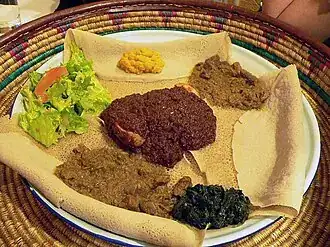
German pumpernickel is traditionally made from a sourdough starter, although modern pumpernickel loaves often use commercial yeasts, sometimes spiked with citric acid or lactic acid to inactivate the amylases in the rye flour. Flemish desem bread (the word means 'starter') is a whole-wheat sourdough. Whole-wheat sourdough flatbreads are traditionally eaten in Azerbaijan. In Ethiopia, teff flour is fermented to make injera. A similar variant is eaten in Somalia, Djibouti, and Yemen (where it is known as lahoh). In India, idlis and dosa are made from a sourdough fermentation of rice and black gram.
Regional preferences
In northern Europe, where bread made from 100% rye flour is popular, bread is typically leavened with sourdough rather than baker's yeast because rye lacks sufficient gluten to support yeast leavening. Instead, rye bread's structure relies on the starch in the flour and other carbohydrates known as pentosans. However, rye amylase remains active at higher temperatures than wheat amylase, which can cause the bread's structure to weaken as the starches break down during baking. The lowered pH of a sourdough starter inactivates the amylases when heat alone cannot, allowing the carbohydrates to gel and set properly in the bread structure.
In southern Europe, sourdough remains traditional for certain breads like panettone. However, in the 20th century, sourdough became less common, replaced by the faster-acting baker's yeast. Sometimes, this yeast is supplemented with longer fermentation periods to allow some bacterial activity, which adds flavor. During the 2010s, sourdough fermentation regained popularity as a major method in bread production, often used alongside baker's yeast as a leavening agent.
More to savor

English Breakfast
Injera (Ethiopian Teff Flatbread)
Kefir at the Table: The Food Behind the Name