The dish is a starting point for exploring a wider food story. The guide below looks more closely at its background and different forms. When you want to cook, visit the recipe collection for ingredient quantities and step-by-step methods.
Overview
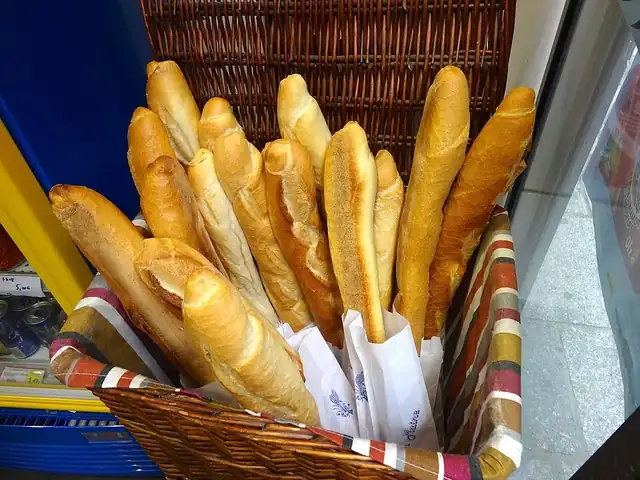
A baguette is a long, thin type of bread commonly made from basic lean dough. Both the dough and the physical dimensions of the traditional baguette are defined by French law. It is distinguishable by its length and crisp crust.
A baguette has a diameter of about 5 to(-) and a usual length of about 65 cm, but can be up to 1 m long.
In November 2018, documentation surrounding the "craftsmanship and culture" of making this bread was added to the French Ministry of Culture's National Inventory of Intangible Cultural Heritage. In 2022, the artisanal know-how and culture of baguette bread was inscribed to the UNESCO Intangible Cultural Heritage Lists.
History
Much of the history of the baguette is speculation; however, some facts can be established. Long, stick-like breads in France became more popular during the 18th century, French bakers started using "gruau," a highly refined Hungarian high-milled flour in the early 19th century, Viennese steam oven baking was introduced to Paris in 1839 by August Zang, and the Austrian Adolf Ignaz Mautner von Markhof's compact yeast in 1867 at the Universal Exposition. Finally, the word "baguette" appears to define a particular type of bread in a regulation of the department of the Seine in August 1920: "The baguette, having a minimum weight of 80 g and a maximum length of 40 cm, may not be sold for a price higher than 0.35 francs apiece". No one of these events constitutes "the invention of the baguette," but together they define the modern "baguette."
In summary, "the bread which became known as the baguette first appeared in its most primitive form in the eighteenth century, then experienced several refinements and variations before being (officially) given that name in 1920."
The word baguette means "wand," "baton," or "stick," as in baguette magique (magic wand), baguettes chinoises (chopsticks), or baguette de direction (conductor's baton). It was first recorded as a kind of bread in 1920.
Outside France, the baguette is often considered a symbol of French culture, but the association of France with long loaves long predates it. Long, wide loaves had been made since the time of King Louis XIV, long thin ones since the mid-18th century, and by the 19th century, some were far longer than today's baguette: "... loaves of bread 6 ft long that look like crowbars!" "Housemaids were hurrying homewards with their purchases for various Gallic breakfasts, and the long sticks of bread, a yard or two [1 yard to 2 yard] in length, carried under their arms, made an odd impression upon me."
Origin myths
Because the history of the French baguette is not completely known, several myths have spread about the origins of this type of bread.
Some say Napoleon, in essence, created the French baguette to allow soldiers to more easily carry bread with them. Since the round shape of other breads took up a lot of space, Bonaparte requested they be made into the skinny stick shape with specific measurements to slide into the soldiers' uniform.
Other stories credit baguettes as being an invention to stop French metro workers from having to carry knives that they used to cut their bread. The workers often fought, so the management did not want them to carry knives and requested that bread be easily ripped apart, ending the need for knives. The skinny, easily rippable shape of a baguette would have been the response to this.
Some believe baguettes were the "Bread of Equality" following a decree post-French Revolution requiring a type of bread to be made accessible to the rich and poor.
Manufacture and styles
The "baguette de tradition française" is made from wheat flour, water, yeast (as the leavening agent), and common salt. It may contain up to 2% broad bean flour, up to 0.5% soya flour, and up to 0.3% wheat malt flour.
Standard baguettes, baguettes ordinaires, are made with baker's yeast, and artisan-style loaves are usually made with a pre-ferment (poolish) to increase flavor complexity and other characteristics. They may include whole-wheat flour or other grains such as rye. Baguettes are also sometimes referred to as either "Classique" (typically mass produced and made with yeast as well as additives), and "tradition" regulated to 4 ingredients (flour, water, leavening, and salt) often using a sourdough starter as the leavening agent
Baguettes are closely connected to France, though they are made worldwide. In France, not all long loaves are baguettes; for example, a short, almost rugby ball-shaped loaf is a bâtard (literally, bastard); its origin is variously explained but undocumented. Another tubular-shaped loaf is known as a flûte, also known in the United States as a parisienne. Flûtes closely resemble baguettes but are about twice the size.
A thinner loaf is called a ficelle (string). A short baguette is sometimes known as a baton (stick), or in the UK, referred to using the English translation French stick. None of these is officially defined, either legally or, for instance, in major dictionaries, any more than the baguette. French breads are also made in forms such as a miche, which is a large pan loaf, and a boule, literally ball in French, a large round loaf. Sandwich-sized loaves are sometimes known as demi-baguettes or tiers. Italian baguettes, or baguette italienne, involve more spices and a denser texture, giving the baguette a slightly different, more Italian taste. Pain viennois is much sweeter and softer than the standard baguette.
In France, a baguette typically weighs around 8+3/4 oz, a bâtard 500 g and a ficelle 100 g; no legal text establishes any of these weights, which can vary throughout the country. Baguettes, either relatively short single-serving size or cut from a longer loaf, are very often used for sandwiches, usually of the submarine sandwich type, but also a panini. They are often sliced and served with pâté or cheese. As part of the traditional continental breakfast in France, slices of baguette, known as tartines, are spread with butter and jam and sometimes dunked in bowls of coffee or hot chocolate.
Consumption
Algeria consumes about 49 million baguettes per day, and France consumes about 30 million.
More to savor
Molasses Cookies
Ají de Gallina (Peruvian Chili Chicken)

Black Tea: The Leaves Behind a Familiar Daily Cup