This longer reference provides the background behind the topic. Read it alongside the recipe collection when you want to connect an ingredient or food idea with a dish to prepare.
In this story
OverviewProductionTraditionalHigh-salt liquid-state fermented soy sauceLow-salt solid-state fermented soy sauceAcid-hydrolyzed vegetable proteinVarietiesOverview
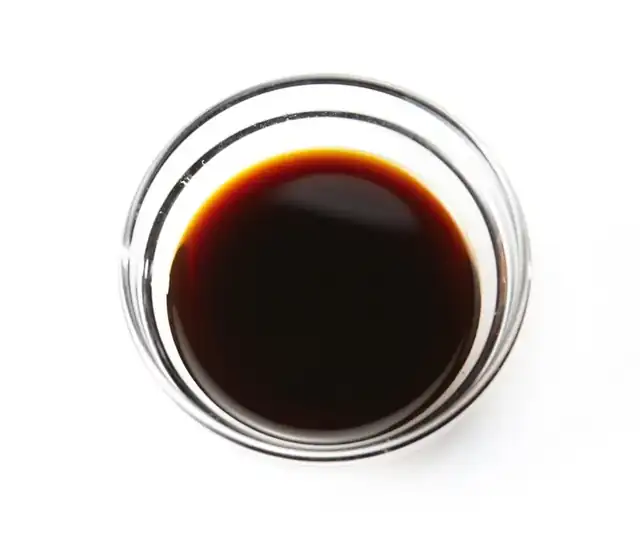
Soy sauce (sometimes called soya sauce in British English) is a liquid condiment of Chinese origin, traditionally made from a fermented paste of soybeans, roasted grain, brine, and Aspergillus oryzae or Aspergillus sojae molds (kōji). It is recognized for its saltiness and pronounced umami taste.
Soy sauce was created in its current form about 2,200 years ago during the Western Han dynasty of ancient China. Since then, it has become an important ingredient in East and Southeast Asian cooking as well as a condiment worldwide.
Production
Soy sauce is made either by fermentation or by hydrolysis. Some commercial sauces have both fermented and chemical sauces.
Flavor, color, and aroma developments during production are attributed to non-enzymatic Maillard browning.
Variation is usually achieved as the result of different methods and durations of fermentation, different ratios of water, salt, and fermented soy, or through the addition of other ingredients.
Traditional
Traditional soy sauces are made by mixing soybeans and grain with mold cultures such as Aspergillus oryzae and other related microorganisms and yeasts (the resulting mixture is called Koji in Japan; the term koji is used both for the mixture of soybeans, wheat, and mold as well as for the mold itself). Historically, the mixture was fermented naturally in large urns and under the sun, which was believed to contribute extra flavors. Today, the mixture is placed in a temperature- and humidity-controlled incubation chamber.
Traditional soy sauces take months to make:
Soaking and cooking: The soybeans are soaked in water and boiled until cooked. Wheat is roasted and crushed.
Koji culturing: Equal amounts of boiled soybeans and roasted wheat are mixed to form a grain mixture. A culture of Aspergillus spore is added to the grain mixture and mixed, or the mixture is allowed to gather spores from the environment itself. The cultures include:
Aspergillus: a genus of fungus that is used for fermenting various ingredients (the cultures are called koji in Japanese). Three species are used for brewing soy sauce:
A. oryzae: Strains with high proteolytic capacity are used for brewing soy sauce.
A. sojae: This fungus also has a high proteolytic capacity.
A. tamarii: This fungus is used for brewing tamari, a variety of soy sauce.
High-salt liquid-state fermented soy sauce
High-salt liquid-state fermentation (HLF) of soybeans depends heavily on microbial activity, metabolism and enzymatic hydrolysis of macronutrients. Most traditional approaches fall into the scope of HLF.
During HLF, koji-infused soybeans are exposed to air so that hydrolytic enzymes of the mold can continuously break down macronutrients within the soybean.
Ample water, usually about 2 to 2.5 times the weight of the feed, is required to support sufficient microbial growth.
High salt concentration (17–20%) is required to selectively inhibit microbial activity.
Low-salt solid-state fermented soy sauce
LSF, also referred as rapid fermenting, is a modern fermentation method invented in response to high market demand.
Compared to HLF, LSF employs pure cultures at a relatively higher temperature (40–55 °C) and lower brine solution concentrations (13–15%). In LSF, koji is mixed with the equivalent weight of brine to form solid moromi.
The elevated temperature accelerates the fermentation process significantly. Due to the short aging (15–30 days) period of LSF, and low production cost, LSF soy sauce accounts for more share of the Chinese soy sauce market.
LSF evolved from salt-free solid-state fermentation, an even faster method working at even higher temperatures (50–65 °C) and taking 72 hours to complete, introduced to China from the Soviet Union in 1958. The aging time turned out to be too short develop a proper flavor profile, with burnt acidic notes left in the sauce. LSF is a compromise between this method and the more traditional HLF: the product tastes passable with more microbes allowed to survive, but still lacks depth. Reducing the salt content accelerates brewing by lifting salt-induced enzyme inhibition.
Acid-hydrolyzed vegetable protein
Some brands of soy sauce are made from acid-hydrolyzed soy protein instead of brewed with a traditional culture. This takes about three days. Although they have a different flavor, aroma, and texture when compared to brewed soy sauces, they can be produced more quickly and cheaply, and also have a longer shelf life and are usually made for these reasons. The clear plastic packets of dark sauce common with Chinese-style take-out food typically use a hydrolyzed vegetable protein formula. Some higher-priced hydrolyzed vegetable protein products with no added sugar or colorings are sold as low-sodium soy sauce alternatives called "liquid aminos" in health food stores, similar to the way salt substitutes are used. These products are, however, not necessarily low in sodium.
Varieties
Koikuchi: Originating in the Kantō region, its usage eventually spread all over Japan. Over 80% of the Japanese domestic soy sauce production is of koikuchi, and can be considered the typical Japanese soy sauce. It is made from roughly equal quantities of soybean and wheat. This variety is also called kijōyu or namashōyu when it is not pasteurized.
Usukuchi: Almost 14% of soy sauce production is usukuchi shoyu. It is particularly popular in the Kansai region of Japan. It matures for less time than koichuchi and is both saltier and lighter in color. It is paler due to the use in its production of amazake, a sweet liquid made from fermented rice. Usukuchi is commonly used in cooking as it does not alter the color and taste of the ingredients.
Tamari: Made mainly in the Chūbu region of Japan, tamari is darker in appearance and richer in flavor than koikuchi. It contains little or no wheat. Wheat-free tamari can be used by people with gluten intolerance. Tamari is more viscous than koikuchi shoyu. Of soy sauce produced in Japan, 1.5% is tamari. It is the "original" Japanese soy sauce, as its recipe is closest to the soy sauce originally introduced to Japan from China. Technically, this variety is known as miso-damari, as this is the liquid that runs off miso (a soybean-based seasoning and soup base) as it matures. The Japanese word tamari is derived from the verb tamaru, referring to the fact that tamari was traditionally a liquid byproduct made during the fermentation of miso.
Japan remains the leading producer of tamari, though it has also become popular in the United States. Tamari shoyu is often used for sashimi. Oftentimes, other varieties of soy sauce for sashimi are inaccurately referred to as tamari shoyu. The back label in Japan, by law, will clarify whether or not it is actually tamari.
More to savor

Chicken Vindaloo
Chicken Tikka Masala
Getting to Know Soybean: A Food Lover’s Guide